

- SOLUTIONS
- SERVICES
- ABOUT US
- RESOURCES
- CONTACT


MANAGEMENT
ASSURANCE
ECOSYSTEM
AI-Powered SMS Fraud Prevention: An $80B Threat to Telecom Operators
Introduction: An Escalating War on an Old Front
The paradox of modern telecommunications is that one of its oldest services, the Short Message Service (SMS), has become one of its most critical—and vulnerable—attack surfaces. As we navigate late 2025, telecom operators worldwide find themselves at a pivotal moment. Juniper Research projects that the global cost of messaging fraud to subscribers will reach a staggering $80.5 billion this year. This is not merely a revenue leakage issue; it is a fundamental threat to customer trust, brand reputation, and regulatory compliance.
The nature of the threat has evolved. Fraudsters are no longer just exploiting technical vulnerabilities; they are leveraging advanced technologies, including artificial intelligence, to launch more precise and damaging attacks. In this high-stakes environment, traditional, rules-based fraud management systems are reaching their breaking point. This article explores the evolving SMS fraud landscape and makes the case for why an AI-first fraud management solution is no longer a strategic advantage but an operational necessity.
The SMS Fraud Landscape in 2025: Key Statistics for Telecom Operators
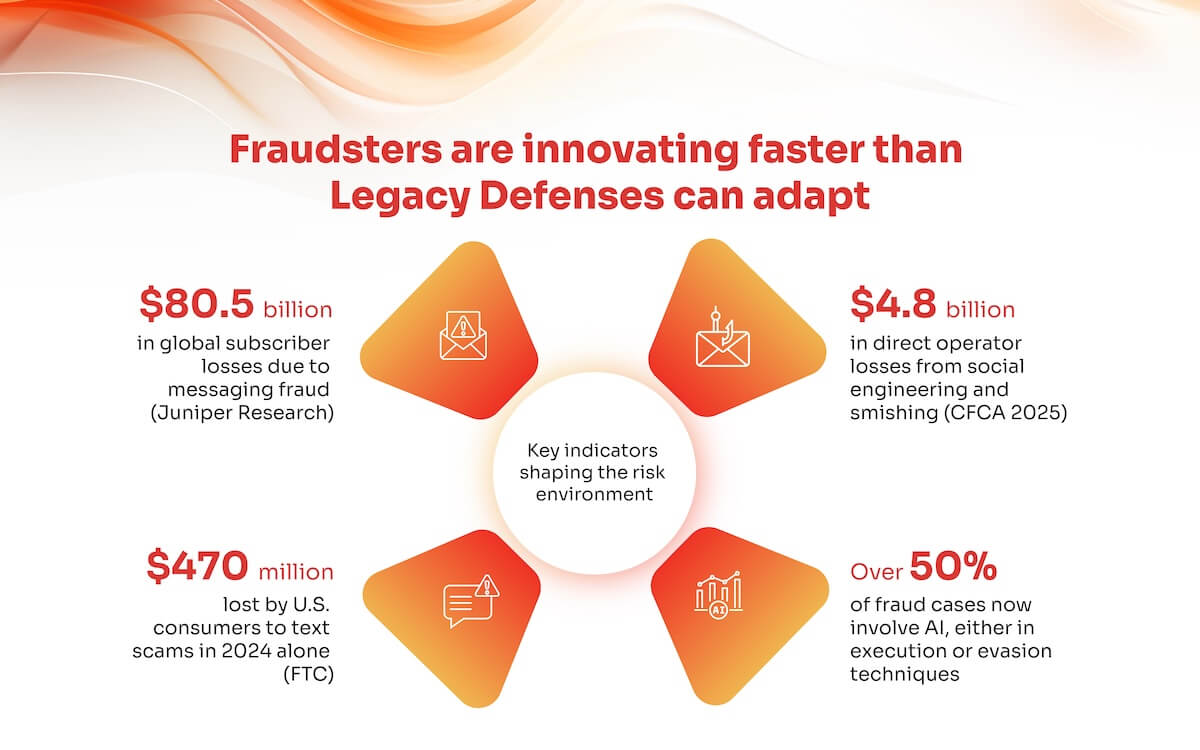
To understand the scale of the challenge, one must first comprehend its magnitude and trajectory. The data paints a clear picture of a costly and persistent threat.
These statistics underscore a critical insight: the sophistication and technological leverage of attacks are accelerating. The operators who thrive will be those who move fastest to close the detection gap.
The New Threat Vectors: Beyond Simple Smishing
Today’s fraud ecosystem is complex, automated, and agile. Understanding its components is the first step toward building an effective defense.
- The AI-Powered Fraud Factory: Generative AI has democratized sophistication. It allows criminals to create hyper-realistic, personalized smishing messages at scale, devoid of the grammatical errors that once served as red flags. These AI models can also analyze successful attack patterns and repackage them dynamically.
- Infrastructure as an Attack Vector: The industry’s own advancements are being weaponized. The rapid growth in eSIM adoption creates a larger, more dynamic attack surface for SIM box fraud and bot-style attacks. Simultaneously, the explosion in connected IoT devices provides fraudsters with armies of potential endpoints to exploit.
- The Sophisticated Smishing Supply Chain: Phishing has industrialized, criminals can easily access tools and services to launch smishing campaigns around fake reward points, tax refunds, and package deliveries. These campaigns are highly seasonal and adapt quickly.
- The Signaling Protocol Achilles’ Heel: At the network core, the traditional SS7 and Diameter signaling protocols remain a profound weakness. These protocols’ lack of inherent authentication allows attackers to intercept one-time passwords (OTPs), track subscriber locations, and spoof sender IDs with ease, enabling high-value fraud like account takeovers.
Why Traditional SMS Fraud Detection Tools Are No Longer Enough
For years, operators have relied on a combination of SMS firewalls, business rule engines (BREs), and threat intelligence feeds. While these tools are necessary, they are increasingly insufficient on their own.
The core problem is one of speed and context. Rule-based systems excel at catching known, cataloged fraud patterns but are blind to novel, evolving attacks. They generate overwhelming volumes of alerts, leading to analyst fatigue and missed true positives.
The AI-First Imperative: A Proactive, Intelligent Defense
An AI-first fraud management solution represents this necessary shift—from reactive blocking to proactive, intelligent risk management. It transforms the operator’s role from fraud chaser to fraud predictor.
- From Rules to Relationships: Instead of just flagging a message from a known bad number, AI analyzes thousands of contextual features in real-time: sender-recipient relationship history, message content semantics, device behavior biometrics, and network traversal path. It can identify that a message appearing to be from a bank is actually out of pattern for how that bank communicates with this specific customer.
- Predictive Threat Hunting: Advanced machine learning models don’t just detect fraud; they predict it. By analyzing global and local traffic patterns, an AI system can identify the early, faint signals of a new smishing campaign or a toll-fraud attack before it reaches peak volume, allowing for pre-emptive containment.
- Automated Intelligence and Workflow: AI reduces the burden on fraud analysts. It can auto-classify threats, prioritize the riskiest cases for human review, and even suggest new detection rules. This augments human analysts, allowing them to focus on complex investigations and strategic response.
- Explainable AI for Compliance and Action: Modern AI frameworks prioritize transparency and explainability. When a transaction is flagged, the system can provide a clear audit trail of the “why”—which factors contributed to the risk score. This is crucial for internal tuning, meeting regulatory demands, and communicating with enterprise customers.
Subex’s AI-Powered SMS Fraud Management Solution
In this complex environment, a point solution is not enough. Operators require a consolidated, AI-native solution that provides end-to-end visibility and control. Subex’s AI-First Fraud Management solution is architected for this reality, moving beyond traditional firewalls to offer a holistic defense.
Our solution integrates several key capabilities:
- Advanced Signaling Protocol Analyzer: Provides the essential first layer of defense, creating the high-fidelity data foundation for our AI/ML engine’s 98.5% detection accuracy.
- AI/ML-Powered Core Engine: Continuously analyzes all traffic, using hybrid techniques to detect 175% more fraud than traditional FMS and achieve a fraud hit rate of over 80%.
- Real-Time Threat Intelligence Fusion: Incorporates global feeds to refine detection, directly contributing to a 60% improvement in precluded loss.
- Automated Investigation & Remediation: Reduces Mean Time to Detect (MTTD) to ~8 minutes, cutting through alert noise and helping drive a ~31% decline in customer complaints.
The Result? A proven, closed-loop fraud defense system that delivers an average ROI within 6-8 months.
This integrated approach closes the gaps that fraudsters exploit between siloed systems, giving operators the “big picture view” needed to eliminate fraud root causes.
Conclusion: Securing the Future of Trust
SMS remains a vital, irreplaceable channel for business communication, customer engagement, and secure authentication. Protecting it is synonymous with protecting the core revenue and trust models of the telecom industry.
By embracing an AI-first, solution-based strategy, operators can transform their fraud management from a cost center focused on loss prevention into a strategic capability that enhances customer security, strengthens partner relationships, and defends the bottom line. The battle for the integrity of your network is happening now. Are you defending with the tools of the past, or with the intelligence of the future?
Explore how Subex’s AI-First Fraud Management solution can future-proof your defenses.
Learn more about our tailored approach to combating SMS fraud
Frequently Asked Questions
1. What is SMS fraud in the telecom industry?
SMS fraud in telecom refers to the misuse of messaging networks to steal money, user credentials, or sensitive data, or to bypass operator controls. Common types include smishing, sender ID spoofing, OTP interception, SIM box–enabled bypass fraud, and A2P SMS fraud.
2. What is A2P SMS fraud?
A2P (Application-to-Person) SMS fraud targets enterprise messaging such as OTPs, alerts, and notifications. It includes spoofed sender IDs, unauthorized routes, grey-route or bypass traffic, template abuse, and techniques used to evade SMS firewalls and charging systems.
3. What is SS7 fraud in telecom networks?
SS7 fraud exploits vulnerabilities in the Signaling System No.7 (SS7) protocol used by traditional telecom networks. Attackers can intercept OTPs, reroute calls and SMS, track subscriber locations, and enable identity-based fraud often through compromised or insecure interconnect access.
4. How is Diameter signaling exploited?
Diameter signaling can be exploited due to weak interconnect security, misconfiguration, or unauthorized roaming partner access. Common abuses include subscriber data leakage, real-time location tracking, session manipulation, and large-scale OTP interception and fraud.
5. What is the difference between AI-based and rule-based SMS fraud detection?
Rule-based detection flags activity based on predefined conditions (thresholds, known bad senders, static patterns). AI-based detection learns behavior from data and identifies suspicious activity even when attackers change tactics. In practice, operators get stronger coverage for “unknown” fraud patterns, better prioritization, and fewer noisy alerts when AI augments rules.
6. What is smishing and how is it different from SMS spoofing?
Smishing is the scam itself phishing delivered via SMS to trick users into clicking links, sharing OTPs, or calling fake numbers. SMS spoofing is a technique used in many smishing campaigns manipulating the sender’s ID to impersonate a trusted brand or institution.

