
Get access to a curated list of the latest blog posts covering a wide range of topics from the telecom industry.

Archives: Social Articles

Telecom fraud has evolved from isolated billing manipulation to a complex, AI-driven global threat ecosystem.
In 2026, Communication Service Providers (CSPs) are facing increasingly sophisticated fraud attacks across voice, SMS, roaming, digital payments, IoT, and 5G networks.

Fraud today is not just a revenue leakage problem it is a strategic business risk impacting EBITDA, customer trust, regulatory compliance, and brand reputation.

This pillar guide explores:
• The major types of telecom fraud impacting operators
• Why traditional fraud systems are failing
• Emerging AI-powered fraud risks
• Best practices for proactive prevention
• How Subex’s AI-First Fraud Management platform enables predictive fraud defense

WHY TELECOM FRAUD IS INCREASING

Several macro trends are driving fraud escalation:
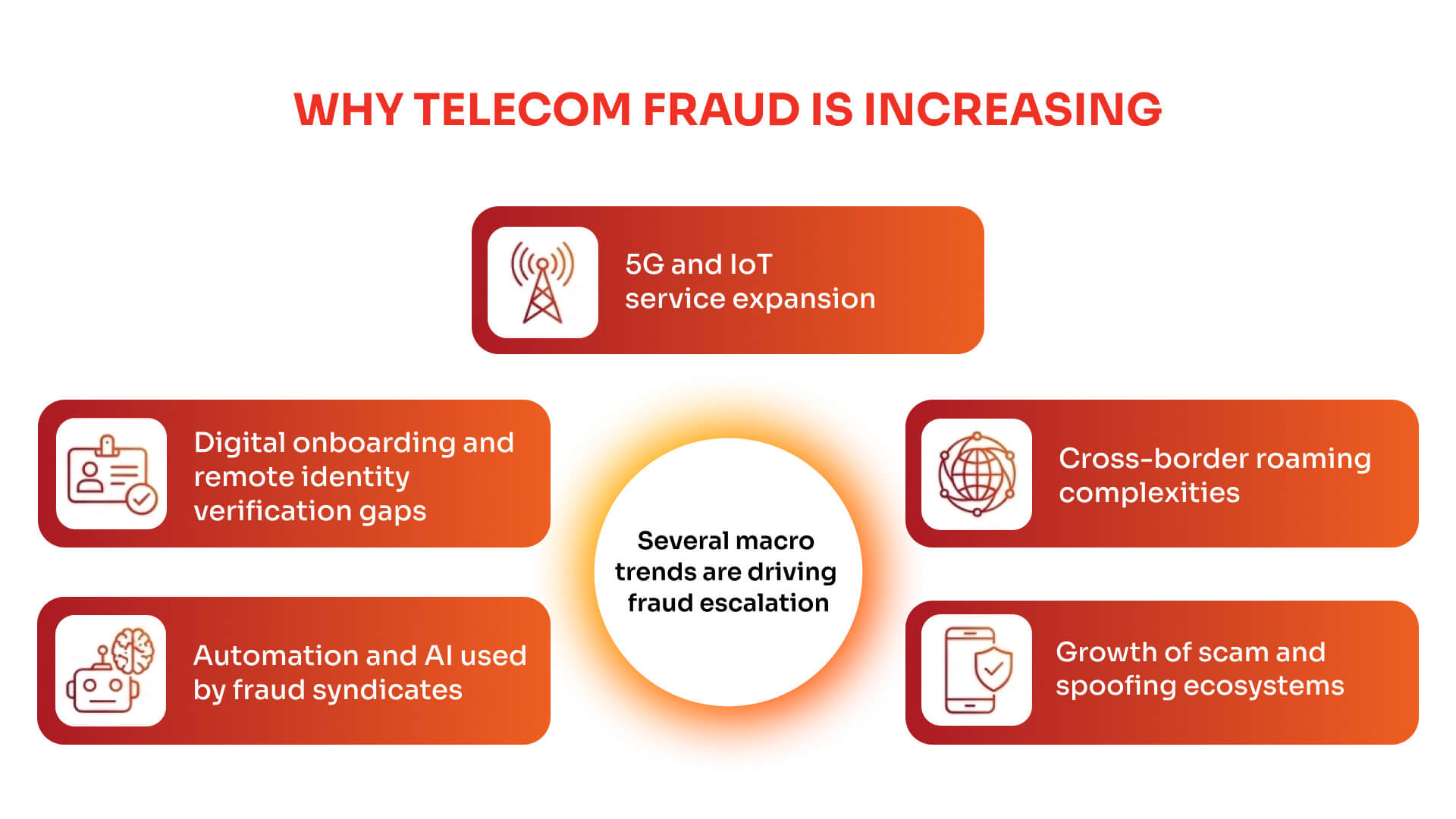
 

1. 5G and IoT service expansion
2. Digital onboarding and remote identity verification gaps
3. Cross-border roaming complexities
4. Automation and AI used by fraud syndicates
5. Growth of scam and spoofing ecosystems

Static rule‑based fraud detection systems cannot keep pace with fraud that evolves daily. Operators increasingly require machine‑learning‑driven detection models capable of identifying complex patterns in network and subscriber data.

MAJOR TYPES OF TELECOM FRAUD

1. International Revenue Share Fraud (IRSF)

What it is:

Fraudsters artificially generate high volumes of calls to premium-rate international numbers they control, earning a share of termination revenue.

Impact:

  • Massive short-term revenue loss
  • Interconnect disputes
  • Regulatory complications

How Subex prevents it:

Subex uses machine‑learning classification models trained on historical IRSF call datasets. These models identify fraud indicators such as abnormal international call bursts, unusual destination patterns, and unexpected call duration distributions.

The model analyzes multiple data sources including call detail records (CDRs), SIP registration data, trunk/carrier information, and signaling events. Based on learned patterns from previously confirmed IRSF incidents, the system predicts whether a call session is likely fraudulent and assigns a confidence score to prioritize investigation.

2. SIM Box / Interconnect Bypass Fraud

What it is:

Fraudsters use SIM boxes or SIM farms to route international calls through local SIM cards, bypassing official interconnect routes and avoiding termination charges.

Impact:

  • Direct revenue erosion
  • Network congestion
  • Reduced service quality

How Subex Detects It:

Detection relies on supervised machine learning classification models trained using labeled datasets of previously identified SIM box calls.

The model evaluates features such as abnormal call origination behavior, unusually high outgoing call volumes, repetitive call routing patterns, and mismatches between subscriber usage and typical traffic behavior.

The detection engine analyzes CDR data, subscriber information, recharge records, cell site information, and aggregated network traffic records to determine the probability that traffic originates from SIM box devices.

3. PBX Hacking & Traffic Pumping

What it is:

Fraudsters compromise enterprise PBX or VoIP systems to generate large volumes of international calls that are billed to the victim organization or telecom operator.

Impact:

  • Enterprise disputes
  • Operator revenue write‑offs
  • Brand trust erosion

How Subex Detects It:

PBX hacking is detected using machine‑learning classification models trained on previously confirmed fraudulent traffic patterns.

The system monitors indicators such as abnormal international call spikes, irregular SIP registration activity, unusual trunk utilization, and traffic bursts outside normal business hours.

Using fixed‑line CDRs, SIP registration data, trunk/carrier information, and signaling events, the ML model evaluates whether call traffic likely originates from compromised PBX systems.

4. Wangiri (One-Ring Scam)

What it is:

Fraudsters place short missed calls from international premium numbers. Victims call back out of curiosity, resulting in expensive international charges.

Impact:

  • Customer financial loss
  • Increased churn
  • Brand reputation damage

How Subex Detects It:

Subex applies supervised classification models trained on previously confirmed Wangiri call datasets.

The model identifies patterns such as extremely short call attempts, high volumes of missed calls from premium destinations, and abnormal callback behaviors.

Using historical labeled call data, the model predicts whether new call attempts resemble Wangiri attack patterns and assigns risk scores for proactive mitigation.

5. Subscription & Identity Fraud

What it is:

Fraudsters impersonate legitimate subscribers and request SIM replacements, allowing them to intercept calls and SMS messages including banking OTPs.

Impact:

  • Financial fraud
  • Account takeover
  • Regulatory compliance risks

How Subex Detects It:

Detection uses subscriber behavioral profiling and anomaly detection models.

Machine learning monitors predefined behavioral metrics such as usage volumes, recharge patterns, billing history, and subscription activity. Significant deviations from established patterns trigger alerts for investigation.

These models analyze subscriber data including usage CDRs, billing records, recharge history, subscriber information, and transaction activity to detect identity‑based fraud risks.

WHY LEGACY FRAUD SYSTEMS FAIL

Traditional fraud management systems rely heavily on static rules, threshold alerts, and manual investigations.

This results in:

  • High false positives
  • Slow detection times
  • Fraud losses before detection occurs
  • Investigator fatigue

Modern fraud prevention requires advanced analytics, machine learning models, and automated mitigation capabilities.
Fraud management must shift from reactive detection to predictive prevention.

THE SUBEX AI-FIRST FRAUD MANAGEMENT APPROACH

Subex delivers a unified, AI-powered fraud management ecosystem designed specifically for telecom operators.

Core Capabilities:

1. Real-Time Fraud Detection
Continuous monitoring across voice, SMS, roaming, digital services, and emerging 5G use cases.

2. Hybrid Detection Engine
Combination of rule-based logic and advanced machine learning models.

3. Behavioral Analytics
Detection based on deviations from normal usage patterns.

4. GenAI-Powered Investigation Agents
AI-assisted workflows that accelerate investigation and reduce manual workload.

5. Fraud Intelligence Repository
Global risk database of high-risk destinations, CLI spoof indicators, and suspicious identities.

6. Automated Mitigation
Integrated workflows enabling immediate blocking and response.

BEST PRACTICES FOR TELECOM FRAUD PREVENTION IN 2026

• Deploy real-time analytics across all services
• Use behavioral and ML-based anomaly detection
• Integrate fraud and revenue assurance insights
• Leverage global fraud intelligence feeds
• Automate response workflows
• Continuously retrain detection models


Frequently Asked Questions About Telecom Fraud

1. What is telecom fraud?
Telecom fraud refers to unauthorized activities that exploit telecom networks to generate illegal revenue or avoid legitimate charges. Fraudsters manipulate voice, SMS, roaming, or digital services to create financial losses for operators and customers. Common examples include IRSF, SIM box fraud, Wangiri scams, and SIM swap fraud.

2. What is a telecom fraud management system (FMS)?
A telecom fraud management system (FMS) is a software platform used by telecom operators to detect, prevent, and investigate fraudulent activities across their networks. It analyzes telecom data such as call detail records (CDRs), signaling events, and subscriber behavior to identify suspicious patterns and stop fraud before significant revenue loss occurs.

3. What are the most common types of telecom fraud?
The most common telecom fraud types include International Revenue Share Fraud (IRSF), SIM box fraud, Wangiri scams, PBX hacking, SIM swap fraud, robocalling, and SMS spoofing. These fraud schemes exploit telecom networks to generate illegal revenue or steal customer data, costing the telecom industry billions each year.

4. What is IRSF fraud in telecom?
International Revenue Share Fraud (IRSF) occurs when fraudsters generate large volumes of calls to premium-rate international numbers they control. Telecom operators unknowingly pay high termination charges, while fraudsters receive a share of the revenue, resulting in significant financial losses.

5. What is SIM box fraud?
SIM box fraud occurs when fraudsters use devices called SIM boxes to route international calls through local SIM cards. This bypasses official telecom interconnect routes and avoids termination charges, causing revenue loss for telecom operators and degrading network performance.

6. How does AI help detect telecom fraud?
AI helps detect telecom fraud by analyzing large volumes of telecom data such as call detail records, subscriber behavior, and signaling events. Machine learning models identify abnormal patterns, detect suspicious activities, and predict fraud risks, enabling operators to prevent fraud before major financial damage occurs.

7. Why are traditional fraud detection systems ineffective?
Traditional fraud detection systems rely on static rules and threshold-based alerts. These systems struggle to detect modern fraud patterns that evolve rapidly and often generate large volumes of false alerts. Machine learning models provide more accurate detection by analyzing behavioral patterns and historical fraud data.

8. How can telecom operators prevent fraud?
Telecom operators can prevent fraud by deploying real-time fraud detection systems, machine learning models, and behavioral analytics. Integrating fraud intelligence databases, monitoring network traffic continuously, and automating mitigation workflows help operators detect threats early and reduce revenue leakage.


FAQ SCHEMA (JSON-LD)

Below is the structured data to implement on the blog page:

CONCLUSION

Telecom fraud in 2026 demands intelligence-led, AI-powered defense mechanisms.
Operators that transition from reactive detection to predictive prevention will protect revenue, strengthen customer trust, and ensure sustainable growth.

Subex’s AI-First Fraud Management platform empowers CSPs to detect, prevent, and mitigate fraud in real time transforming fraud management into a strategic growth enabler.

Discover how Subex’s AI-First Fraud Management platform enables real-time detection, automated mitigation, and predictive fraud prevention.
Speak to a Fraud Expert

Introduction: An Escalating War on an Old Front

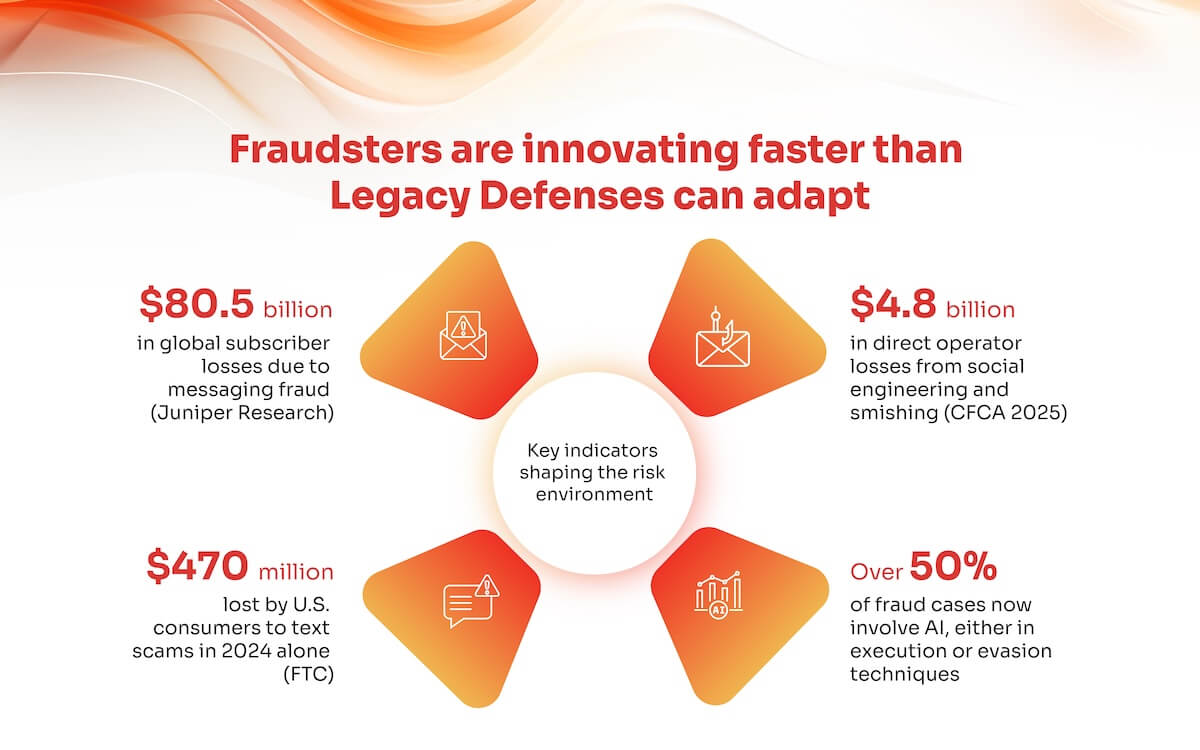
The paradox of modern telecommunications is that one of its oldest services, the Short Message Service (SMS), has become one of its most critical—and vulnerable—attack surfaces. As we navigate late 2025, telecom operators worldwide find themselves at a pivotal moment. Juniper Research projects that the global cost of messaging fraud to subscribers will reach a staggering $80.5 billion this year. This is not merely a revenue leakage issue; it is a fundamental threat to customer trustbrand reputation, and regulatory compliance.

The nature of the threat has evolved. Fraudsters are no longer just exploiting technical vulnerabilities; they are leveraging advanced technologies, including artificial intelligence, to launch more precise and damaging attacks. In this high-stakes environment, traditional, rules-based fraud management systems are reaching their breaking point. This article explores the evolving SMS fraud landscape and makes the case for why an AI-first fraud management solution is no longer a strategic advantage but an operational necessity.

The SMS Fraud Landscape in 2025: Key Statistics for Telecom Operators

To understand the scale of the challenge, one must first comprehend its magnitude and trajectory. The data paints a clear picture of a costly and persistent threat.

These statistics underscore a critical insight: the sophistication and technological leverage of attacks are accelerating. The operators who thrive will be those who move fastest to close the detection gap.

The New Threat Vectors: Beyond Simple Smishing

Today’s fraud ecosystem is complex, automated, and agile. Understanding its components is the first step toward building an effective defense.

  • The AI-Powered Fraud Factory: Generative AI has democratized sophistication. It allows criminals to create hyper-realistic, personalized smishing messages at scale, devoid of the grammatical errors that once served as red flags. These AI models can also analyze successful attack patterns and repackage them dynamically.
  • Infrastructure as an Attack Vector: The industry’s own advancements are being weaponized. The rapid growth in eSIM adoption creates a larger, more dynamic attack surface for SIM box fraud and bot-style attacks. Simultaneously, the explosion in connected IoT devices provides fraudsters with armies of potential endpoints to exploit.
  • The Sophisticated Smishing Supply Chain: Phishing has industrialized, criminals can easily access tools and services to launch smishing campaigns around fake reward points, tax refunds, and package deliveries. These campaigns are highly seasonal and adapt quickly.
  • The Signaling Protocol Achilles’ Heel: At the network core, the traditional SS7 and Diameter signaling protocols remain a profound weakness. These protocols’ lack of inherent authentication allows attackers to intercept one-time passwords (OTPs), track subscriber locations, and spoof sender IDs with ease, enabling high-value fraud like account takeovers.

Why Traditional SMS Fraud Detection Tools Are No Longer Enough

For years, operators have relied on a combination of SMS firewalls, business rule engines (BREs), and threat intelligence feeds. While these tools are necessary, they are increasingly insufficient on their own.

The core problem is one of speed and context. Rule-based systems excel at catching known, cataloged fraud patterns but are blind to novel, evolving attacks. They generate overwhelming volumes of alerts, leading to analyst fatigue and missed true positives.

The AI-First Imperative: A Proactive, Intelligent Defense

An AI-first fraud management solution represents this necessary shift—from reactive blocking to proactive, intelligent risk management. It transforms the operator’s role from fraud chaser to fraud predictor.

  • From Rules to Relationships: Instead of just flagging a message from a known bad number, AI analyzes thousands of contextual features in real-time: sender-recipient relationship history, message content semantics, device behavior biometrics, and network traversal path. It can identify that a message appearing to be from a bank is actually out of pattern for how that bank communicates with this specific customer.
  • Predictive Threat Hunting: Advanced machine learning models don’t just detect fraud; they predict it. By analyzing global and local traffic patterns, an AI system can identify the early, faint signals of a new smishing campaign or a toll-fraud attack before it reaches peak volume, allowing for pre-emptive containment.
  • Automated Intelligence and Workflow: AI reduces the burden on fraud analysts. It can auto-classify threats, prioritize the riskiest cases for human review, and even suggest new detection rules. This augments human analysts, allowing them to focus on complex investigations and strategic response.
  • Explainable AI for Compliance and Action: Modern AI frameworks prioritize transparency and explainability. When a transaction is flagged, the system can provide a clear audit trail of the “why”—which factors contributed to the risk score. This is crucial for internal tuning, meeting regulatory demands, and communicating with enterprise customers.

Subex’s AI-Powered SMS Fraud Management Solution

In this complex environment, a point solution is not enough. Operators require a consolidated, AI-native solution that provides end-to-end visibility and control. Subex’s AI-First Fraud Management solution is architected for this reality, moving beyond traditional firewalls to offer a holistic defense.

Our solution integrates several key capabilities:

  1. Advanced Signaling Protocol Analyzer: Provides the essential first layer of defense, creating the high-fidelity data foundation for our AI/ML engine’s 98.5% detection accuracy.
  1. AI/ML-Powered Core Engine: Continuously analyzes all traffic, using hybrid techniques to detect 175% more fraud than traditional FMS and achieve a fraud hit rate of over 80%.
  2. Real-Time Threat Intelligence Fusion: Incorporates global feeds to refine detection, directly contributing to a 60% improvement in precluded loss.
  3. Automated Investigation & Remediation: Reduces Mean Time to Detect (MTTD) to ~8 minutes, cutting through alert noise and helping drive a ~31% decline in customer complaints.

The Result? A proven, closed-loop fraud defense system that delivers an average ROI within 6-8 months.

This integrated approach closes the gaps that fraudsters exploit between siloed systems, giving operators the “big picture view” needed to eliminate fraud root causes.

Conclusion: Securing the Future of Trust

SMS remains a vital, irreplaceable channel for business communication, customer engagement, and secure authentication. Protecting it is synonymous with protecting the core revenue and trust models of the telecom industry.

By embracing an AI-first, solution-based strategy, operators can transform their fraud management from a cost center focused on loss prevention into a strategic capability that enhances customer security, strengthens partner relationships, and defends the bottom line. The battle for the integrity of your network is happening now. Are you defending with the tools of the past, or with the intelligence of the future?


Explore how Subex’s AI-First Fraud Management solution can future-proof your defenses.

Learn more about our tailored approach to combating SMS fraud


Frequently Asked Questions

1. What is SMS fraud in the telecom industry?
SMS fraud in telecom refers to the misuse of messaging networks to steal money, user credentials, or sensitive data, or to bypass operator controls. Common types include smishing, sender ID spoofing, OTP interception, SIM box–enabled bypass fraud, and A2P SMS fraud.

2. What is A2P SMS fraud?
A2P (Application-to-Person) SMS fraud targets enterprise messaging such as OTPs, alerts, and notifications. It includes spoofed sender IDs, unauthorized routes, grey-route or bypass traffic, template abuse, and techniques used to evade SMS firewalls and charging systems.

3. What is SS7 fraud in telecom networks?
SS7 fraud exploits vulnerabilities in the Signaling System No.7 (SS7) protocol used by traditional telecom networks. Attackers can intercept OTPs, reroute calls and SMS, track subscriber locations, and enable identity-based fraud often through compromised or insecure interconnect access.

4. How is Diameter signaling exploited?
Diameter signaling can be exploited due to weak interconnect security, misconfiguration, or unauthorized roaming partner access. Common abuses include subscriber data leakage, real-time location tracking, session manipulation, and large-scale OTP interception and fraud.

5. What is the difference between AI-based and rule-based SMS fraud detection?
Rule-based detection flags activity based on predefined conditions (thresholds, known bad senders, static patterns). AI-based detection learns behavior from data and identifies suspicious activity even when attackers change tactics. In practice, operators get stronger coverage for “unknown” fraud patterns, better prioritization, and fewer noisy alerts when AI augments rules.

6. What is smishing and how is it different from SMS spoofing?
Smishing is the scam itself phishing delivered via SMS to trick users into clicking links, sharing OTPs, or calling fake numbers. SMS spoofing is a technique used in many smishing campaigns manipulating the sender’s ID to impersonate a trusted brand or institution.

As a Communications Service Provider (CSP), your network is a revenue asset. But what if part of it is hijacked to target your customers?

Voice calls are the bedrock of your service, but scammers have turned them into a primary weapon. While the 2024 Global State of Scams Report records a staggering $1.03 trillion lost globally to all fraud, a deep dive into the data reveals the overwhelming role of phone calls. With phone calls consistently cited as a top contact method for scammers worldwide, we can conservatively estimate that this single channel accounts for over $343 billion of these losses. This isn’t a distant threat; it’s a direct attack on the core utility of your network, resulting in:

  • Customer Churn: Subscribers frustrated with incessant spam are more likely to switch to a provider they perceive as safer.
  • Brand Erosion: Being known as a “spam-friendly” network devastates brand trust and acquisition efforts.
  • Revenue Leakage: Fraudulent traffic drains your network without generating revenue.
  • Regulatory Risk: Inadequate protection against robocalls and scams can lead to significant fines and regulatory scrutiny.

The financial and reputational damage is already triggering action. The 2024 State of the Call Report reveals that nearly 11% of consumers have already switched carriers to escape scam calls, with another 27% considering it. This isn’t a future risk; it’s a present-day drain on your subscriber base and revenue.

The status quo of reactive defenses is no longer sustainable. It’s time to treat fraud for what it is: a revenue attack aimed at your bottom line.

The High Cost of Complacency: Why Your Current Defenses Are Costing You Money

Many CSPs have taken a checkbox approach to fraud prevention, implementing STIR/SHAKEN and basic firewalls. While these are necessary steps, they are woefully insufficient against modern, AI-driven fraud operations.

The Limitations of a Siloed Defense

  • STIR/SHAKEN verifies identity, not intent.
    It does nothing to stop a verified number from running a scam or a warranty robocall campaign.
  • Basic firewalls and blacklists are reactive.
    They rely on known signatures, while modern fraud uses AI to generate new numbers and patterns faster than any manual list can be updated.
  • You lack full visibility.
    Without deep, network-wide signaling analysis, you have blind spots that fraudsters exploit with impunity. You can’t protect what you can’t see.

This gap in your defense isn’t just a technical oversight; it’s a financial liability. You are leaving revenue on the table and exposing your business to immense risk.

Shifting from Cost Center to Profit Protection: The AI-Powered Blueprint

The next generation of network protection isn’t an expense; it’s an investment in network integrity, customer retention, and revenue protection. The winning strategy involves a holistic, AI-powered approach that operates at the network level.

Here’s how leading CSPs are building a defensible, ROI-positive network:

1. Gain Total Network Visibility: See Every Threat Across All Protocols

To stop fraud, you must first see it. This requires a solution that provides deep signaling intelligence across your entire network stack, from the IP layer to the application layer.

A solution like Subex’s Signaling Risk Intelligence deploys network-agnostic probes to capture and analyze voice traffic across protocols like SIP and ISUP. By monitoring SIP messages (INVITE, ACK, CANCEL), it constructs a complete picture of call behavior, identifying malicious patterns and sources regardless of the protocol used.

This eliminates blind spots and provides the data needed for informed and decisive action.

2. Move from Reactive to Proactive with Real-Time AI Analytics

Legacy systems look for what was bad. AI looks for what is bad, right now.
An advanced AI analytics engine performs real-time analysis of signaling patterns to detect anomalies that indicate potential fraud. This includes:

  • Behavioral Analysis: ML models that identify spam/scam call patterns through abnormal Answer-Seizure Ratios (ASR), call durations, and call volumes.
  • Number Analysis: Detecting campaigns from suspicious A-number clusters and ranges.
  • Threat Intelligence: Leveraging pre-packaged controls and global threat feeds to identify known fraud signatures and zero-day attacks.

This proactive detection allows you to identify and stop new fraud campaigns before they impact your subscribers, and your bottom line.

3. Enforce Protection at the Network Core: Automate Blocking for Instant ROI

The final, critical step is automated enforcement. Detection without action is merely an alert; it doesn’t protect your revenue.

The solution must integrate via APIs with core network components, such as SBCs and firewalls.
When a high-risk call is identified, the system provides a real-time risk score to the SBC, instructing it to block the call at the network edge.

This is where you save money:

  • Core Network Resource Preservation: Stop fraudulent traffic from consuming network resources.
  • Reduced Operational Overhead: Fully automate the detection and blocking of new spam, scam, and robocall patterns, freeing your fraud and security teams from constant manual analysis and list updates.
  • Enhanced Customer Lifetime Value (CLV): Protect subscribers from malicious and harassing calls, dramatically reducing spam-related churn and reinforcing your brand as a trustworthy, customer-first provider.

The Business Case: Turning Network Protection into a Competitive Advantage

Investing in a comprehensive AI-powered solution is not just about stopping fraud.
It’s about building a more efficient, trustworthy, and profitable network.

Business Problem Traditional Approach Impact AI-Powered Solution ROI
Network Impact Fraudulent traffic consumes valuable network capacity, degrading service quality for customers. Optimized Network Performance by blocking unwanted traffic, freeing up capacity for genuine, revenue-generating calls.
Customer Churn High cost of acquisition to replace lost subscribers. Increased retention by being the “safe” provider.
Operational Cost Manual threat hunting and blacklist management. Automated mitigation reduces OpEx and the overhead of managing threats.
Regulatory Fines Risk of non-compliance and fines. Demonstrable compliance and best-practice adherence.
Brand Value Erosion of trust and brand equity. A powerful marketing advantage: “The network that protects you.”

Conclusion: Secure Your Network, Protect Your Profit

The conversation around spam and scam calls must evolve from a technical challenge to a strategic business imperative.
The persistent drain on network value and customer trust will only be plugged by CSPs who are willing to move beyond compliance and invest in intelligent, automated protection.

The technology to achieve this exists today, solutions like Subex’s Signaling Risk Intelligence provide full-stack visibility, AI-driven analytics, and network-level automation required to turn your operational resilience posture from a cost center into a powerful engine for customer retention and revenue protection.

The question is no longer if you can afford to implement this solution, but if you can afford not to.

See how our Spam Detection Solution helps in protecting your revenue.

Book your custom consultation now

In today’s rapidly evolving telecom industry, Communication Service Providers (CSPs) are racing to embrace digital transformation. Cloud-native architectures, AI-driven automation, and open digital ecosystems promise to reshape how CSPs operate, innovate, and engage customers. Yet, as networks and services grow more complex, so do the risks — revenue leakage, operational inefficiencies, compliance gaps, and customer dissatisfaction to loom large.

This is where Digital Transformation Assurance (DTA) comes in a proactive, data-driven framework that ensures CSPs navigate their digital transformation journey with confidence, financial integrity, and operational resilience.

The Challenges of Telecom Assurance in a Digital Era

Telecom operators today manage vast, interconnected ecosystems: from 5G networks and IoT devices to API-driven platforms and third-party partnerships. While these innovations unlock tremendous potential, they also introduce unprecedented complexity.

Some of the key challenges include:

  • Revenue Leakage: New monetization models like consumption-based pricing or API billing can lead to untracked or incorrect revenue streams.
  • Operational Disruptions: Migrating to cloud or rolling out Open Digital Architecture (ODA) can introduce service downtime, data inconsistencies, and integration issues.
  • Compliance Risks: As regulatory requirements evolve, ensuring data privacy and adhering to industry standards becomes more difficult.
  • Customer Experience Risks: Service interruptions or billing errors can damage trust and loyalty.

These challenges underscore the need for a structured, end-to-end assurance strategy tailored for the digital era, and Digital Transformation Assurance delivers exactly that.

What is Digital Transformation Assurance?

Digital Transformation Assurance (DTA) is a comprehensive approach that integrates business assurance and telecom risk management disciplines into telecom digital transformation initiatives. It goes beyond traditional assurance practices by embedding proactive, data-centric controls into every phase of transformation — from planning and migration to operation and innovation. Digital Transformation Assurance helps Communication Service Providers achieve:

  • Revenue models remain protected despite complex digital monetization strategies (e.g., subscription-based, API-driven, and consumption-based pricing).
    • Operational risks such as system failures, integration challenges, and cloud migration errors are proactively mitigated.
  • Security vulnerabilities, fraud risks, and regulatory compliance gaps are continuously monitored and addressed.
  • Customer experience remains uncompromised, minimizing service disruptions and ensuring seamless transitions in digital services.

In essence, DTA ensures that transformation into digital architectures initiatives not only succeed technically but also deliver sustainable business value.

How Digital Transformation Assurance Solves These Challenges

Structured Risk Management

DTA provides a framework for identifying, assessing, and mitigating risks across five key dimensions:

  • Strategic Risks: Misalignment of digital goals with corporate strategy.
  • Operational Risks: Process inefficiencies, system failures, or human errors.
  • Technological Risks: Cybersecurity threats, compatibility issues, or performance gaps.
  • Regulatory Risks: Compliance failures with privacy, security, or industry mandates.
  • Financial Risks: Budget overruns, untracked costs, or revenue leakage.

By systematically addressing these risks, CSPs can safeguard their transformation of investments and outcomes.

End-to-End Visibility

DTA leverages advanced analytics and data-driven monitoring to provide real-time visibility across business processes and customer journeys. This enables operators to detect anomalies, pinpoint root causes, and take corrective actions promptly.

Assurance by Design

Rather than retrofitting assurance controls, DTA integrates them into the design of digital assurance transformation processes and architectures — ensuring resilience and trust are built-in from the start. This includes embedding controls within Open APIs, microservices, and cloud-native platforms.

A manifestation of this approach is the inclusion of the assurance dimension in the TMF’s capabilities map, covering the risks related to the required capabilities for achieving business value.

Continuous Improvement

Through continuous monitoring, feedback loops, and automated audits, DTA fosters ongoing optimization. As digital ecosystems evolve, so does the assurance framework, ensuring CSPs stay ahead of emerging risks.

Business Benefits of Digital Transformation Assurance

Implementing DTA offers tangible benefits to CSPs navigating digital transformation:

  • Increased Profitability: By eliminating revenue leakages and optimizing margins.
  • Improved Efficiency: Through automated risk detection and streamlined processes.
  • Stronger Compliance: Ensuring adherence to evolving regulations and standards.
  • Better Customer Experience: By minimizing service disruptions and billing errors, reinforcing customer trust.
  • Sustainable Growth: With proactive governance and risk mitigation embedded in every initiative.

The following key benefits highlight how ODA empowers telecom operators to drive growth, streamline operations, and unlock new revenue streams in an increasingly digital ecosystem. By treating assurance as a strategic enabler, in relation to capabilities and new architectures, like TMF’s ODA (Open Digital Architecture), not just a cost-control measure, CSPs can unlock new growth opportunities and differentiate themselves in a competitive market, while managing the risks emerging from the digital transformation.

Building Trust in a Digital Future

Digital transformation is no longer optional, it is imperative for CSPs striving to thrive in an interconnected, digital-first world. However, transformation without assurance is fraught with risks that can undermine its promise.

By adopting Digital Transformation Assurance, telecom operators can confidently accelerate their digital initiatives, ensuring they are secure, resilient, and aligned with business goals. This proactive approach not only protects revenue and reputation but also empowers CSPs to innovate fearlessly and deliver exceptional value to customers.

Reference Acknowledgement: GB1004G TM Forum Guidebook

Streamline Your Digital Transformation with Assurance, Secure Growth and Build Trust!

Request a Demo

In today’s world, where consumers face an overwhelming array of options, too much choice can lead to indecision and frustration. This phenomenon, often referred to as “the paradox of choice,” is particularly relevant in the telecom industry. With the convergence of services, rapid technological advancements, and the growing demand for tailored bundles, telecom operators face the challenge of ensuring that customers receive the most relevant and satisfying offerings. Successfully recommending the right product not only enhances customer satisfaction but also drives higher revenue, making effective personalization a critical component of modern telecom strategies.

Historically, recommending an offer was far simpler when choices were limited to basics like voice, SMS, and a handful of add-on services. However, as telecom operators transform into digital service providers, product complexity has surged, making it increasingly difficult to find the right product-user fit. Variables such as user behavior, seasonality, device preferences, historical data, new launches, and pricing all impact the recommendations process. To navigate this complexity, telecom operators are turning to AI-driven Next Best Offer (NBO) systems. By combining advanced analytics and machine learning, these systems deliver highly relevant, real-time recommendations, reshaping customer engagement strategies in telecom.

What’s a Recommendation Engine?

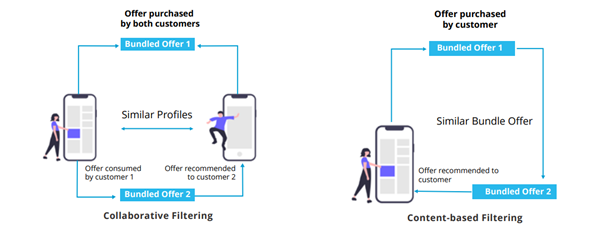
At the core of NBO lies the recommendation engine, a sophisticated system of algorithms that predict consumer behavior and suggest products that a user is likely to need next. Two prominent methods underpin recommendation engines: collaborative filtering and content-based filtering.

  • Collaborative Filtering: This technique predicts what a user might want based on actions taken by other users with similar profiles. For example, if a customer buys a particular bundle, collaborative filtering can suggest that same bundle to other users with similar characteristics or usage patterns.
  • Content-Based Filtering: Also known as cognitive filtering, content-based filtering personalizes offers by analyzing each customer’s unique profile and past interactions. This method generates recommendations that are customized to reflect the individual’s behavior rather than relying on the preferences of others.

These filtering approaches work together to deliver data-driven, real-time recommendations that provide a more personalized experience, aligning each offer with the customer’s distinct preferences.

Next Best Offer (NBO) Finding the Right Offer for Your Customers

What Can Be Delivered Through a Recommendation Engine?

The capabilities of an AI-driven NBO system extend well beyond merely suggesting products; it empowers CSPs with several valuable functionalities:

  • Improving Customer Experience: By analyzing historical customer usage, AI-driven NBO systems recommend products that align with the user’s habits, creating a tailored and seamless experience.
  • Customer Segmentation: NBO systems help segment customers based on shared product profiles, allowing telecom operators to deliver more precisely targeted offers.
  • Cross-Selling and Upselling: AI-driven recommendations encourage revenue growth by identifying and promoting high-value opportunities. For instance, a customer with a basic data plan may receive offers for premium add-ons or upgrades.
  • Demographic-Based Recommendations: Offers can be tailored based on demographic data, allowing CSPs to tap into region-specific or age-specific customer interests.
  • Identifying New Product Needs: By analyzing customers’ usage profiles, CSPs can proactively identify emerging needs and introduce new products that meet those demands.
  • Event-Based Recommendations: During major events, such as sports tournaments, CSPs can offer streaming packages to customers interested in live sports, enhancing relevance and engagement.
Delivering Value with NBO Systems

With the introduction of advanced machine learning techniques, such as deep learning, social learning, and tensor factorization, the capabilities of recommendation engines have reached new heights. These methods enable telecom operators to gain real-time insights into customer preferences and apply a hyper-personalized approach to their marketing efforts. By focusing on these techniques, CSPs can achieve a deeper understanding of customer behavior, which translates into more accurate segmentation, higher lifetime value (LTV), and stronger customer retention.

The Logic Behind Recommendation Engines

The effectiveness of an NBO system hinges on data. Every digital engagement, whether it’s a phone call, app usage, or social media interaction, must be recorded and analyzed. However, the accuracy and trustworthiness of data are essential—biased or incorrect data can lead to suboptimal recommendations, resulting in customer dissatisfaction and potential revenue loss.

As the volume of customer interaction data grows, old methods of segmentation fall short. Today, AI-based systems can divide customers into groups based on value, behavior, lifecycle stage, or other criteria. A recommendation engine, when driven by these segmentation standards, enables telecom operators to deliver hyper-personalized bundled offers, making each interaction more relevant and meaningful to the customer.

Advanced Customer Profiling and Targeting

Enhanced profiling allows CSPs to predict customer needs, preferences, and reactions with accuracy, improving both planning and customer targeting. This level of insight is invaluable for developing targeted campaigns, launching product bundles, optimizing pricing, and setting ARPU (Average Revenue Per User) targets.

AI-Driven NBO: Transforming Telecom

The AI-driven NBO approach significantly advances beyond traditional recommendation engines by integrating real-time insights and advanced analytics. Here’s how NBO is reshaping customer engagement in telecom:

1. Real-Time Data Analysis: By continuously monitoring customer activity, such as browsing patterns, app usage, and call behavior, AI-driven NBO systems generate real-time insights that enable CSPs to deliver relevant offers in the moment. For instance, a customer who frequently streams video content may receive offers for data plans that cater specifically to high-bandwidth needs, while a voice-centric customer might be offered discounted call packages.

2. Usage Pulse Intelligence: AI-powered NBO systems categorize users based on their primary service usage, identifying groups like heavy streamers, frequent callers, or data-focused customers. This segmentation empowers CSPs to align their offers with the specific needs of each group. For example, if a customer consistently exceeds their data limit, an NBO system might proactively upsell them to a higher data tier, increasing customer satisfaction and reducing churn.

3. Predictive Analytics to Reduce Churn: AI-driven NBO plays a critical role in customer retention by identifying customers who may be at risk of churning. Predictive analytics anticipate potential issues, enabling CSPs to offer personalized deals that address each customer’s unique needs and concerns. For instance, a dissatisfied customer might receive a loyalty discount or a tailored plan, reducing the likelihood of them switching providers.

The Three Stages of AI-Driven NBO

An AI-driven NBO system operates through a systematic, multi-stage process to ensure offers are both relevant and timely:

1. Data Filtering with Advanced AI: AI models sift through large volumes of customer data to extract actionable insights. Large Language Models (LLMs), for example, are highly effective at processing data from diverse sources and uncovering patterns that might go unnoticed with traditional methods.

2. Scoring and Prioritization with Reinforcement Learning: Once data is filtered, the system scores and prioritizes potential offers using Reinforcement Learning (RL), which adapts over time based on customer responses to previous offers.

3. Real-Time Ranking and Delivery: In the final stage, the AI system ranks the most relevant offers and delivers them in real time. Contextual factors, such as device type, time of day, and location, are also considered, ensuring that offers reach customers at the right moment.

AI-Driven Portfolio Management: Streamlining and Maximizing Value

Managing a portfolio of products and services is a complex task for CSPs, especially when outdated or redundant offers create inefficiencies. AI-driven portfolio management enables CSPs to streamline their offerings, focusing on maximizing value while reducing operational costs:

  • Analyzing Offer Performance: AI continuously evaluates the performance of each offer, identifying which ones should be retained, updated, or retired. This approach eliminates redundant offerings, enhancing overall efficiency.
  • Dynamic Creation of New Offers: As customer preferences and market conditions evolve, AI can generate new, relevant offers. This flexibility ensures CSPs remain competitive while minimizing time-to-market for new services.
Strategic Business Outcomes with AI-Driven NBO

The deployment of AI-driven NBO systems provides CSPs with several strategic advantages:

1. Revenue Uplift: Personalized recommendations increase acceptance rates, driving revenue through premium upsells.

2. Enhanced Customer Retention: Proactive engagement based on predictive analytics helps CSPs reduce churn.

3. Increased ARPU: Targeted cross-sell and upsell opportunities encourage customers to adopt higher-value services.

4. Operational Efficiency: Automation of recommendation processes reduces marketing costs and minimizes operational complexity.

Unlocking the Future with AI-Driven NBO

AI-driven NBO systems represent a significant evolution in telecom customer engagement. They go beyond simple product recommendations, offering a comprehensive framework for understanding and addressing customer needs. With real-time insights, predictive modeling, and hyper-personalized offers, CSPs can build stronger relationships with customers and foster long-term loyalty. As AI technology advances, NBO systems will become even more sophisticated, helping telecom providers maintain a competitive edge in an increasingly customer-centric world.

In conclusion, AI-driven NBO provides a powerful solution for CSPs seeking to enhance customer satisfaction, reduce churn, and increase revenue. By ensuring the right offer reaches the right customer at the right time, AI-driven NBO systems are transforming telecom operators into proactive, customer-focused organizations, paving the way for a future of enhanced engagement and sustainable growth.

Transform customer engagement with AI-driven Next Best Offer systems.

See our Demo in Action!

In today’s rapidly evolving telecommunications industry, migrations are an unavoidable reality. Whether upgrading to new systems, transitioning to a 5G infrastructure, or consolidating legacy systems, the complexity and risks involved in such initiatives are immense. Without a robust migration assurance framework, telecom operators risk financial losses, operational inefficiencies, and customer dissatisfaction. This blog delves into the concept of migration assurance, key challenges faced without it, and how Subex is enabling operators to execute risk-free migrations through its comprehensive suite of solutions.

What is Migration Assurance?

Migration assurance is a strategic mix of technology, consulting, and services designed to mitigate risks associated with system migrations. It ensures a seamless transition from legacy systems to new platforms while safeguarding financial integrity, operational stability, and customer satisfaction. By employing a structured approach to planning, testing, and validating every step of the migration process, operators can avoid potential pitfalls and achieve their goals efficiently.

The Key Challenges Without Migration Assurance

Migration projects, if not executed with assurance measures, can face a host of issues that adversely impact operators’ business operations. These include:

1. Inadequate Planning and Governance

A lack of strong governance frameworks and communication gaps often lead to ineffective planning and execution. This failure can cascade into delays and unforeseen complications during the migration process.

2. Project Delays and Overruns

Unrealistic timelines often cause significant project delays. Additionally, managing old and new systems in parallel leads to increased overheads, budget overruns, and operational inefficiencies.

3. Application Instability

Improper development practices and insufficient validation can lead to application stability issues in the new systems. These can result in operational downtimes and reduced system reliability.

4. Revenue Leakage

Migrations often introduce errors in charging, rating, and re-rating processes. Such inconsistencies can directly impact revenues, especially when inaccurate billing or uncalibrated rates are applied post-migration.

5. Data Integrity Challenges

Data loss or inconsistency between legacy and new systems is a critical risk during migration. This not only affects business operations but also undermines customer trust and satisfaction.

6. Customer Dissatisfaction

Any errors in billing, service continuity, or account migration can frustrate customers, leading to churn and long-term reputational damage.

How Subex is Leading the Way in Migration Assurance

Subex’s Migration Assurance Framework empowers operators with the right tools, methodologies, and expertise to mitigate these challenges. Here’s how Subex’s solutions are transforming migration processes for operators globally:

1. Validation of Migration Strategy

Subex provides end-to-end validation of the migration strategy, ensuring that risks across all business-critical systems are addressed. The process involves reengineering business processes, revamping existing controls, and creating new Standard Operating Procedures (SOPs) to maintain alignment with business goals.

2. Subscription Service and UAT Test Case Assurance

Subex assures data consistency for subscriber information between legacy and new systems. This includes rigorous validation of UAT test cases, ensuring comprehensive coverage of risk scenarios through participation in rehearsals, Business Continuity Testing (BCT), and Regression Cycle Testing (RCT).

3. Transactional Data and Seamless Integration Assurance

Data consistency for critical transactional data—such as user details, bills, invoices, and rates—is a cornerstone of Subex’s approach. The solution identifies potential integration risks, mitigates them through impact analysis, and ensures seamless integration with downstream systems.

4. Re-rating Validation and Data Cleansing

Subex validates subscriber plans and re-rates them during migration phases, including BCT/RCT and post-migration periods. Unprofitable price plans are identified and removed, ensuring the new system operates at optimal profitability.

The Broader Role of Migration Assurance in Business Assurance

Migration assurance forms a critical pillar within Subex’s broader Business Assurance Framework. By integrating advanced tools, automation, and Subject Matter Expertise (SME), Subex ensures that every aspect of the migration process is accounted for. Key benefits include:

Cost-Effective Resourcing Model

Subex offers a flexible and scalable resourcing model, reducing costs while maintaining high levels of quality and expertise.

Experience Across BSS/OSS Systems

With extensive experience in migrating various BSS/OSS systems, Subex has built a proven track record of successful implementations for telecom operators worldwide.

Quality Assurance with 3-Dimensional Checks

Subex employs a 3-dimensional quality assurance approach that includes validation, optimization, and risk mitigation to achieve migration excellence.

Optimized Project Costs

Through automation and resource optimization, Subex helps operators reduce overall project costs while accelerating time-to-market.

Key Migration Areas Supported by Subex

Subex’s migration assurance solutions address multiple facets of telecom operations, providing a holistic and integrated approach. These include:

  • Partnership & Commission Management: Ensuring the seamless migration of partnership data and commission models to maintain business continuity.
  • Collection & Payables: Validating billing and payment processes to prevent revenue leakages.
  • Order Management: Ensuring order data integrity and seamless migration of order management systems.
  • Mobile Money & Digital Services: Safeguarding the migration of mobile money and digital service platforms to enhance customer experience.
  • Margin & Cost Management: Identifying and mitigating cost inefficiencies during migration.
  • 5G & Network ROI: Supporting migrations to 5G systems to optimize network ROI and operational performance.
  • Customer Experience Management: Addressing migration risks that impact customer touchpoints to enhance satisfaction.
  • Product & Profitability Analysis: Ensuring profitability through accurate product migration and cost analysis.
  • Revenue Reporting: Validating revenue reporting processes for post-migration consistency.
The Hybrid Rule Engine: Automation at Its Core

Subex leverages a hybrid-rule-engine that combines rule-based approaches with AI and ML techniques to automate validation checks. This ensures faster and more accurate analysis, reduces human error, and accelerates project timelines.

Why Choose Subex for Migration Assurance?

Operators face significant challenges during system migrations, but with Subex, these risks are effectively mitigated. Subex’s proven expertise in migration assurance is reflected in its ability to:

1. Streamline Operations: By automating validation checks and leveraging SMEs, Subex ensures smoother transitions with minimal disruptions.

2. Safeguard Revenue: Rigorous validation processes reduce the risk of revenue leakage, ensuring accurate billing and reporting post-migration.

3. Enhance Customer Experience: Proactive measures to ensure data integrity and service continuity lead to improved customer satisfaction and retention.

4. Optimize Costs and Timelines: With an optimized resourcing model and automation-driven efficiencies, Subex ensures that migrations stay on budget and schedule.

Conclusion

Migration Assurance is not just a technical necessity but a strategic imperative for telecom operators navigating complex transitions. By addressing key challenges like data integrity, operational stability, and revenue protection, Subex’s Migration Assurance Framework empowers operators to execute risk-free migrations with confidence.

With a combination of advanced tools, extensive expertise, and a proven track record, Subex is at the forefront of delivering seamless migration experiences. (Request a demo today to explore how Subex can transform your next migration project into a resounding success.)

Protect your revenue, data integrity, and customer satisfaction during system migrations.

See our Demo in Action!

In the evolving landscape of the telecom industry, providing exceptional customer support has become a cornerstone for companies striving to retain customer loyalty. One of the more persistent challenges has been resolving billing queries, which are often complex and varied, stemming from intricate billing structures, diverse plans, and individualized usage patterns. With the introduction of GenAI-powered Billing Queries Co-Pilot, telecom providers are now equipped to handle these challenges more efficiently, offering real-time assistance to customer care agents and significantly enhancing the support experience.

What is the Billing Queries Co-Pilot?

The Billing Queries Co-Pilot is an AI-powered tool designed to provide telecom agents with real-time guidance when addressing customer billing issues. Acting as a smart assistant, it processes queries, analyzes customer data, and offers recommended solutions instantly. With this technology, even the most junior agents can access the knowledge base of a seasoned expert, ensuring that customers receive accurate, consistent information without delay.

How It Works: GenAI in Real-Time Support

GenAI (Generative Artificial Intelligence) is the driving force behind the Billing Queries Co-Pilot. It operates by analyzing both historical and real-time data related to customer interactions, billing issues, and resolutions. Through this analysis, it can predict potential queries, guide agents through optimal responses, and deliver recommendations that align with each customer’s unique situation.

Some key capabilities of GenAI in this application include:

  • Understanding Contextual Nuances: The Co-Pilot can interpret nuanced details within billing data, such as usage patterns, promotional rates, or temporary adjustments, enabling it to offer specific solutions tailored to individual accounts.
  • Instantaneous Response Generation: By processing large volumes of data instantly, GenAI provides agents with immediate suggestions for resolving queries, which significantly cuts down response times.
  • Continuous Learning: As the Co-Pilot is used, it continually improves its recommendations by learning from past interactions and agent feedback, becoming progressively smarter over time.
Key Benefits of the Billing Queries Co-Pilot for Telecoms

1. Accelerated Query Resolution

In traditional telecom support systems, billing queries can take substantial time to resolve due to the need for thorough data analysis and the intricacies of telecom billing. The Co-Pilot transforms this process by delivering recommendations in real time, minimizing the need for manual data lookup and reducing customer wait times. As a result, customers experience faster resolutions, leading to increased satisfaction and reduced frustration.

2. Empowered Customer Support Agents

With the Co-Pilot at their disposal, agents—regardless of their experience level—can handle billing inquiries with greater confidence. This tool essentially bridges the gap between seasoned and junior agents, granting every agent access to a vast knowledge base of billing information and best practices. Furthermore, with the Co-Pilot’s guidance, agents can resolve more queries in less time, resulting in a productivity increase of over 50% in some cases.

3. Consistency in Customer Service

In the telecom industry, customers expect reliable and consistent support. However, variations in agent experience and knowledge can lead to inconsistencies in query resolution. By providing standardized recommendations, the Co-Pilot ensures that every customer interaction meets a high standard of accuracy, leading to more dependable service delivery across the board. This consistency is particularly valuable in maintaining positive Net Promoter Scores (NPS) and overall customer satisfaction.

4. Reduced Training Time for New Agents

One of the most challenging aspects of customer support is onboarding and training new agents. The Co-Pilot alleviates some of this burden by acting as an interactive guide for newer agents, reducing the need for extensive training sessions on billing specifics. By utilizing the Co-Pilot, new agents can be brought up to speed faster and with fewer resources, enabling them to contribute to the team’s productivity sooner.

5. Improved Customer Loyalty

When customers face frequent billing issues, it can damage their trust in the service provider. The Co-Pilot minimizes these negative experiences by ensuring that billing inquiries are resolved quickly and accurately, reducing the chances of repeated issues and leading to a smoother support experience. Ultimately, satisfied customers are more likely to remain loyal, thus reducing churn and enhancing long-term retention rates.

Real-World Impact: How the Billing Queries Co-Pilot Transforms Customer Experience

The implementation of the Billing Queries Co-Pilot within telecom companies has proven to be a game-changer in multiple ways. By addressing common pain points associated with billing inquiries, the Co-Pilot fosters a support environment that is both proactive and responsive to customer needs.

Case Study: Enhancing Agent Performance and Customer Satisfaction

In a recent deployment of the Billing Queries Co-Pilot by a leading telecom provider, the results were remarkable. Agent productivity improved by over 50%, while average handling times for billing-related queries decreased significantly. The Co-Pilot’s influence also contributed to a noticeable increase in NPS, as customers reported higher satisfaction with the prompt and accurate resolutions they received.

Additionally, the telecom company noted a reduction in training time for new hires, as the Co-Pilot acted as a learning tool during live interactions. This not only reduced onboarding costs but also allowed new agents to become proficient faster, adding immediate value to the support team.

A Seamless Transition from Reactive to Proactive Support

Traditionally, telecom support has been predominantly reactive, with agents responding to customer inquiries as they arise. However, the Billing Queries Co-Pilot enables a shift towards a more proactive support model. By analyzing trends in billing complaints, the Co-Pilot can highlight common issues or errors within the billing process. This insight allows telecom providers to address recurring problems at their root, preventing future issues and reducing the overall volume of billing queries.

What’s Next? The Future of AI-Driven Customer Support in Telecom

The Billing Queries Co-Pilot represents a significant step forward in customer support, but it’s only the beginning. As AI technology continues to evolve, telecom providers can anticipate even greater enhancements in support capabilities. Some possible advancements include:

  • Personalized Support Recommendations: AI can evolve to provide increasingly tailored responses based on a customer’s service history, preferences, and previous interactions, creating a more personalized support experience.
  • Multilingual and Cultural Adaptations: The Co-Pilot could become more adaptable by offering support recommendations that align with customers’ cultural preferences or language needs, enhancing the global customer experience.
  • Cross-Channel Consistency: Expanding the Co-Pilot’s capabilities to other customer support channels (such as chat and email) would ensure consistency in billing assistance across all communication platforms.
Overcoming Challenges: Implementation and Integration of the Co-Pilot

Implementing a GenAI-powered Co-Pilot in a telecom environment requires strategic planning and careful integration. Telecom companies need to consider factors such as data privacy, integration with existing CRM systems, and continuous monitoring to ensure the Co-Pilot’s responses align with brand guidelines.

Moreover, maintaining transparency with customers about AI’s role in their interactions is essential. Clear communication can foster customer trust and enhance their willingness to engage with AI-driven support systems. Companies can also encourage feedback from customers and agents alike, using their insights to continually refine and enhance the Co-Pilot’s performance.

Final Thoughts: Building a Competitive Edge with GenAI

In an industry as competitive as telecom, customer experience is a crucial differentiator. The Billing Queries Co-Pilot not only elevates the quality of customer support but also provides telecom companies with a distinctive advantage by streamlining operations, empowering agents, and enhancing customer satisfaction.

As telecom companies continue to embrace AI-driven solutions like the Billing Queries Co-Pilot, they position themselves to offer more agile, responsive, and customer-centric services. In the long run, these advancements will reshape the support landscape, driving higher levels of customer loyalty and setting new standards for service excellence across the telecom industry.

The future of telecom customer support is undeniably digital, and with AI-powered tools like the Billing Queries Co-Pilot, telecom providers are well-equipped to meet the ever-growing demands of today’s customers.

Revolutionize your customer support with the Billing Queries Co-Pilot.

See our Demo in Action!

As the telecommunications landscape rapidly evolves, the complexities in managing wholesale billing have grown, demanding advanced solutions to maintain accuracy, efficiency, and scalability. Wholesale billing platforms, traditionally tasked with the crucial role of calculating and managing payments between telecommunications companies, are now leveraging AI and ML to meet these demands. This transformation aims to enhance operational efficiency and introduce new revenue streams for telecom companies navigating an increasingly competitive market.

The Importance of Modern Wholesale Billing Solutions

Wholesale billing has historically been an intricate aspect of telecom operations, involving complex calculations, inter-operator negotiations, and strict compliance requirements. The introduction of next-generation services like 5G and IoT and rising consumer expectations have increased the pressure on telecom operators to adapt and scale efficiently. Traditional billing methods relying on manual oversight and legacy systems now struggle to handle the volume and variety of transactions generated daily.

In this new era, telecom companies face key challenges in their wholesale billing operations:

1. Scalability: Handling an exponential increase in data as devices, users, and services expand.

2. Accuracy: Reducing errors in billing calculations, which can lead to disputes and revenue losses.

3. Efficiency: Automating routine processes to reduce manual effort and increase speed.

4. Adaptability: Responding to evolving regulatory requirements and customer expectations.

The integration of AI/ML in wholesale billing solutions addresses these challenges by introducing data-driven intelligence, reducing manual errors, and providing real-time insights for better decision-making.

How AI and ML Are Shaping Telecom Wholesale Billing Platforms

AI and ML bring a transformative approach to wholesale billing, reshaping the way telecom operators manage billing processes and interact with partners. Some of the critical applications of AI/ML in wholesale billing include:

1. Automated Error Detection and Correction

AI algorithms enable billing platforms to detect and correct errors autonomously, identifying patterns in data that may indicate inaccuracies. This ensures that errors are corrected in real time, reducing potential disputes and ensuring that both parties—operators and clients—have confidence in the billing process.

2. Predictive Analytics for Demand Forecasting

ML models analyze historical billing data, network usage trends, and external factors to predict future demand. This forecasting capability allows telecom operators to proactively adjust their offerings, make strategic partnerships, and negotiate favorable agreements, which directly impacts revenue generation.

3. Dynamic Pricing Models

AI-driven pricing models enable telecom companies to adapt to market changes swiftly. By analyzing trends in data usage, customer demographics, and competitor offerings, AI-powered billing platforms can adjust pricing dynamically, ensuring competitive positioning while maximizing revenue.

4. Fraud Detection and Prevention

Wholesale billing platforms integrated with AI can monitor transactions in real-time, identifying potential fraud patterns as they occur. This is especially critical given the rise in interconnect fraud, where malicious actors exploit vulnerabilities in telecom billing to profit from unauthorized access. AI models can detect anomalies based on usage patterns and other indicators, alerting operators before significant losses occur.

5. Customer Segmentation and Personalization

AI enables telecom operators to segment their wholesale customers based on usage patterns, value, and risk profile, allowing for a more tailored approach to managing partnerships. For example, high-value clients might be offered more favorable terms, while high-risk clients are flagged for additional scrutiny.

Case Study: Telenor Norway’s Success with Subex’s Wholesale Billing Solution

Telenor Norway, a leader in the telecommunications sector, recognized the need to modernize its wholesale billing operations to align with the rapidly changing telecom environment. As a long-term Subex customer, Telenor had been utilizing Subex’s Wholesale Billing solution but identified areas where further enhancements could optimize their operations and position them for future growth.

Challenges Faced

The traditional solution, while functional, required manual interventions that occasionally led to errors and delays. These inefficiencies became more apparent as Telenor expanded its offerings and customer base, pushing for a solution that would minimize human intervention and improve operational agility.

The Solution: Managed SaaS by Subex

Telenor chose to upgrade to Subex’s Managed SaaS solution, integrating it with the latest ROC PS (Revenue Operations Center for Partner Settlement) platform. This decision allowed Telenor to leverage a cutting-edge solution with advanced automation capabilities, scalability, and enhanced functionality.

Key benefits achieved by Telenor through this upgrade included:

  • Enhanced Performance: By automating several processes, the new system minimized manual errors and streamlined workflows, significantly boosting overall efficiency.
  • Improved Accuracy: The upgraded platform enhanced billing precision, strengthening stakeholder trust and reducing the risk of disputes.
  • Scalability: With ROC PS, Telenor’s billing operations are now positioned to scale seamlessly, adapting to market dynamics as they arise.
  • Agility: The platform’s adaptable infrastructure allowed Telenor to respond to changing market needs rapidly.

According to Telenor’s team, the switch to Subex’s Managed SaaS solution not only optimized operations but also enabled them to reduce costs while improving agility and performance. This success story highlights how strategic upgrades in wholesale billing platforms, especially those powered by AI and ML, can empower telecom operators to achieve operational excellence and future readiness​.

Future Trends: AI and ML Transforming Wholesale Billing Platforms

As AI and ML technologies continue to mature, wholesale billing platforms will undergo further evolution, integrating additional capabilities to support telecom operators in their revenue-generation and cost-optimization efforts. Here are some trends to watch:

1. Real-Time Settlement and Reconciliation

Future wholesale billing platforms will likely support real-time settlements, allowing operators to reconcile transactions instantly. This feature reduces lag in payment cycles and enhances trust between operators by ensuring that all parties have visibility into shared transaction data.

2. Enhanced Decision Intelligence

AI/ML can provide decision intelligence for various levels of the billing process. For instance, predictive analytics could assess the likelihood of a billing dispute and suggest preventive measures, helping operators proactively manage relationships and maintain positive partner experiences.

3. Self-Learning Algorithms for Better Scalability

Self-learning algorithms are poised to transform wholesale billing platforms, enabling them to autonomously improve their accuracy and efficiency over time. As these algorithms learn from past billing transactions, they will be better equipped to adapt to new types of billing arrangements and market demands.

4. Integration with Blockchain for Transparency

Blockchain technology can be combined with AI-powered billing platforms to enhance transparency and security in telecom transactions. Blockchain’s immutable ledger capabilities provide a trustworthy, secure platform for recording wholesale billing data, minimizing fraud risks and fostering transparency across the telecom ecosystem.

5. Multi-Cloud Architecture for Global Reach

To support international billing operations and scale seamlessly, wholesale billing platforms will move toward multi-cloud architectures, facilitating global data management and real-time data access from various regions. AI and ML algorithms will optimize data flows within these cloud infrastructures, ensuring that data is processed quickly and accurately.

Conclusion: The Strategic Advantage of AI/ML in Wholesale Billing

The incorporation of AI and ML into wholesale billing platforms is revolutionizing how telecom operators approach their billing and partner management. With AI-driven automation, enhanced accuracy, and data-backed insights, these platforms empower operators to streamline operations, reduce manual effort, and minimize errors. Furthermore, AI/ML’s predictive capabilities allow for more informed decision-making and dynamic adjustments, providing telecom operators with a significant competitive edge.

Telenor Norway’s journey with Subex’s Wholesale Billing solution showcases the tangible benefits of adopting AI-powered platforms. By upgrading to a Managed SaaS solution, Telenor achieved higher efficiency, accuracy, and scalability, underscoring the value that AI/ML technologies bring to modern wholesale billing operations.

For telecom operators aiming to maximize revenue and adapt to the demands of a digital-first world, embracing AI and ML in their wholesale billing operations is no longer optional—it’s essential. As AI/ML technologies continue to advance, wholesale billing platforms will only become more sophisticated, setting new standards for accuracy, efficiency, and strategic growth in the telecom industry.

Transform your telecom billing with AI-powered efficiency—explore the future of revenue optimization.

See our Demo in Action!

In today’s fast-evolving telecom industry, effective Enterprise Asset Management (EAM) is critical for optimizing the value of assets, reducing operational costs, and ensuring regulatory compliance. With the integration of Artificial Intelligence (AI) and Machine Learning (ML), EAM solutions can now offer advanced predictive capabilities, automated workflows, and data-driven insights, revolutionizing how telecom operators manage and maximize their assets. This blog will explore the core components of AI/ML-driven EAM, key features, the role of predictive analytics, and real-world applications, focusing on how telcos can leverage these tools to maximize ROI.

The Role of AI/ML in Enterprise Asset Management

Enterprise Asset Management is about tracking and managing physical and digital assets through their lifecycle—from acquisition to deployment, maintenance, and retirement. For telecom companies, these assets range from network towers and switches to software assets essential for service continuity. EAM’s traditional focus is expanding rapidly, and AI/ML-driven EAM solutions can provide several transformational benefits, including:

  • Predictive and Preventive Maintenance: Using AI algorithms, EAM systems can predict when assets will need maintenance or replacement, preventing costly breakdowns and extending the lifecycle of critical infrastructure.
  • Data-Driven Decision Making: ML models process and analyze vast amounts of data, delivering actionable insights that empower telecom operators to make informed decisions on asset investments and replacements.
  • Workflow Automation: AI/ML technologies automate repetitive tasks, such as maintenance scheduling and compliance checks, reducing administrative workload and human error.
Why EAM is Vital for Telcos

The telecom sector’s high-value infrastructure demands careful management to ensure longevity and optimal performance. Here’s why EAM is indispensable for telecom companies:

  • Enhanced Asset Visibility and Utilization: With real-time tracking, telecom operators gain a comprehensive view of assets, maximizing utilization and identifying underutilized resources that can be repurposed to reduce CAPEX.
  • Reduced Operational Costs: AI-driven EAM systems use predictive analytics to schedule maintenance only when needed, thus reducing unnecessary repairs and avoiding emergency breakdown costs.
  • Regulatory Compliance: Telecom is a highly regulated industry, and EAM solutions provide audit-ready data that helps operators meet compliance standards and avoid penalties.
Key Features of AI/ML-Driven EAM Systems

For EAM to deliver the highest ROI, it must have features that go beyond traditional tracking and management. Here are some essential capabilities in modern AI/ML-driven EAM systems:

  • Predictive Analytics: Leveraging data analytics to predict when assets will need maintenance ensures telecom operators can proactively schedule repairs, reducing downtime.
  • Centralized Data Repository: A single source of truth for all asset-related data helps operators make strategic decisions based on accurate, up-to-date information.
  • Mobile Access and Remote Management: Field operators and managers can access real-time data from mobile devices, enabling faster, data-driven decision-making on the go.
  • Asset Lifecycle Management: From acquisition to disposal, asset lifecycle management ensures resources are optimized at every stage, preventing wastage.
  • Integration with ERP and CRM Systems: Seamless integration with other enterprise systems, such as ERP and CRM, enables data sharing and coordination across departments, resulting in better decision-making.
Maximizing ROI: How AI/ML-Driven EAM Enhances Financial Performance

AI/ML-driven EAM systems can contribute directly to ROI by reducing costs, optimizing asset usage, and minimizing risks. Here’s how:

  • Optimizing Maintenance Costs: By predicting asset failure before it happens, predictive analytics reduces reactive maintenance costs and improves asset reliability.
  • Improving CAPEX Efficiency: AI-driven insights on asset utilization allow telecom companies to allocate capital more effectively, reducing unnecessary expenditures on new assets.
  • Enhancing Revenue through Asset Utilization: Identifying underutilized assets through AI-based analysis enables telcos to either repurpose or sell these assets, generating additional revenue streams.
  • Boosting Operational Efficiency: AI-powered automation of routine tasks, such as inventory tracking and compliance checks, frees up valuable employee time, allowing them to focus on core business activities and innovation.
Real-World Use Cases in Telecom: Leveraging AI/ML-Driven EAM for Optimal ROI

Let’s explore some use cases that demonstrate how AI/ML-driven EAM can help in transforming asset management in the telecom industry.

1. Network Auto Discovery
AI-driven EAM systems equipped with network auto-discovery capabilities can automatically identify new assets as they are deployed, ensuring up-to-date records and reducing manual input errors. This functionality helps maintain an accurate asset registry, improving asset tracking and enabling more informed decision-making.

2. Predictive Maintenance and Downtime Reduction
Predictive maintenance, powered by AI algorithms, forecasts potential failures based on historical data and current asset conditions. For instance, if a telecom operator’s data suggests that a particular type of router experiences issues after three years, the EAM system can schedule maintenance before a failure occurs, minimizing downtime and reducing maintenance costs.

3. Asset Utilization and Capex/Opex Optimization
EAM systems can analyze asset usage across multiple locations, helping telecom companies determine the most profitable sites. Assets at underperforming sites can be redeployed to areas where they will generate higher returns, optimizing both CAPEX and OPEX expenditures.

4. Compliance and Risk Mitigation
AI-driven EAM systems streamline compliance by tracking regulatory requirements and providing automated alerts when assets require inspection or maintenance. This feature helps telecom operators avoid non-compliance fines and reputational damage.

The Impact of AI on EAM Optimization Strategies

To maximize ROI, telecom operators can adopt various strategies enabled by AI/ML-driven EAM:

  • Proactive Risk Management: AI models identify potential risks by analyzing asset health, usage patterns, and maintenance data, allowing operators to implement proactive measures.
  • Data Integration and Unification: EAM systems can consolidate data from multiple sources—such as supply chain, ERP, and network operations—into a single view, ensuring accuracy and completeness.
  • Automated Workflow Management: Routine processes, such as inventory reconciliation and invoice verification, can be automated, reducing administrative burden and minimizing errors.
How AI-Enhanced EAM Supports Digital Transformation in Telecom

As telecom operators transition to digital, software-defined networks, the complexity of asset management increases. EAM solutions enhanced by AI and ML support this transformation in several ways:

  • Scalability and Flexibility: AI-powered EAM systems scale easily as the asset base grows, ensuring that telcos can manage both physical and virtual assets with equal efficiency.
  • Enhanced Customer Experience: Reliable network infrastructure directly impacts customer satisfaction. By improving asset reliability through predictive maintenance and reducing service disruptions, telecom operators can maintain high customer loyalty.
  • Enabling New Revenue Streams: EAM systems can identify redundant or underutilized assets that can be repurposed, redeployed, or sold, creating opportunities for new revenue.
Industry Applications Beyond Telecom

While AI-driven EAM systems offer unique benefits to the telecom industry, their value extends across other sectors as well:

  • Manufacturing: In manufacturing, EAM supports uptime and productivity by tracking machinery and optimizing maintenance schedules, reducing costs associated with unplanned downtimes.
  • Energy and Utilities: Utility companies use EAM to manage critical infrastructure, reducing outages and enhancing reliability by monitoring assets such as transformers and power lines.
  • Healthcare: In healthcare, EAM manages medical equipment and facilities to ensure compliance with safety standards, reducing the risk of equipment failure and improving patient care quality.
  • Transportation: EAM systems in transportation help manage fleets, optimizing maintenance for safety and cost-efficiency, and reducing downtime.
Best Practices for Maximizing ROI with AI/ML-Driven EAM

To fully leverage AI-driven EAM, telecom companies should adopt the following best practices:

1. Invest in Predictive Maintenance: Proactively scheduling maintenance based on predictive analytics can significantly reduce reactive repair costs and minimize service disruptions.

2. Ensure Cross-Departmental Collaboration: EAM systems should integrate with other enterprise solutions (e.g., ERP, CRM) to provide a holistic view, facilitating seamless communication and decision-making.

3. Use Real-Time Data: Utilize AI algorithms that process real-time data to get the most accurate insights on asset health, usage, and compliance.

4. Optimize the Asset Lifecycle: Implement strategies for each stage of the asset lifecycle—acquisition, maintenance, and disposal—to maximize asset utility and reduce costs.

5. Enhance Compliance with Automated Workflows: Use AI-driven EAM to automate compliance and regulatory checks, reducing human error and ensuring adherence to industry standards.

The Future of EAM in Telecom: Embracing AI for Maximum ROI

As AI and ML technologies continue to evolve, their impact on Enterprise Asset Management will only grow. The future of EAM in telecom lies in increased automation, real-time data processing, and predictive analytics. By fully embracing these technologies, telecom operators can unlock new levels of operational efficiency, cost savings, and customer satisfaction, driving higher ROI from their EAM investments.

The adoption of AI/ML-driven EAM systems isn’t merely about maintaining assets; it’s about transforming asset management into a strategic advantage. As competition intensifies in the telecom industry, companies that leverage AI-driven EAM will be best positioned to maintain robust infrastructure, respond swiftly to market demands, and provide superior service to their customers.

Conclusion

For telecom operators, AI/ML-driven Enterprise Asset Management represents an essential strategy for optimizing the value of their assets, reducing operational costs, and enhancing service reliability. By adopting AI-powered EAM solutions, telecom operators can not only extend the lifecycle of their infrastructure but also unlock new revenue opportunities, create cost efficiencies, and improve regulatory compliance. Embracing AI-driven EAM is no longer just an operational decision but a strategic imperative for telecom operators seeking a competitive edge. As they continue to invest in advanced AI/ML technologies, telecom companies can expect substantial gains in both asset reliability and financial performance. These systems enable a proactive approach to asset management that maximizes ROI by minimizing unplanned downtimes, optimizing capital and operational expenditures, and ensuring regulatory compliance with minimal manual intervention.

Ultimately, the future of EAM in telecom lies in its potential to become a cornerstone of digital transformation. As telecom operators adopt next-generation networks like 5G and incorporate AI into broader strategic initiatives, the synergy between EAM and AI will deepen, yielding even more robust data-driven insights and automation capabilities. By deploying an AI/ML-driven EAM system, telecom operators not only optimize their current asset base but also set themselves up for future scalability, adaptability, and success.

This advanced, ROI-focused approach to EAM allows telecom operators to meet the demands of today’s fast-paced market while also preparing for tomorrow’s challenges. Whether it’s extending asset lifecycles, improving operational efficiency, or opening up new revenue streams, AI/ML-driven EAM is the key to turning complex asset management into a streamlined, profit-generating process that benefits both the business and its customers.

In a highly competitive and evolving telecom industry, AI/ML-driven EAM provides a transformative path forward—one that maximizes asset value, minimizes costs, and ensures telecom operators are always ready to meet and exceed customer expectations. By embracing these technologies now, telecom companies can lead in both operational excellence and customer satisfaction, truly maximizing the return on every asset they manage.

Unlock the full potential of your telecom assets with AI-driven EAM solutions to boost ROI

See our Demo in Action!

Our Offices
Subex Limited
Pritech Park,
SEZ Block -09, 4th Floor B Wing Survey No. 51 to 64/4 Outer Ring Road, Bellandur Village Varthur, Hobli, Bengaluru, Karnataka 560103, India
Tel : +91 80 37451377
Subex, Inc
1499 W 120th Ave,
Suite 210 Westminster,
CO 80234, USA

Subex (UK) Limited
Unit 1J, Sambhav House, First Floor
275-287 Station Road, Harrow HA1 1NA

Email Id: info@subex.com
Contact Number: +447736518379

Subex (UK) Limited – Ipswich
Rooms N2-06 Columba House
Innovation Martlesham
Adastral Park, Ipswich,
IP5 3RE, United Kingdom.

Subex Limited Dubai Office
Office number 722,
Building number 6WA,
Dubai Airport Free Zone
Authority (DAFZA),
P.O. Box: Box 54834, Dubai
United Arab Emirates
Tel : +971 4 214 6700
Fax : +971 4 214 6714

Subex (Asia Pacific) Pte Limited
175A Bencoolen Street
#08-03 Burlington Square
Singapore 189650
Tel : +65 6338 1218
Fax: +65 6338 1216

© Copyright SUBEX 2026. All Rights Reserved.