Get access to a curated list of the latest blog posts covering a wide range of topics from the telecom industry.

Archives: Social Articles

The telecom industry, with its large-scale operations and complex services, relies on accurate and efficient rating and billing systems to maintain smooth financial operations. As telecom companies expand their offerings and customers demand increasingly flexible service options, these systems become more critical, yet more difficult to manage. With the introduction of Artificial Intelligence (AI) into telecom operations, telecom rating and billing systems are experiencing a significant revolution. AI’s ability to process vast amounts of data and automate decisions is transforming how telecom companies handle rating and billing processes, enhancing accuracy, efficiency, and customer satisfaction.

The Importance of Rating and Billing in Telecom

Telecom rating is the process of calculating the charges for various telecom services, including voice calls, data usage, and value-added services (VAS). Telecom Billing, on the other hand, is the generation of invoices based on these usage charges. These systems are crucial in ensuring that telecom operators maintain smooth financial operations by charging customers correctly and promptly.

Given the sheer volume of data generated by modern telecom services, the rating and billing process is highly complex. It must account for different pricing models, customer plans, taxes, discounts, and real-time usage variations. Inaccurate billing can lead to revenue loss, customer dissatisfaction, and even regulatory penalties.

Telecom companies that have implemented AI-driven billing systems have seen a significant 45% boost in invoice processing speed and a 60% decrease in errors typically caused by manual data entry.

Traditional Challenges in Telecom Rating and Billing

Traditional telecom rating and billing systems have faced numerous challenges, including:

1. Data Volume and Complexity: With millions of users generating billions of usage events daily, the amount of data that needs to be processed is enormous. Traditional systems often struggle with this sheer volume.

2. Real-Time Billing: As customers move towards pay-per-use models, real-time billing becomes crucial. Legacy systems typically lack the agility to process and invoice usage data in real time, leading to delays and inaccuracies.

3. Fraud and Revenue Leakage: Telecom companies are vulnerable to fraud, such as incorrect billing for services not rendered or errors in rating premium services. Revenue leakage through misbilling is a significant concern in the industry​.

4. Inaccurate Invoices: Manual processes involved in traditional systems often result in discrepancies between what is charged and what is delivered, leading to customer complaints and lost trust.

How AI-Powered Business Assurance is Revolutionizing Telecom Rating and Billing

AI-driven business assurance systems are set to revolutionize telecom rating and billing by addressing these challenges through automation, accuracy, and advanced data analytics. Below are some key ways AI is making a difference:

1. Automated Data Processing and Accuracy

AI algorithms excel at processing vast amounts of data quickly and accurately. In telecom rating and billing, this capability translates to improved accuracy in determining charges for services rendered. By analyzing usage patterns, AI can automatically adjust rates and charges in real time, ensuring that customers are billed accurately based on their service usage.

For instance, AI can automatically detect errors in the data, such as discrepancies between a customer’s usage and the charges applied, and correct them before invoices are generated. This not only reduces human error but also ensures that customers receive accurate bills, boosting trust and satisfaction.

2. Real-Time Billing and Dynamic Pricing

One of the major shifts in the telecom industry is the move towards dynamic pricing models, where customers pay based on real-time usage of services. AI enables telecom companies to implement real-time billing solutions by continuously analyzing usage data and applying relevant pricing models as services are consumed.

For example, AI-powered billing systems can instantly calculate charges for data consumed during streaming, calls made, or cloud services used, and update the customer’s bill in real time. This offers customers transparency and flexibility, while telecom operators can ensure timely revenue collection.

3. Fraud Detection and Revenue Assurance

Revenue leakage due to fraud or billing errors is a major issue in the telecom sector. AI enhances fraud detection and revenue assurance by identifying anomalies in the billing process. Using machine learning algorithms, AI systems can analyze customer usage patterns to detect irregularities that could indicate fraud or errors in billing.

For example, an AI system could detect if a customer is being charged for services they did not use, or if premium services are incorrectly billed at standard rates. This proactive approach helps telecom companies minimize revenue leakage and protect their bottom line.

4. Improving Customer Experience with AI-Driven Billing

Customer experience is a key factor in the competitive telecom landscape. AI not only improves the accuracy of billing but also offers personalized billing solutions to customers. AI can tailor billing options and payment plans based on individual usage patterns and preferences, making billing more flexible and customer-centric.

Moreover, AI-driven chatbots can assist customers with billing inquiries, providing real-time responses to questions about charges, payment options, and billing history. This reduces the burden on customer support teams while improving customer satisfaction through instant, accurate responses.

Rating Assurance in Telecom

In addition to AI, ensuring the accuracy of telecom rating and billing systems is becoming increasingly important. Rating assurance refers to the process of validating that the correct charges are applied to usage events, recurring fees, or one-time fees, ensuring the completeness, validity, accuracy, and timeliness of the rating process.

According to the TM Forum, the rating process in telecom should ensure that all billing tariffs are correctly applied and that any discounts, allowances, or bundles are accurately calculated and reflected in the customer’s bill. AI-driven systems help automate this validation process, ensuring that all usage records are properly rated and invoiced.

Limitations of Traditional Rating Assurance Approaches

Traditional rating assurance approaches typically involve reprocessing data and comparing it with the original output. However, this time-consuming process often results in a limited review of data, focusing only on a sample of rate plans rather than the entire population. As a result, traditional methods are prone to sampling bias and fail to identify all potential issues in the rating process.

Leveraging AI for Rating Assurance

AI-driven rating assurance systems ensure greater accuracy and coverage across all rate plans. This eliminates the need for sample-based methods and provides telecom operators with a more comprehensive view of their rating processes. By automating the analysis of vast amounts of data, AI reduces the risk of human error, speeding up the rating validation process while ensuring accuracy across various customer segments and services.

Additionally, AI can continuously learn and adapt to new pricing models, usage patterns, and market demands. This flexibility allows telecom operators to swiftly accommodate changes in their offerings, such as dynamic pricing or personalized discounts, without compromising billing accuracy. In the long run, leveraging AI for rating assurance not only prevents revenue leakage but also strengthens customer trust by providing transparent and error-free billing experiences.

Key Benefits of AI-Powered Business Assurance in Telecom Billing

The application of AI to telecom billing provides several significant advantages:

1. Operational Efficiency

AI automates many of the manual processes involved in rating and billing, freeing up resources for other critical tasks. This results in faster billing cycles, fewer errors, and reduced operational costs. Automation also ensures that telecom companies can handle the increasing volume of data generated by modern telecom services without compromising on accuracy or speed.

2. Cost Savings

By reducing manual errors and ensuring timely revenue collection, AI helps telecom companies save costs associated with revenue leakage and billing disputes. The ability to detect and correct billing errors before invoices are sent out prevents costly adjustments and compensations down the line.

3. Enhanced Revenue Assurance

AI systems provide telecom companies with advanced analytics to detect and mitigate instances of revenue leakage. Whether through fraud detection or by identifying errors in billing, AI ensures that telecom companies can maximize their revenue and reduce financial losses.

4. Personalized Services

AI-powered billing systems can offer personalized billing solutions based on customer behavior. For instance, AI can identify a customer’s usage patterns and recommend the most suitable pricing plans. This not only enhances customer satisfaction but also helps telecom companies build long-term customer loyalty.

5. Regulatory Compliance

Telecom companies are often subject to stringent regulatory requirements related to billing transparency and accuracy. AI helps telecom operators stay compliant by ensuring that billing processes are accurate, transparent, and consistent with regulatory standards. AI-driven reporting tools can also generate compliance reports, reducing the risk of fines or sanctions.

Overcoming Common Telecom Billing Challenges with AI-Powered Business Assurance

AI has the potential to address several common billing challenges in the telecom industry, including:

1. Billing Discrepancy

Billing discrepancies, such as those arising from mismatches between usage and charges, can lead to revenue leakage. AI-driven billing systems can continuously monitor usage data and compare it against billing records to identify discrepancies early on, ensuring that they are corrected before bills are issued.

2. Complex Pricing Models

Telecom operators often offer multiple pricing models, from flat rates to pay-as-you-go and tiered pricing plans. AI simplifies the management of these complex pricing models by automatically applying the correct rates based on a customer’s usage patterns and the terms of their contract.

3. Fraudulent Activities

AI’s ability to detect anomalies in billing patterns makes it an invaluable tool for fraud detection. By identifying unusual patterns, such as sudden spikes in usage or charges for services not rendered, AI can help telecom operators detect and prevent fraudulent activities before they cause significant revenue losses.

4. Real-Time Billing and Payments

Modern telecom customers expect real-time billing and payment options. AI enables telecom companies to implement real-time billing solutions that automatically update charges as services are consumed, offering greater flexibility and transparency to customers.

The Future of AI-Powered Business Assurance in Telecom Billing

AI’s role in telecom billing is only set to grow as the telecom industry continues to evolve. With the rise of 5G networks, IoT devices, and cloud services, telecom companies will need even more advanced systems to manage the increased volume of data and the complexity of service offerings. AI will play a central role in enabling telecom companies to stay competitive by providing real-time, personalized billing solutions, enhancing operational efficiency, and improving customer satisfaction.

Furthermore, AI’s integration with other technologies, such as blockchain, could bring additional benefits to telecom billing. Blockchain’s decentralized and transparent nature could enhance the security and accuracy of billing records, while AI ensures that the data is processed efficiently and accurately.

Conclusion

AI is revolutionizing the telecom industry, particularly in the areas of rating and billing. By automating processes, improving accuracy, and providing real-time solutions, AI-driven billing systems are transforming how telecom companies operate. These systems not only reduce operational costs and revenue leakage but also enhance customer satisfaction through personalized and transparent billing solutions. As telecom companies continue to expand their service offerings and adopt new technologies like 5G, the role of AI in rating and billing will become even more critical, driving innovation and ensuring sustainable growth.

Optimize your telecom billing and reduce errors by 60% with AI-driven solutions!

Book a Free Demo

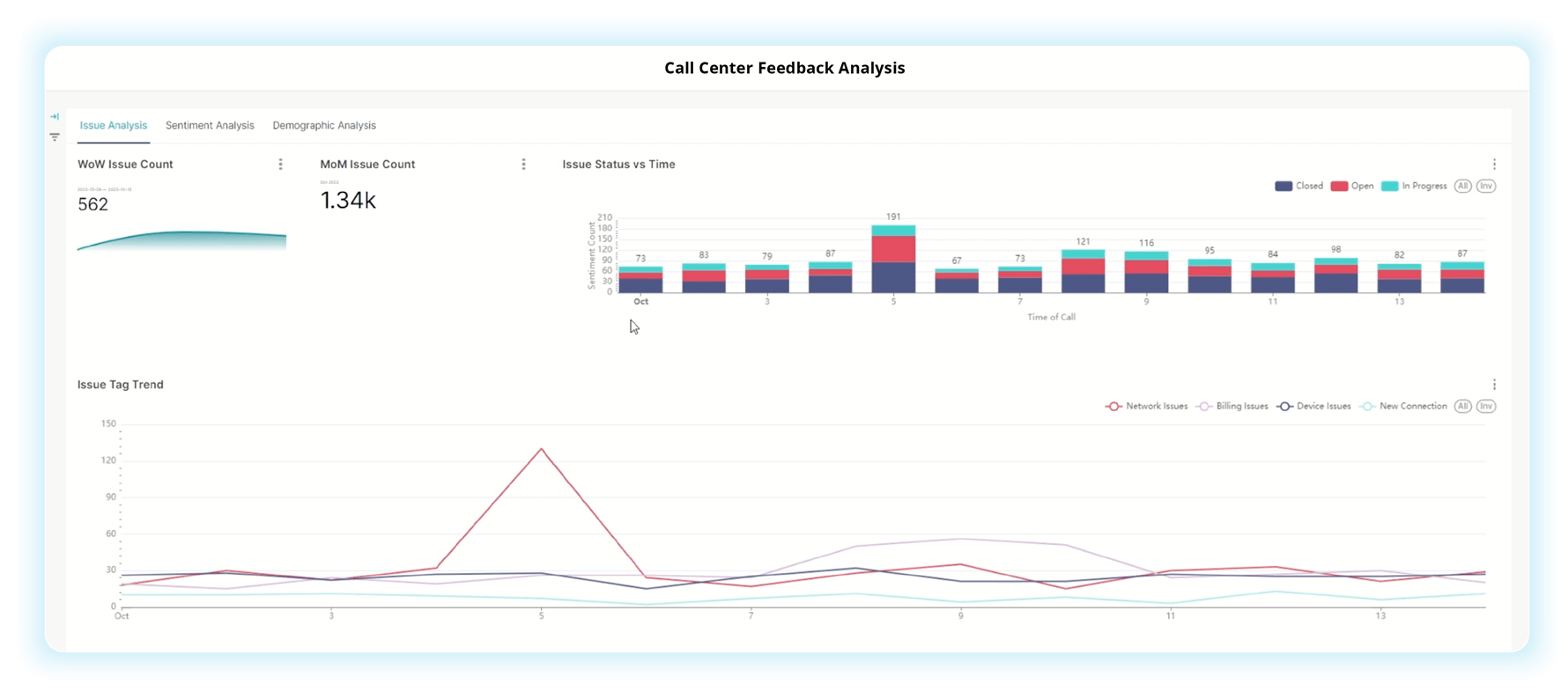
In the high-stakes world of telecom, customer satisfaction isn’t just a nice-to-have—it’s the lifeline that keeps companies ahead of their competition. With millions of interactions flowing through telecom call centers every day, how a company responds to customer issues can make or break its reputation. The challenge? Identifying and resolving problems quickly before they spiral into dissatisfaction or churn. Enter AI-powered solutions, which are revolutionizing the way telecom operators analyze customer feedback and streamline their call center operations. By harnessing the power of AI, telecom companies can turn customer insights into actionable strategies, transforming their call centers from reactive trouble spots into proactive, value-driving assets.

AI-driven customer feedback analysis enables telecom companies to leverage cutting-edge technologies to sift through the vast amounts of data generated by call centers. By extracting valuable insights from customer interactions, these technologies can drastically improve operational efficiency, boost customer satisfaction, and even reduce churn. Let’s explore how telcos are using AI to revolutionize their call centers and enhance their overall performance.

The Power of AI in Telecom Call Centers

Telecom operators face unique challenges in managing their call centers, given the millions of customer interactions they handle daily. Customers reach out with questions about billing, technical support, service outages, and more. However, many of these calls are repetitive, with customers experiencing similar issues over time.

AI in Telecom has emerged as a game-changer in addressing these challenges. By using customer feedback analysis tools, operators can process large datasets from telecom call centers and extract actionable insights. This leads to more effective resolution of customer problems and faster responses to emerging service issues.

One of the most valuable applications of AI in telecom call centers is topic mining. This AI-driven technology automatically scans through millions of call transcripts, categorizing them into relevant themes, incident categories, and sub-categories. By identifying patterns in customer complaints and frequently asked questions, telecom operators can better understand the root causes of customer dissatisfaction.

What is Call Center Feedback analysis?

Call center feedback analysis uses topic mining to automatically process large volumes of data from call transcripts, organizing the information into key themes, incident categories, and subcategories. This helps telecom operators uncover patterns in customer complaints, common questions, and recurring service issues. By understanding these patterns, operators can better identify the root causes of customer dissatisfaction and make data-driven decisions to improve service quality and customer experience.

Topic Mining for Customer Feedback Intelligence

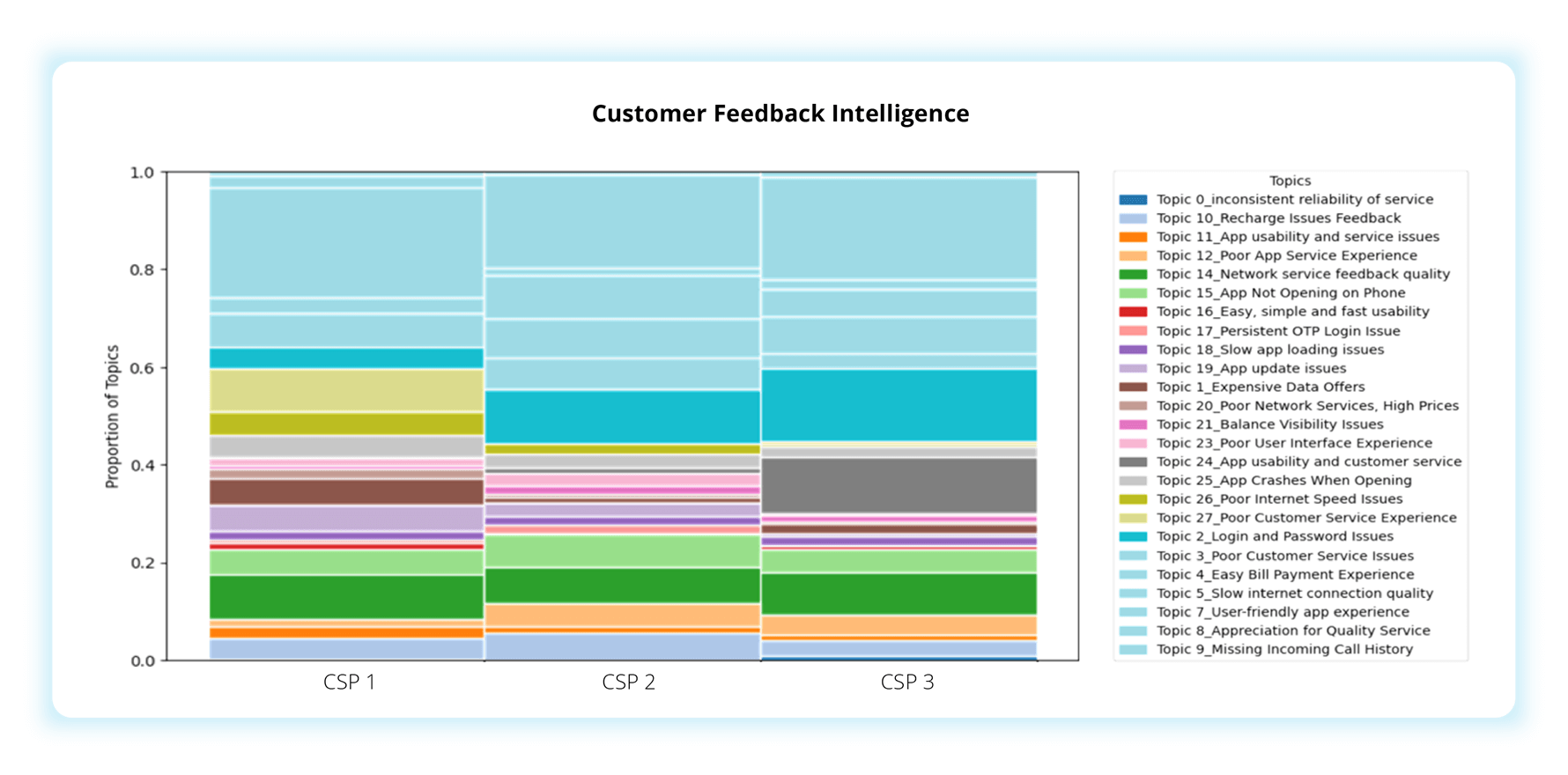
Customer Feedback Intelligence is about understanding customer sentiments at scale. This involves processing vast amounts of data to uncover trends that aren’t immediately visible through manual analysis. Topic mining automates this process by quickly identifying recurring themes in customer interactions.

For example, a telecom company might receive thousands of calls daily related to billing disputes, network reliability issues, or service disruptions. Through topic mining, the system categorizes these calls and identifies the most frequent topics, allowing the company to focus on resolving the issues that matter most to its customers. This approach not only streamlines customer service operations but also provides telecom operators with insights that improve their strategic decision-making.

Case Study: How Topic Mining Transformed a Telecom Giant’s Call Center

Let’s look at a real-world example of a North American telecommunications conglomerate with over 115 million subscribers. With millions of customer interactions daily, the company struggled to keep pace with the volume of inquiries and complaints. Recognizing the need for a more scalable solution, they implemented a sophisticated AI-powered solution to analyze their telecom call center data through topic mining.

Key Findings from Topic Mining:

  1. Billing Issues: Approximately 25% of all calls were related to billing disputes and unclear statements. This issue had been underreported in previous internal assessments.
  2. Network Reliability: About 18% of calls pertained to network reliability, with many customers reporting service outages in specific regions that had not been fully addressed in operational planning.

Outcome:

The insights from topic mining allowed the telecom operator to make more informed, data-driven decisions, resulting in significant improvements across several key performance indicators (KPIs):

  • Prioritized Problem Resolution: By identifying the most frequently mentioned issues, the operator was able to proactively address these problems, leading to a 20% reduction in incoming call volume.
  • Enhanced Agent Training: The insights from topic mining empowered customer service representatives with better information to handle common queries. This reduced average handling time by 19%.
  • Service Process Optimization: Based on the data-driven understanding of key pain points, the operator optimized its service processes. This included overhauling billing systems and improving network reliability in underperforming regions.
  • Reduced Customer Churn: As a result of resolving these recurring issues, the operator saw a sharp increase in customer satisfaction scores (CSAT), from 66% to 84%, within just six months. Additionally, they experienced a notable reduction in churn rates, proving the effectiveness of churn prediction powered by AI.

This case study highlights how AI-powered solutions can revolutionize telecom call center performance. By automating the analysis of customer interactions and leveraging customer feedback intelligence, telecom operators can identify critical issues, streamline processes, and deliver a more personalized customer experience.

Improving Telecom Call Center Efficiency with AI-Driven Customer Insights

Reducing Call Volume and Repeat Interactions

One of the biggest challenges telecom call centers face is the high volume of incoming calls, many of which are repeat interactions. According to industry estimates, the average cost per call landing in a telecom call center ranges between $2 and $5. With approximately 29% of calls being repeat interactions due to unresolved issues, the financial impact on telecom operators is significant.

By using customer feedback analysis powered by AI, telecom companies can reduce the number of repeat calls by addressing the root causes of customer issues. This not only decreases operational costs but also frees up customer service representatives to focus on more complex inquiries.

The North American telecom operator from the case study managed to reduce their call volume by 20%, thanks to AI-powered customer feedback analysis. By addressing the most frequently mentioned issues, they were able to reduce the need for customers to call back multiple times.

Improving First-Call Resolution (FCR)

First-call resolution (FCR) is one of the most important metrics for telecom call centers. It measures the ability of the call center to resolve a customer’s issue during their first contact. Improving FCR not only enhances customer satisfaction but also reduces costs by minimizing the need for follow-up calls.

With customer feedback intelligence, telecom companies can significantly improve FCR rates. By providing customer service agents with actionable insights into recurring issues, AI empowers them to resolve more inquiries during the first call. In the case study, the telecom operator saw a 37% improvement in FCR rates after implementing their topic mining solution.

Enhancing Customer Satisfaction and Reducing Churn

In the competitive telecom industry, customer churn is a constant concern. High churn rates can erode profitability and damage brand reputation. One of the key drivers of churn is poor customer service, often resulting from unresolved issues or long wait times for resolutions.

AI-driven customer feedback analysis allows telecom companies to proactively address the issues that are most likely to drive churn. For example, if a large portion of customer complaints relates to billing disputes, telecom operators can prioritize billing system improvements to reduce dissatisfaction.

In the case study, the telecom operator achieved a 30% improvement in customer retention by proactively addressing the issues identified through AI-driven analytics. This demonstrates the powerful role AI can play in churn prediction and customer retention strategies.

Leveraging AI for Personalized Customer Experience

Another significant advantage of AI-driven customer feedback analysis is the ability to provide a more personalized customer experience. By analyzing customer interactions at scale, AI can uncover individual preferences and behaviors, allowing telecom companies to tailor their services accordingly.

For instance, if a customer frequently contacts the call center regarding network reliability in a specific region, the telecom company can proactively notify them about network maintenance or improvements in that area. This level of personalization not only improves the customer experience but also builds customer loyalty.

Predictive Analytics for Proactive Support

Predictive analytics, a key component of AI, enables telecom companies to anticipate customer needs before they arise. By analyzing historical data and identifying patterns in customer behavior, AI can predict when a customer is likely to encounter an issue and provide proactive support.

For example, if the AI system identifies a pattern of customers calling about service outages in a particular area, the telecom company can send out proactive notifications to customers in that region, offering solutions before they even need to call. This proactive approach not only reduces telecom call center volume but also enhances the customer experience.

Conclusion: AI Is the Future of Telecom Call Centers

As the telecom industry continues to evolve, the role of AI in optimizing call center performance will only grow. AI-powered solutions such as customer feedback analysis and topic mining provide telecom operators with the tools they need to improve customer satisfaction, reduce costs, and stay competitive in an increasingly crowded marketplace.

By leveraging AI to analyze vast amounts of customer interaction data, telecom companies can identify patterns, optimize service processes, and proactively address issues before they escalate. As seen in the case study, the implementation of AI in telecom call centers has the potential to deliver significant improvements in key performance metrics, including reduced call volume, higher first-call resolution rates, and improved customer satisfaction.

Ultimately, the telecom operators that invest in AI-driven customer feedback intelligence will be better equipped to meet the demands of modern customers and stay ahead of the competition. The future of call center performance lies in the seamless integration of AI technologies that not only enhance operational efficiency but also create a more personalized customer experience.

Transform your telecom call center with AI-driven insights today!

Book a Free Demo

The telecom industry is at a pivotal moment. With the rapid rollout of 5G networks, the proliferation of Internet of Things (IoT) devices, and the demand for real-time, high-speed connectivity, telecom operators are under immense pressure to deliver seamless, scalable, and secure services. At the same time, they face growing challenges from increasingly complex networks, higher customer expectations, and the constant threat of fraud.

Enter artificial intelligence (AI). In recent years, AI has become a game changer for telecom operators. By leveraging AI technologies like machine learning, predictive analytics, and natural language processing, operators can automate network operations, optimize resources, detect fraud, and deliver personalized customer experiences at scale.

The potential of AI in telecom goes beyond operational efficiency—it opens up entirely new possibilities for innovation. AI’s ability to process vast amounts of data in real time allows telecom companies to make smarter decisions, respond to customer needs faster, and predict future trends with a high degree of accuracy. As a result, telecom operators that integrate AI into their core operations are not just enhancing their current capabilities—they are future-proofing their businesses for the next generation of telecom services.

Subex has been at the forefront of AI innovation in telecom, helping operators navigate these complexities. As a leading provider of AI-driven telecom solutions, Subex delivers advanced technologies that empower operators to tackle key challenges such as network optimization, fraud prevention, and customer engagement. Through its AI-native approach, Subex enables telecom operators to extract actionable insights from their data, automate decision-making processes, and deliver exceptional service to customers.

AI in Telecom: Key Areas of Transformation

Network Optimization: AI-powered network optimization allows telecom operators to dynamically manage and allocate resources, ensuring peak performance even during high traffic periods. By using machine learning and predictive analytics, AI can anticipate network disruptions before they occur, allowing for proactive maintenance and minimizing downtime.

Fraud Detection and Prevention: The telecom industry is a frequent target of fraudulent activities, such as SIM swap fraud, subscription fraud, and identity theft. AI-driven fraud detection systems use advanced algorithms to identify abnormal behaviors and flag potential threats in real time, protecting both operators and customers from financial losses.

Customer Experience Management: As customers demand more personalized and faster service, AI enables telecom operators to deliver customized experiences by analyzing customer data and predicting their needs. From AI-powered chatbots to tailored service recommendations, AI allows telecom companies to enhance customer satisfaction and reduce churn.

Business Assurance: AI plays a critical role in business assurance by helping telecom operators detect revenue leakages, ensure accurate billing, and optimize overall business operations. Subex’s AI-powered business assurance solutions allow operators to monitor transactions in real time, identifying discrepancies and preventing revenue loss.

Subex’s AI Solutions in Telecom

Subex’s suite of AI-driven solutions is designed to address the unique challenges of the telecom industry. Through innovative technologies and a deep understanding of telecom networks, Subex empowers operators to achieve operational excellence, reduce fraud, and enhance customer satisfaction. Here’s a closer look at Subex’s core AI solutions:

AI-Driven Network Optimization: By analyzing network data in real time, Subex’s AI-driven network optimization platform ensures that telecom operators can manage bandwidth, predict outages, and improve network performance. This solution is particularly critical for operators managing 5G networks and IoT infrastructure, where real-time decision-making is key to maintaining service quality.

AI-Powered Fraud Management: Subex’s fraud management system leverages AI to monitor telecom networks in real time, detecting suspicious activity and preventing fraud before it escalates. With advanced machine learning models, Subex helps operators stay ahead of fraudsters, protecting their networks and customers from financial losses.

AI for Customer Engagement: Subex’s customer engagement solutions use AI to personalize customer interactions and offer tailored recommendations. By analyzing customer behavior and preferences, AI enables telecom operators to provide a more engaging and satisfying user experience, improving customer retention and loyalty.

AI-Driven Network Optimization

The telecom industry is evolving rapidly with the advent of 5G networks, cloud computing, and the exponential growth of Internet of Things (IoT) devices. This evolution has brought both opportunities and challenges. Telecom operators must ensure their networks can handle growing demands for faster data, lower latency, and greater coverage, all while managing costs and optimizing performance. AI-driven network optimization is emerging as a critical solution to these challenges.

AI-powered network optimization allows telecom operators to enhance network performance by leveraging real-time data and advanced analytics. By continuously analyzing network traffic, performance metrics, and user behavior, AI enables telecom operators to make data-driven decisions that improve network efficiency, reduce operational costs, and enhance customer experience.

Predictive Network Maintenance

One of the most significant contributions of AI in telecom is its ability to predict and prevent network failures before they occur. Traditional network management often relies on reactive measures, addressing issues only after they affect performance. However, with AI-driven predictive maintenance, telecom operators can analyze historical data to identify patterns that indicate potential network problems.

Subex’s AI-powered predictive maintenance solution uses machine learning algorithms to monitor network equipment in real-time, identifying anomalies that could lead to failures. By predicting when equipment is likely to fail, Subex allows operators to schedule maintenance before a breakdown occurs. This proactive approach reduces downtime, extends equipment lifespan, and ensures a higher level of network reliability.

For example, Subex’s AI solution can analyze data from thousands of base stations, detecting early signs of wear and tear. If the system identifies abnormal power consumption, signal degradation, or temperature spikes, it alerts the operator, allowing them to take preventive action. The result is reduced downtime, fewer emergency repairs, and a smoother customer experience.

Real-Time Network Optimization

As telecom networks become more complex, real-time network optimization is essential to ensure consistent performance. AI-driven network optimization allows operators to automatically adjust network configurations based on current conditions, ensuring that network resources are allocated efficiently.

For example, during periods of high demand, AI can dynamically adjust bandwidth allocation to prioritize essential services and reduce congestion. This real-time adaptability is critical in 5G networks, where diverse services such as autonomous vehicles, augmented reality, and remote healthcare must all operate seamlessly.

Subex’s AI-driven network optimization platform uses advanced analytics and machine learning to monitor real-time network traffic and adjust resource allocation based on current demand. By analyzing data from multiple sources, such as customer usage patterns, weather conditions, and equipment performance, Subex’s solution ensures that network resources are used optimally, minimizing downtime and improving service quality.

Network Slicing and 5G Optimization

5G networks introduce a new level of complexity with the concept of network slicing. Network slicing allows telecom operators to create multiple virtual networks on a single physical infrastructure, each tailored to the specific needs of different applications or services. For example, one slice might prioritize low-latency applications such as autonomous driving, while another slice could prioritize bandwidth-heavy services like video streaming.

Managing these slices efficiently requires real-time decision-making and advanced analytics, which is where AI comes into play. AI-driven network slicing allows operators to dynamically manage and allocate resources across different slices, ensuring that each application receives the necessary resources for optimal performance.

Subex’s AI platform is designed to optimize 5G network slices by analyzing traffic patterns, predicting future demand, and adjusting resources accordingly. This ensures that critical services receive priority, while less urgent traffic is managed efficiently. By leveraging AI for network slicing, Subex helps telecom operators maximize the potential of their 5G networks, delivering high-quality service across a wide range of applications.

AI for Fraud Detection and Prevention

The telecom industry is a prime target for fraudsters, with billions of dollars lost each year to fraudulent activities. SIM swap fraud, subscription fraud, and identity theft are just a few of the many threats that telecom operators face. Traditional fraud detection systems, which rely on static rules and manual monitoring, are often unable to keep pace with the ever-evolving tactics of fraudsters.

AI-driven fraud detection offers a more effective solution by using machine learning algorithms to analyze large volumes of data and detect suspicious activity in real time. AI can identify patterns and anomalies that indicate fraudulent behavior, enabling operators to prevent fraud before it results in financial losses.

AI-Powered Fraud Detection

Subex’s AI-powered fraud management system is designed to protect telecom operators from a wide range of fraudulent activities. The system uses machine learning to continuously monitor network traffic, customer behavior, and transaction data, identifying anomalies that may indicate fraud.

For example, if the system detects an unusually high number of SIM card swaps or suspicious account activity, it automatically flags the account for further investigation. This proactive approach allows operators to prevent fraud before it escalates, protecting both the operator’s revenue and the customer’s data.

Machine Learning and Anomaly Detection

At the heart of Subex’s fraud detection solution is its machine learning engine, which is capable of learning from historical data and adapting to new fraud tactics. Traditional fraud detection systems rely on static rules, which can quickly become outdated as fraudsters develop new techniques. In contrast, Subex’s machine learning models are continuously updated, allowing the system to detect new and emerging threats.

The system’s anomaly detection capabilities enable it to identify unusual patterns in real-time data, such as abnormal call durations, excessive roaming activity, or multiple failed login attempts. By analyzing these patterns, Subex’s AI system can flag potential fraud before it causes significant harm.

AI for Customer Experience Enhancement

In today’s competitive telecom landscape, delivering exceptional customer experiences is critical for retaining customers and reducing churn. AI is transforming how telecom operators engage with their customers by enabling personalized interactions, automating customer service, and predicting customer needs.

Subex’s AI-powered customer engagement solutions help operators analyze customer data to deliver personalized services, respond to inquiries more efficiently, and offer proactive support. By using AI to anticipate customer preferences and behavior, telecom operators can enhance customer satisfaction, improve retention rates, and increase revenue.

Personalizing Customer Engagement with AI

Personalization is key to creating a memorable customer experience. Telecom operators have access to vast amounts of customer data, including usage patterns, preferences, and service history. However, making sense of this data and turning it into actionable insights can be challenging.

Subex’s AI-driven customer engagement platform uses machine learning algorithms to analyze customer data and deliver personalized recommendations. For example, if a customer frequently exceeds their data limit, AI can suggest a more suitable data plan. Similarly, if a customer is nearing the end of their contract, AI can recommend an upgrade or renewal offer tailored to their usage.

By delivering personalized offers and services, telecom operators can increase customer satisfaction and loyalty. Customers are more likely to remain with an operator that understands their needs and offers relevant solutions.

AI-Powered Virtual Assistants and Chatbots

AI-powered virtual assistants and chatbots are revolutionizing customer service in the telecom industry. These systems use natural language processing (NLP) to understand and respond to customer inquiries, providing instant support without the need for human intervention. By handling routine inquiries, such as billing questions or troubleshooting issues, AI-driven chatbots free up human agents to focus on more complex tasks.

Subex’s AI-powered chatbot solution enables telecom operators to offer 24/7 support to their customers. The chatbot can answer frequently asked questions, guide customers through self-service processes, and even troubleshoot basic technical issues. As the chatbot interacts with customers, it learns from these interactions, continuously improving its ability to provide accurate and helpful responses.

In addition to improving efficiency, AI-powered chatbots also enhance the customer experience by reducing wait times. Customers can get immediate assistance, without the frustration of waiting in a call queue or being transferred between departments.

Predictive Analytics for Customer Retention

Customer retention is a major focus for telecom operators, especially in highly competitive markets. Predicting which customers are likely to churn—and taking steps to retain them—can have a significant impact on an operator’s bottom line.

Subex’s predictive analytics solution uses AI to analyze customer behavior and identify patterns that indicate a risk of churn. For example, if a customer’s usage has dropped significantly or if they’ve experienced multiple service issues, the system can flag this as a potential churn risk. By identifying these customers early, operators can take proactive steps to retain them, such as offering discounts, upgrading their service, or addressing any concerns.

The ability to predict and prevent churn is critical for maintaining a stable customer base and reducing the costs associated with acquiring new customers. Subex’s AI solution empowers telecom operators to act before customers decide to leave, improving retention rates and fostering long-term loyalty.

The Role of AI in 5G and IoT Networks

As telecom operators deploy 5G and manage increasingly complex Internet of Things (IoT) networks, the need for real-time decision-making and dynamic resource management has never been greater. AI plays a pivotal role in enabling telecom operators to manage these next-generation networks efficiently, ensuring that services are delivered with high quality and minimal downtime.

Subex’s AI-powered solutions are designed to optimize 5G and IoT networks, helping operators manage bandwidth, monitor device activity, and ensure seamless connectivity across a vast array of connected devices. By leveraging AI, Subex empowers operators to deliver the low-latency, high-bandwidth services required for 5G and IoT applications, while minimizing operational costs and network disruptions.

AI in 5G Network Slicing

Network slicing is a key feature of 5G networks, allowing operators to create multiple virtual networks on a single physical infrastructure. Each slice is tailored to the specific needs of a particular application, such as low-latency services for autonomous vehicles or high-bandwidth services for streaming media.

Managing these slices requires real-time analytics and dynamic resource allocation, which is where AI comes in. AI-driven network slicing enables telecom operators to optimize resource allocation across different slices, ensuring that each application receives the necessary bandwidth and latency for optimal performance.

Subex’s AI platform is designed to manage 5G network slices efficiently, analyzing real-time data from the network to adjust resources dynamically. By predicting traffic patterns and anticipating demand, Subex’s solution ensures that critical services receive priority, while less essential traffic is managed effectively. This enables telecom operators to offer high-quality services across a range of applications, from smart cities to industrial automation.

AI in IoT Network Management

The proliferation of IoT devices has added a new layer of complexity to telecom networks. With billions of connected devices generating data in real-time, telecom operators must manage vast amounts of traffic while ensuring that each device receives the necessary bandwidth for seamless operation.

Subex’s AI-powered IoT network management solution helps operators monitor and optimize their IoT networks by analyzing device activity, network traffic, and resource utilization in real-time. AI allows operators to identify potential bottlenecks, allocate bandwidth dynamically, and ensure that IoT devices operate without interruption.

For example, Subex’s AI solution can detect when certain IoT devices are consuming more bandwidth than expected, allowing operators to reallocate resources to prevent network congestion. This level of real-time optimization is essential for IoT applications that require consistent connectivity, such as smart homes, connected cars, and industrial IoT.

Generative AI for Telecom Innovation

One of the most exciting developments in AI is the rise of Generative AI. Unlike traditional AI systems, which are designed to analyze existing data and make predictions based on historical patterns, Generative AI is capable of creating new content, models, and solutions. This opens up a wide range of possibilities for telecom operators, particularly in areas like network design, customer engagement, and product development.

For example, Generative AI can be used to create network simulation models that allow operators to test new network configurations before deploying them in the real world. By generating realistic traffic patterns and simulating different failure scenarios, Generative AI enables operators to optimize their networks for performance, security, and reliability.

In customer engagement, Generative AI can be used to create personalized content and recommendations for individual users. By analyzing customer data, the AI system can generate targeted marketing messages, service offers, and support responses that are tailored to each user’s preferences and needs. This level of personalization can significantly improve customer satisfaction and loyalty, giving telecom operators a competitive edge.

Subex is already exploring the potential of Generative AI for its telecom clients, helping them leverage this powerful technology to innovate and improve their services. By incorporating Generative AI into its platform, Subex enables operators to create new opportunities for growth and differentiation in an increasingly crowded market.

Edge AI for Real-Time Decision Making

With the rollout of 5G networks and the growth of the Internet of Things (IoT), telecom operators are dealing with massive amounts of data generated by connected devices and applications. Processing this data in real-time is essential for delivering low-latency services, such as autonomous vehicles, remote healthcare, and smart cities. However, sending all of this data to centralized cloud servers for processing can introduce delays and increase network congestion.

Edge AI offers a solution to this challenge by moving AI processing closer to the source of the data—at the network edge. By deploying AI models on edge devices, such as base stations, routers, and IoT gateways, telecom operators can analyze and act on data in real-time, without the need to send it to the cloud. This reduces latency, improves service quality, and ensures that critical applications receive the necessary resources to operate smoothly.

Subex’s Edge AI solutions are designed to help telecom operators manage real-time decision-making at the network edge. By analyzing data locally and making adjustments in real-time, Subex’s platform ensures that 5G and IoT applications can operate with minimal delays and optimal performance. This is particularly important for applications like autonomous vehicles, smart factories, and telemedicine, where even a small delay can have serious consequences.

AI for Autonomous Networks

The ultimate goal of AI in telecom is to create fully autonomous networks—networks that can monitor, manage, and optimize themselves with minimal human intervention. Autonomous networks use AI to detect issues, adjust configurations, and allocate resources in real-time, ensuring that they always operate at peak performance.

Subex’s AI-driven autonomous network management platform is already helping operators move toward this vision. By leveraging machine learning and predictive analytics, the platform can monitor network conditions, predict potential failures, and automatically make adjustments to prevent downtime and ensure service quality. This level of automation reduces the need for manual intervention, allowing operators to focus on higher-value tasks, such as developing new services and expanding their networks.

As AI technologies continue to improve, the capabilities of autonomous networks will expand. Future networks will be able to not only optimize themselves but also anticipate future needs and adapt to changing conditions. For example, an autonomous network could predict an increase in traffic due to a major event, such as a concert or sports game, and automatically allocate additional resources to prevent congestion.

AI-Driven Opportunities for New Revenue Streams

In addition to improving operational efficiency, AI is also creating new revenue opportunities for telecom operators. By leveraging AI to analyze customer data, predict trends, and identify new service opportunities, operators can develop innovative products and services that cater to emerging needs.

For example, AI can be used to analyze customer usage patterns and identify potential upsell opportunities. If a customer is consistently exceeding their data limit, the AI system can automatically recommend a higher-tier plan or additional data packages. Similarly, AI can be used to identify customers who may be interested in new services, such as 5G-enabled applications or IoT devices, and target them with personalized offers.

Subex’s AI-powered customer analytics platform helps operators uncover these revenue opportunities by providing detailed insights into customer behavior and preferences. By using AI to predict customer needs and deliver personalized offers, operators can increase their average revenue per user (ARPU) and drive long-term growth.

The Future of AI in Telecom: A Vision for the Next Decade

As we look to the future, it’s clear that AI will play an increasingly important role in the telecom industry. Over the next decade, AI will enable telecom operators to build intelligent, self-optimizing networks that can adapt to changing conditions and deliver services with unparalleled efficiency. AI will also drive new innovations in areas like Generative AI, Edge AI, and autonomous networks, creating new opportunities for growth and differentiation.

Subex’s vision for the future of AI in telecom is centered on helping operators navigate these changes and capitalize on the opportunities that AI presents. By continuously innovating and incorporating the latest AI technologies into its platform, Subex is committed to helping telecom operators stay ahead of the curve and thrive in an increasingly competitive market.

The next decade will see the telecom industry transformed by AI, with operators able to deliver faster, more reliable, and more personalized services than ever before. As AI technologies continue to evolve, Subex will remain at the forefront of this transformation, providing the tools and expertise that telecom operators need to succeed in the AI-driven future.

Explore how cutting-edge solutions can elevate your 5G and IoT networks.

See our Demo in Action!

The competitive landscape of the telecom industry makes customer feedback one of the most valuable data points available to telecom operators. Feedback comes from various sources such as surveys, app reviews, social media, and direct customer service interactions. However, extracting meaningful insights from this unstructured data can be challenging. Artificial Intelligence (AI) steps in as a game-changer, transforming this vast pool of data into actionable insights, driving improved service quality, innovation, and enhanced customer satisfaction.

This blog delves into how AI is revolutionizing the feedback analysis process for telecoms and highlights the business benefits of using AI to transform customer feedback into actionable insights.

The Challenges of Unstructured Customer Feedback

Customer feedback in the telecom industry often comes in various formats, including structured data like survey ratings and unstructured data like comments on social media, call transcripts, or app reviews. Telecom operators struggle to analyze this unstructured data because it does not fit neatly into predefined categories, making it difficult to quantify and analyze.

Without advanced analytics, operators may only be able to scratch the surface of what their customers are truly saying. As a result, they risk missing key insights about product dissatisfaction, service quality issues, or latent demands for new features. Failing to act on these insights can lead to customer churn, lower satisfaction, and missed opportunities for innovation.

AI and the Evolution of Customer Feedback Insights

AI technologies have advanced to the point where they can process enormous volumes of data and extract valuable insights in real time. By leveraging techniques like natural language processing (NLP), machine learning, and advanced topic mining, telecom operators can analyze unstructured feedback data and reveal patterns that might have gone unnoticed using traditional analytics methods.

Sentiment Analysis: Understanding the Customer’s Emotions

One of the first and most essential steps in analyzing customer feedback is understanding the sentiment behind the feedback. Sentiment analysis, powered by AI, allows telecom companies to detect whether customer feedback is positive, negative, or neutral. Sentiment analysis tools go beyond keyword searches and can understand the nuances of language, including sarcasm, context, and emotional tone.

For example, feedback such as “The customer service agent was helpful, but the issue still isn’t resolved” might seem neutral at first glance. However, sentiment analysis can detect underlying frustration or dissatisfaction, helping operators prioritize this issue for quicker resolution.

By analyzing the sentiment behind feedback, telecom operators can:

  • Prioritize issues: Negative feedback can be flagged for urgent attention.
  • Monitor customer satisfaction trends: Over time, trends in positive or negative sentiment can reveal shifts in customer perceptions, indicating whether recent changes or updates have been successful.
  • Improve customer communication: Sentiment analysis allows operators to tailor their responses based on the customer’s emotional state, improving customer service interactions and resolution rates.

Feedback Categorization: Uncovering the Themes Behind Customer Feedback

Feedback often touches on multiple areas of an operator’s services, from billing issues to network coverage to product features. By using AI-powered feedback categorization, telecom companies can automatically group feedback into predefined categories or topics, making it easier to identify recurring themes and areas for improvement.

For example, feedback from a mobile app review might mention slow load times, a confusing interface, and poor connectivity. AI can categorize this feedback into three distinct categories—app performance, user interface design, and network quality—enabling operators to take targeted actions in each area.

Feedback categorization also allows for cross-referencing between different feedback channels. For instance, complaints about network quality from call center transcripts can be matched with similar complaints on social media, providing a more comprehensive view of customer pain points.

Case Study: A Major European Telecom Operator’s AI-Driven Feedback Transformation

To illustrate the power of AI in transforming customer feedback, let’s take a closer look at a major European telecom operator that serves over 35 million customers across multiple countries. Facing the challenge of processing millions of feedback data points daily, the company turned to AI to enhance its customer feedback intelligence capabilities.

Key Findings:

  • Product Feature Gaps: Sentiment analysis revealed that 30% of the negative feedback was related to unmet expectations surrounding specific product features. In particular, customers frequently mentioned the lack of real-time data usage tracking and the cumbersome navigation of the mobile app.
  • Service Quality in Rural Areas: Feedback from rural customers consistently highlighted issues such as slower internet speeds and intermittent connectivity, which had been previously overlooked in internal reports.

Outcomes:

  • Increased Customer Satisfaction: By incorporating the feedback into product development, the company was able to launch an updated version of its mobile app, resulting in a 25% increase in positive feedback.
  • Improved Net Promoter Score (NPS): The NPS increased by 10 points in six months, demonstrating higher customer satisfaction and loyalty.
  • Reduced Customer Churn: A 5% reduction in customer churn was achieved through product and service improvements driven by customer feedback insights.
  • Enhanced Rural Service: The operator invested in network upgrades for underserved regions, leading to a 15% improvement in customer satisfaction scores among rural customers.

This case demonstrates the tangible benefits of leveraging AI-driven customer feedback insights, which translated into better service quality, improved product offerings, and increased customer loyalty.

Unlocking New Opportunities and Solving Issues with Zero-Shot Learning

AI has not only improved how telecom operators analyze existing feedback but also how they discover new opportunities and problems. One of the most transformative applications of AI in customer feedback intelligence is the use of zero-shot learning.

What Is Zero-Shot Learning?

Zero-shot learning is an AI technique that can identify new, previously unknown issues or opportunities without needing to be trained on labeled data. Traditional machine learning models rely on large datasets of labeled examples to learn how to classify new information. In contrast, zero-shot learning allows AI models to recognize entirely new patterns, topics, or problems based on a single instance of feedback.

For telecom operators, this means that AI systems can identify emerging issues and latent demands without needing months or years of historical data to draw conclusions. This proactive approach enables operators to stay ahead of market trends and customer needs.

Discovering New Product Opportunities with AI

AI-powered topic mining can sift through vast amounts of unstructured customer feedback from social media, app store reviews, and customer service transcripts to detect patterns that suggest potential new products or services. For example, feedback from multiple customers indicating a desire for more data flexibility in their mobile plans could signal a new market opportunity.

By identifying these trends early, telecom companies can:

  • Develop new products: Feedback insights can reveal unmet needs that suggest entirely new offerings, such as mobile plans designed for heavy data users or specific regions with different connectivity requirements.
  • Enhance existing services: Customer feedback can help operators fine-tune their existing products, ensuring that they meet or exceed customer expectations.
  • Detect latent demands: AI can uncover hidden needs that customers have not explicitly requested but are essential for improving satisfaction.

Solving Issues in a Zero-Shot Way

One of the most valuable applications of zero-shot learning is the ability to identify and resolve issues before they escalate. Traditional methods of detecting problems require historical data and predefined labels, making it difficult to address emerging issues promptly. However, zero-shot learning allows AI to identify previously unknown issues based on a single piece of feedback.

For instance, if multiple customers provide feedback about billing discrepancies, AI can quickly flag this as a potentially widespread issue, even if the system has never encountered it before. This allows telecom operators to act swiftly, resolving problems before they become major sources of customer dissatisfaction.

Benefits of Zero-Shot Learning:

  • Early detection of new problems: AI can spot emerging issues in real time, allowing operators to address them before they affect a large portion of the customer base.
  • Proactive problem-solving: Telecom companies can resolve issues before they escalate, reducing the likelihood of customer churn.
  • Agility in a dynamic environment: The telecom industry is constantly evolving, and AI’s ability to adapt to new challenges ensures that operators remain flexible and responsive to customer needs.
Reducing Repeat Calls and Call Transfers with AI

Customer service is a critical touchpoint in the telecom industry, but it is often fraught with inefficiencies that lead to customer frustration. Studies show that 11% of calls to telecom call centers are repeat calls, where customers are calling back to resolve the same issue. Additionally, high call transfer rates—where customers are passed between multiple agents—significantly diminish customer satisfaction.

AI-driven feedback intelligence helps reduce these inefficiencies by identifying the root causes of repeat calls and providing agents with real-time insights during customer interactions. By analyzing feedback from customer service interactions, AI can highlight common problems that require escalation, ensuring that these issues are addressed during the first call.

Future-Proofing Telecom Operations with AI-Driven Feedback Intelligence

As the telecom industry continues to evolve, customer expectations are becoming increasingly demanding. With the rapid rollout of 5G, the increasing complexity of mobile services, and the growing influence of digital channels, telecom operators are under more pressure than ever to deliver seamless customer experiences.

AI-driven customer feedback intelligence offers a powerful solution for meeting these expectations by transforming feedback into actionable insights. This allows telecom operators to:

  • Continuously improve services: By analyzing customer feedback in real time, operators can make data-driven decisions to enhance service quality and product offerings.
  • Reduce customer churn: Understanding customer pain points and acting on them promptly can significantly reduce the likelihood of churn.
  • Stay ahead of competitors: AI-driven insights provide a competitive edge by helping operators identify emerging market trends and customer needs before their competitors do.
Business Benefits of AI Feedback Analysis

1. Increased Customer Satisfaction & Improved Experience: AI enables telecom operators to quickly identify and respond to customer feedback, improving overall customer satisfaction. By using AI-driven tools to monitor sentiment and flag negative feedback early, operators can take proactive steps to resolve issues before they escalate. This not only enhances customer satisfaction but also reduces churn by demonstrating to customers that their concerns are being heard and addressed.

2. Enhanced Customer Insights: AI-driven feedback analysis goes beyond basic metrics like Net Promoter Score (NPS) or satisfaction ratings. It uncovers deeper insights into customer behavior by analyzing emotions, intent, and urgency, providing a complete picture of customer needs. By analyzing feedback across multiple channels, telecom operators gain a holistic view of customer experiences, helping them tailor their services more effectively.

3. Eliminating Errors in Repetitive Tasks: AI reduces human error in tasks such as feedback categorization and sentiment classification. Consistency in tagging and sentiment detection ensures that feedback is analyzed more accurately, allowing telecom operators to make data-driven decisions without the risk of human bias. Additionally, AI can analyze large volumes of data quickly, reducing the time it takes to generate insights from feedback.

4. Refining Products & Services with Precision: AI doesn’t just identify complaints; it uncovers patterns in customer feedback that help refine product features and services. By continuously analyzing feedback, AI provides real-time insights into areas where customers are frustrated, allowing operators to improve products based on precise customer needs rather than assumptions.

5. Simplified Data Transformation: Feedback comes from various sources—social media, open-ended surveys, call center interactions—and can be challenging to standardize. AI automates the process of transforming this unstructured data into standardized formats, allowing telecom operators to generate insights faster. Real-time analytics ensures that operators can respond to feedback quickly, improving operational efficiency.

6. Scalability and Efficiency: AI-driven feedback analysis is scalable, making it possible for telecom operators to handle growing amounts of feedback without increasing their operational load. As feedback volumes increase, AI systems can continue to process data efficiently, ensuring that telecom companies can keep up with customer needs as they expand.

7. Proactive Issue Resolution: AI allows telecom operators to identify emerging issues early, enabling them to take action before these problems become widespread. By analyzing trends in customer feedback, AI can flag recurring issues that may not yet be critical but have the potential to escalate. This proactive approach helps telecom operators stay ahead of problems, improving both service quality and customer satisfaction.

Conclusion

AI has revolutionized how telecom operators transform customer feedback into actionable insights, providing a clear path to improving customer satisfaction, reducing churn, and identifying new opportunities. By leveraging AI technologies such as sentiment analysis, feedback categorization, and zero-shot learning, telecom companies can unlock the full potential of customer feedback intelligence and drive business success.

With AI, feedback becomes more than just a tool for reactive problem-solving—it becomes a strategic asset for driving innovation, improving customer experiences, and ensuring long-term success in a highly competitive market.

Turn customer feedback into telecom success. See how AI-driven insights transform your operations

Watch our Demo in Action!

The rollout of 5G networks is transforming the telecom landscape, ushering in a new era of connectivity and data generation. With the proliferation of connected devices and the Internet of Things (IoT), telecom operators are faced with an overwhelming influx of data. This exponential growth in data presents both challenges and immense opportunities.

For telecom operators, 5G is not just about faster internet speeds—it is about unlocking the potential to deliver advanced services, enhance customer experiences, and generate new revenue streams. However, the challenge lies in effectively leveraging this vast amount of data to create monetizable opportunities. Traditional methods of data analysis are no longer sufficient in managing the complexity of real-time, high-volume data that 5G networks produce.

This is where artificial intelligence (AI) comes into play. AI-driven solutions are now essential in enabling telecom operators to analyze, interpret, and act on the vast volumes of 5G data. By utilizing advanced analytics, machine learning, and AI models, telecom companies can not only improve operational efficiency but also discover new revenue streams and improve customer retention. In this blog, we’ll explore how Subex’s AI-powered solutions can help operators monetize their 5G data effectively and strategically.

The Role of AI in Unlocking 5G Data Potential

With 5G networks delivering a surge in data from various sources such as smart devices, IoT sensors, and high-definition media, the potential for revenue growth is immense—but only if telecom operators can harness this data effectively. AI provides the key to unlocking this potential by enabling telecom operators to derive actionable insights from the vast and diverse data streams generated by 5G technology.

AI’s ability to process and analyze high-volume data in real-time allows operators to move beyond basic data analytics toward more complex, predictive, and prescriptive insights. For instance, AI can identify patterns in customer behavior, predict future trends, and recommend next-best actions for customer engagement, all based on real-time data analytics. These capabilities allow operators to develop new, personalized services and improve existing offerings, driving higher revenue and customer satisfaction.

Subex’s AI solutions take this a step further by offering telecom operators the ability to monetize their 5G data in several ways:

  • Data Monetization: Subex’s AI-powered solutions enable telecom operators to turn raw 5G data into valuable assets by identifying trends and patterns that can inform new service offerings or strategic partnerships. By analyzing how customers interact with networks and services, operators can create targeted, high-value services tailored to specific customer segments.
  • Operational Optimization: AI also enhances operational efficiency, allowing operators to reduce costs while improving service delivery. Through intelligent network management and predictive maintenance, operators can ensure smooth, high-quality network performance, which is critical in the 5G era.
  • Personalized Experiences: With AI, operators can deliver highly personalized experiences to customers by analyzing individual usage patterns and preferences, driving customer loyalty and engagement.

Subex’s AI solutions empower telecom companies to use 5G data as a strategic asset, enabling them to lead in a data-driven economy and maximize revenue opportunities while enhancing customer satisfaction. By integrating AI into their operations, telecom operators can not only stay competitive but also unlock the full potential of 5G technology.

AI-Powered Revenue Uplift Strategies with Subex

The massive data influx from 5G networks opens up unprecedented revenue opportunities for telecom operators. However, unlocking these revenue streams requires more than just access to data—it necessitates advanced AI-driven tools that can process, analyze, and deliver actionable insights. Subex’s AI-powered revenue uplift strategies are designed to help telecom operators identify and capitalize on these opportunities effectively.

Next-Best-Offer (NBO) Analytics

One of the most effective ways telecom operators can enhance revenue is through personalized marketing and service offerings. Subex’s Next-Best-Offer (NBO) Analytics uses AI to analyze vast amounts of customer data, including usage patterns, preferences, and behaviors. By processing this data, AI can predict the most relevant products or services to offer each customer, at precisely the right time.

This personalized approach leads to a higher acceptance rate for offers, whether it’s recommending upgraded data plans, add-on services, or value-added products like entertainment bundles. The result is not just increased upsell and cross-sell opportunities but also enhanced customer satisfaction, as customers receive offers tailored to their specific needs and preferences. By continuously learning from customer behavior, NBO Analytics ensures telecom operators stay ahead of evolving customer demands, leading to long-term revenue growth.

Business Applications:

  • Personalized product offers increase customer engagement and loyalty.
  • Boost in upsell and cross-sell opportunities, driving higher average revenue per user (ARPU).
  • Continuous AI learning enhances the precision of offers, keeping marketing efforts effective.

Usage Pulse Intelligence

With 5G networks delivering massive bandwidth and data speeds, customers’ data consumption patterns have become more complex. Subex’s Data Usage Pulse Intelligence helps telecom operators monitor and analyze these patterns in real-time. By gaining a deep understanding of how different customer segments use data, operators can create personalized data plans that cater to individual needs.

For example, high-bandwidth users who frequently stream media or engage in gaming may benefit from customized data plans with premium speed and higher data caps. On the other hand, light data users might prefer lower-cost, smaller data bundles. By offering plans that align with actual usage, operators not only increase customer satisfaction but also drive data monetization—maximizing the revenue from each customer.

Business Applications:

  • Real-time insights into customer data consumption patterns allow the creation of customized data packages.
  • Increased customer satisfaction through personalized plans that align with user behavior.
  • Enhanced revenue generation by tapping into diverse customer data needs, driving higher customer loyalty.

Mobile Money and Fintech Solutions

As 5G enables more services and applications, there is a growing opportunity for telecom operators to expand into financial services. Subex’s Mobile Money and Fintech Solutions leverage AI to analyze transaction data and customer behavior, allowing operators to offer personalized financial products. These products could include digital wallets, microloans, or mobile payment services, which cater to the specific financial needs of customers.

By entering the fintech space, operators can diversify their revenue streams while strengthening customer engagement. Offering seamless, integrated financial services within the telecom ecosystem not only increases customer stickiness but also positions the operator as a trusted financial services provider. This approach is particularly valuable in regions where access to traditional banking services is limited, enabling telecom operators to fill the gap with innovative financial solutions.

Business Applications:

  • Personalization of financial products boosts customer engagement and satisfaction.
  • Diversification of revenue streams through mobile money and fintech offerings.
  • Strengthened position in the fintech market by providing integrated financial services within the telecom ecosystem.
Monetizing 5G Data: Use Cases with Subex AI

To fully harness the potential of 5G data, telecom operators need to integrate AI across their operations. Subex’s AI solutions provide multiple use cases for monetizing 5G data by identifying untapped opportunities, enhancing customer engagement, and improving operational efficiency.

Customer Segmentation and Churn Prediction

Subex’s AI-powered Customer Lifetime Value (CLV) Segmentation and Churn Prediction tools allow telecom operators to segment their customers based on lifetime value and accurately predict which customers are at risk of churning. By focusing retention efforts on high-value customers, operators can proactively prevent churn and secure long-term revenue.

This proactive approach not only reduces customer attrition but also maximizes the return on investment (ROI) for retention strategies. By analyzing customer usage patterns, interaction history, and behavior, Subex’s AI solution ensures that operators are focusing their efforts on customers who bring the most value to their business, thereby securing a higher revenue potential over time.

Business Applications:

  • Targeted retention campaigns to keep high-value customers engaged.
  • Reduced churn through proactive intervention, preserving revenue streams.
  • Optimized marketing resources by focusing on customers with the highest ROI.

CSP Data Monetization

Subex’s CSP Data Monetization solution helps telecom operators unlock the hidden value of their vast data assets. With 5G generating enormous amounts of data from various sources such as IoT devices, smart cities, and customer interactions, operators can leverage AI to analyze this data and extract valuable insights. These insights can inform the development of new services, create strategic partnerships, and open up additional revenue streams.

For instance, operators can offer data analytics services to other industries like healthcare, smart cities, or retail, helping them optimize their operations based on real-time data insights. Alternatively, operators can use the data themselves to develop new products or services tailored to emerging market demands. Subex’s CSP Data Monetization solution enables operators to transform 5G data into a strategic asset that drives both innovation and profitability.

Business Applications:

  • Create new services and products based on real-time data insights.
  • Establish strategic partnerships with industries that can benefit from 5G data.
  • Generate additional revenue by turning data into a valuable, monetizable asset.

Topic Mining for New Product Opportunities

Subex’s AI-driven Topic Mining solution empowers telecom operators to discover new product opportunities and identify emerging issues in real-time. By analyzing vast amounts of unstructured data from customer feedback, social media, and other sources, topic mining enables operators to detect patterns and unmet customer needs.

The integration of zero-shot learning techniques allows the system to identify these needs even without labeled datasets, making it possible to discover emerging trends before they become widely recognized. This proactive approach gives operators a competitive edge by allowing them to introduce new products or services that address these unmet needs, thereby increasing customer satisfaction and generating new revenue streams.

Business Applications:

  • Early detection of new product opportunities based on customer behavior and feedback.
  • Proactive problem-solving to address emerging issues before they escalate.
  • Introduction of innovative solutions to meet unmet customer needs, driving revenue growth.

AI-Driven Network Optimization for 5G

The high speeds and low latency of 5G networks require telecom operators to deliver consistent, reliable, and high-quality services. The complexity of managing and optimizing 5G networks, however, presents new challenges. AI-driven solutions can significantly improve the operational efficiency of telecom networks, enabling proactive network management, anomaly detection, and issue resolution.

Subex’s AI-powered network optimization solutions are designed to help operators stay ahead of potential issues, ensuring seamless service for customers while reducing operational costs. By leveraging AI for predictive maintenance, real-time monitoring, and intelligent resource allocation, operators can enhance network performance, prevent service disruptions, and ultimately improve customer satisfaction.

Operational Efficiency

5G networks demand constant monitoring and quick adjustments to ensure optimal performance. Subex’s AI solutions help automate routine tasks, such as network performance analysis and capacity planning, reducing the need for manual intervention. By integrating AI-powered predictive analytics, operators can forecast network congestion, equipment failures, and other performance issues before they impact service quality.

Zero-touch operations, which rely on advanced AI techniques, further streamline operations by enabling autonomous management of the network. These operations minimize human intervention, reducing operational costs while maintaining high levels of network performance.

Business Applications:

  • Zero-Touch Operations: Automation of routine network tasks with minimal human intervention, ensuring smooth operation and reduced downtime.
  • Predictive Maintenance: AI analyzes network data to predict potential failures, allowing operators to address issues before they escalate.
  • Cost Reduction: Lower operational costs by automating repetitive tasks and optimizing resource allocation.

Anomaly Detection and Issue Resolution

As the volume and complexity of data in 5G networks increase, the ability to identify and resolve anomalies becomes crucial. Subex’s Anomaly Detection solution continuously monitors data streams across various metrics, such as network performance, revenue, payments, and subscriptions. By detecting irregularities early, the AI system alerts operators to potential issues, enabling them to take corrective actions before customer experience is affected.

For example, if an anomaly in network performance is detected in a specific region, AI can quickly identify the root cause—whether it’s equipment failure, bandwidth overload, or external factors—and recommend corrective measures. This proactive approach ensures that operators maintain high service reliability, enhancing customer trust and reducing churn.

Business Applications:

  • Proactive Issue Resolution: Detect network anomalies before they affect service quality, ensuring smooth operations.
  • Improved Service Reliability: Maintain consistent network performance, building customer trust and loyalty.
  • Faster Issue Resolution: AI-driven insights enable operators to quickly identify the cause of network disruptions and resolve them efficiently.

By optimizing network performance with AI, telecom operators can not only enhance customer satisfaction but also reduce operational costs, making network optimization a critical aspect of monetizing 5G data.

Enhancing Customer Experience through 5G Data Monetization

5G technology is transforming how customers interact with telecom services, with faster speeds and lower latency driving the demand for more personalized and seamless experiences. The ability to monetize 5G data through enhanced customer experience (CX) strategies is essential for telecom operators to maintain a competitive edge. Subex’s AI-powered solutions enable operators to leverage 5G data to deliver tailored, responsive, and engaging customer interactions.

By tapping into the vast amounts of customer data generated by 5G networks, operators can gain deeper insights into customer needs, preferences, and behaviors. This data is invaluable in shaping personalized service offerings, improving customer engagement, and increasing retention rates.

Customer Feedback Intelligence

One of the most critical factors in enhancing customer experience is understanding and acting on customer feedback. Subex’s Customer Feedback Intelligence solution uses AI to mine feedback from multiple sources—call centers, social media, surveys, and more—to extract actionable insights. By analyzing this feedback, operators can identify areas where customers are facing issues, uncover emerging trends, and improve service offerings accordingly.

For example, if customers frequently mention a lack of transparency in billing, AI-driven feedback analysis can highlight this issue, prompting the operator to make necessary improvements. Additionally, by monitoring feedback across multiple touchpoints, operators can ensure a consistent customer experience, regardless of the platform or service channel.

Business Applications:

  • Feedback Analysis: Extract valuable insights from customer feedback across different channels, such as social media, surveys, and call centers.
  • Service Improvement: Identify common pain points and enhance service offerings based on customer feedback.
  • Proactive Customer Engagement: Use real-time feedback to address customer concerns before they escalate, improving overall satisfaction.

Advanced At-Risk Customer Prediction

Churn is a significant concern for telecom operators, and reducing churn is vital for maintaining a stable customer base and revenue flow. Subex’s Advanced At-Risk Customer Prediction solution utilizes AI to predict which customers are most likely to churn based on their behavior, usage patterns, and interaction history.

By identifying these at-risk customers early, operators can implement targeted retention strategies, such as personalized offers or improved service engagements, to retain them. This proactive approach not only reduces churn rates but also strengthens customer loyalty, ensuring long-term business growth.

Business Applications:

  • Churn Prediction: AI analyzes customer behavior to predict which customers are at risk of leaving, enabling proactive retention efforts.
  • Targeted Retention Strategies: Operators can implement personalized offers or engagement strategies to retain high-value customers.
  • Increased Customer Loyalty: By reducing churn and providing personalized services, operators can enhance customer loyalty and secure long-term revenue.

By enhancing customer experience through AI-driven solutions, telecom operators can turn 5G data into a powerful tool for customer retention, satisfaction, and revenue growth. Subex’s AI solutions enable operators to leverage customer data effectively, ensuring they stay competitive in an increasingly customer-centric market.

Integrating AI for Sustainable Growth

As telecom operators seek to capitalize on the vast data generated by 5G networks, integrating AI into their operations becomes a critical factor for long-term, sustainable growth. AI enables operators to make data-driven decisions, streamline processes, and unlock new revenue opportunities while maintaining cost-efficiency. Subex’s AI solutions are designed to not only optimize current operations but also position telecom operators for future growth by leveraging data and insights in innovative ways.

Long-Term Revenue Growth through AI-Driven Insights

The traditional revenue streams for telecom operators are evolving with the advent of 5G, and AI plays a pivotal role in unlocking new opportunities. By integrating AI into core operations, operators can move beyond basic connectivity services to offer more advanced, data-driven products and services.

For example, Subex’s AI-powered insights help telecom operators identify trends in customer behavior, usage patterns, and service needs. This data can be used to introduce new services, such as personalized mobile plans, enhanced entertainment offerings, or even smart city solutions that are powered by 5G infrastructure. Additionally, AI-driven insights allow operators to continuously refine and improve their services, ensuring that they stay competitive in an ever-evolving market.

Business Applications:

  • Strategic Service Development: AI identifies trends in customer behavior, enabling operators to develop and launch new data-driven services.
  • Continuous Service Improvement: Real-time data analytics allow for the ongoing refinement of offerings, keeping operators ahead of market demands.
  • Revenue Diversification: AI enables telecom operators to expand into new areas such as IoT, smart cities, and fintech, diversifying revenue streams.

Cost-Efficiency through AI-Driven Automation

In addition to driving new revenue streams, AI also helps operators achieve significant cost savings by automating routine processes and optimizing resource allocation. Subex’s AI agents enable autonomous operations by taking over repetitive tasks such as data analysis, anomaly detection, and customer support management. This allows human resources to focus on higher-value, strategic activities.

For instance, automating network performance monitoring and issue resolution through AI not only ensures continuous service quality but also reduces the need for manual intervention, thereby lowering operational costs. Additionally, AI’s ability to predict and prevent network failures through predictive maintenance further enhances operational efficiency and reduces downtime, driving long-term cost efficiency.

Business Applications:

  • Operational Automation: AI agents handle routine tasks, reducing the need for manual intervention and lowering operational costs.
  • Predictive Maintenance: AI predicts potential equipment failures, allowing for proactive maintenance and reducing costly network downtime.
  • Resource Optimization: Efficient allocation of resources ensures that human talent is focused on strategic, high-value tasks rather than routine operations.

By integrating AI into their operations, telecom operators can achieve sustainable growth by combining revenue uplift strategies with cost-efficiency. Subex’s AI solutions enable operators to maximize both the revenue and operational potential of 5G data, positioning them for long-term success in a competitive market.

Conclusion

In the rapidly evolving telecom landscape, the advent of 5G presents both challenges and opportunities for operators. While the sheer volume of data generated by 5G networks can be overwhelming, it also holds immense potential for revenue generation, operational efficiency, and enhanced customer experiences. However, to fully capitalize on these opportunities, telecom operators must adopt AI-driven solutions that allow them to unlock the value of their 5G data.

Subex’s comprehensive AI solutions are designed to empower telecom operators to make the most of 5G technology. From personalized customer engagement through Next-Best-Offer (NBO) Analytics to unlocking hidden value through CSP Data Monetization and Mobile Money Solutions, Subex’s AI-powered tools enable operators to turn data into actionable insights that drive both revenue growth and customer satisfaction. At the same time, solutions like Operational Automation and Anomaly Detection help operators streamline their networks, reduce costs, and maintain service reliability.

By integrating Subex’s AI offerings into their operations, telecom operators are not only responding to the demands of today’s 5G-driven market but are also future-proofing their business for the next wave of technological advancements. Whether it’s discovering new product opportunities through Topic Mining or improving customer retention with Churn Prediction, Subex helps operators lead the way in a highly competitive and data-rich environment.

Unlock the Revenue Potential of 5G with AI-Driven Insights

See our Demo in Action!

Introduction: How AI is Transforming the Telecom Industry

The telecom industry is experiencing a monumental transformation, one that is being driven by the widespread adoption of artificial intelligence (AI). As telecom operators face mounting pressure to deliver faster, more reliable, and highly personalized services, they are increasingly turning to AI to meet these demands. AI is not just a luxury or a supplementary tool—it has become essential for telecom companies to manage their operations, enhance customer experiences, and prevent the rising tide of fraud. With the complexity of telecom networks growing due to the advent of 5G, IoT, and ever-expanding customer bases, manual management and traditional systems are simply no longer enough. AI in the telecom industry is reshaping how operators work, providing them with unprecedented levels of automation, real-time insights, and predictive capabilities.

Telecom operators today are expected to handle immense volumes of data—from millions of customer interactions, network operations, and internet traffic. AI-based telecom solutions allow these operators to analyze massive datasets in real time, giving them the ability to optimize network performance, detect and prevent outages, and deliver a seamless experience for customers. This shift towards AI adoption has resulted in the telecom industry experiencing a new level of operational efficiency. By automating routine tasks and processes, AI frees up human resources, enabling telecom companies to focus on strategic initiatives and innovation.

At the heart of this transformation is the growing reliance on telecom AI solutions, which have emerged as a critical tool in streamlining operations, enhancing customer engagement, and providing robust protection against fraud. AI technologies, such as machine learning (ML) and predictive analytics, have made it possible for telecom operators to predict network issues before they occur, allowing for proactive rather than reactive maintenance. This is crucial in an industry where downtime can lead to significant revenue loss and customer dissatisfaction. Predictive maintenance, one of the cornerstones of AI-based solutions, is ensuring that telecom operators are more efficient and cost-effective in managing their infrastructure.

Moreover, the application of AI in customer service is revolutionizing how telecom companies engage with their users. Today’s consumers demand personalized, always-on support. AI-powered chatbots, virtual assistants, and recommendation engines are enabling telecom companies to meet these expectations at scale. These AI systems can quickly and efficiently handle thousands of inquiries at once, ensuring that customers receive timely responses while reducing the burden on human customer service agents. By leveraging AI-powered telecom solutions, companies can now offer an enhanced, frictionless customer experience that fosters greater loyalty and satisfaction.

However, one of the most critical roles that AI in telecom is playing is in the realm of fraud detection and prevention. Telecom fraud, including SIM swap attacks, phishing scams, and call fraud, costs the industry billions of dollars each year. Traditional methods of identifying fraud are no longer sufficient as fraudsters evolve their tactics to exploit vulnerabilities in telecom systems. AI-driven fraud detection solutions, powered by advanced machine learning algorithms, are providing telecom operators with the tools they need to detect, prevent, and mitigate fraud in real time. AI can sift through vast amounts of data and spot patterns or anomalies that would otherwise go unnoticed by human analysts. By identifying and stopping fraudulent activities early, AI systems are safeguarding both telecom companies and their customers.

As the AI in telecom industry continues to evolve, the integration of AI into daily operations is not just about managing existing challenges but also about enabling telecom companies to prepare for the future. The advent of 5G and the rise of the Internet of Things (IoT) are creating new opportunities and challenges for telecom operators. Networks are becoming more complex, and the volume of data being generated is increasing exponentially. AI is helping telecom companies keep up with these changes by offering real-time network monitoring, predictive analysis, and data-driven decision-making that ensures optimal network performance.

Key Applications of AI in Telecom

Key Applications of AI in TelecomAI’s ability to handle large-scale data processing, automate complex tasks, and provide real-time insights has made it a game changer for the telecom industry. From network optimization to fraud detection and customer service automation, AI is enabling telecom operators to improve efficiency, reduce operational costs, and deliver better services. Here’s how AI is being applied in some of the most critical areas of telecom operations.

AI for Network Optimization

The backbone of every telecom operator is its network, and managing these vast, complex networks requires a high degree of precision and real-time adaptability. Telecom networks are constantly under strain from increasing data traffic, the deployment of new technologies like 5G, and the rapid rise of connected devices through the Internet of Things (IoT). Managing these networks manually is not only inefficient but also unsustainable as the demands continue to grow. That’s where AI-based telecom solutions for network optimization come into play.

AI enables telecom operators to monitor and manage their networks with unparalleled precision by analyzing real-time data from network sensors and user activities. AI for network optimization leverages machine learning algorithms that can predict and prevent network bottlenecks, outages, and inefficiencies before they happen. By analyzing historical and real-time data, AI can identify traffic patterns, network load, and other performance metrics to optimize resource allocation dynamically.

For example, during periods of high traffic, AI systems can reroute network resources to maintain high performance levels, preventing service degradation. Predictive analytics can also forecast when a particular piece of network equipment is likely to fail, allowing operators to perform maintenance before an outage occurs. This approach, known as predictive maintenance, minimizes downtime, ensures that networks run smoothly, and reduces the costs associated with emergency repairs and network disruptions.

Additionally, as telecom operators roll out 5G, AI will be critical in managing the complexities of 5G networks. The enhanced capabilities of 5G, such as ultra-low latency and massive bandwidth, require real-time optimization to deliver the promised user experience. AI can help manage 5G’s massive data flows, optimizing performance in real-time and ensuring seamless user experiences across different network conditions.

The key takeaway is that AI-powered telecom solutions provide operators with the ability to automate network optimization, reducing human intervention and associated costs while significantly improving network efficiency and reliability. This not only enhances the quality of service for customers but also boosts the operator’s ability to stay competitive in a rapidly evolving industry.

AI for Fraud Detection

Fraud is one of the most pressing challenges facing telecom operators today. With billions of transactions and communications happening every day, telecom networks have become prime targets for fraudsters. Common types of telecom fraud include SIM swap fraud, call fraud, and premium-rate fraud, all of which can result in significant financial losses for both telecom companies and their customers. Traditional fraud detection systems are often too slow to catch these threats in real time. That’s where AI-driven telecom fraud detection systems are changing the game.

AI’s ability to analyze vast amounts of data in real time allows it to detect anomalies and suspicious behavior patterns that indicate fraudulent activity. For example, AI can detect unusual behavior, such as a SIM card being swapped multiple times in a short period, large volumes of calls being made to high-risk countries, or sudden spikes in data usage. Once flagged, AI systems can trigger alerts, allowing telecom operators to intervene before fraud can escalate. This is particularly important for preventing high-impact fraud schemes like SIM-swap attacks, where fraudsters take over a user’s phone number to access sensitive accounts such as banking apps.

Machine learning algorithms used in AI for fraud detection are constantly evolving and learning from new data, which means they can quickly adapt to emerging fraud tactics. Unlike traditional fraud detection systems that rely on pre-defined rules, AI systems can recognize previously unknown fraud patterns. This adaptability is essential in combating sophisticated fraud schemes that continuously evolve to bypass older security measures.

Some telecom companies have successfully deployed AI-powered fraud detection systems that have significantly reduced fraud incidents. For instance, AI systems can perform real-time analysis of network traffic, comparing it to known patterns of fraud. They can also use historical data to identify potential vulnerabilities and predict where fraud is likely to occur. By integrating AI into their fraud management systems, telecom operators can dramatically improve their ability to detect and prevent fraud, protecting both their revenues and their customers.

AI’s role in fraud detection not only minimizes financial losses but also enhances trust between telecom companies and their customers. Customers are more likely to remain loyal to operators that can protect their data and personal information, making AI-powered fraud detection a vital component of modern telecom operations.

AI in Customer Service

Customer service is one of the most visible and important areas where AI is making a substantial impact. With customer expectations constantly rising, telecom operators are under pressure to provide fast, accurate, and personalized customer support. Traditional customer service models that rely solely on human agents are often too slow and inefficient to meet these demands, especially during peak times. AI-based telecom automation is changing the way operators manage customer service, enabling them to provide better support while reducing operational costs.

One of the most common AI applications in customer service is the use of AI-powered chatbots and virtual assistants. These systems can handle a wide variety of customer inquiries, from troubleshooting technical issues to managing billing questions. By leveraging natural language processing (NLP), AI-powered chatbots can understand and respond to customer inquiries in real-time, offering immediate solutions without the need for human intervention. This not only improves response times but also reduces the workload for customer service teams, allowing them to focus on more complex or specialized issues.

In addition to chatbots, AI in customer service is being used to personalize interactions. AI can analyze customer data to offer tailored recommendations, service upgrades, and personalized support based on individual preferences and usage patterns. For example, AI might suggest a new data plan to a customer who is consistently exceeding their current limit or recommend value-added services based on past usage behavior. This level of personalization enhances the customer experience and increases customer satisfaction.

AI also plays a critical role in predictive customer service, where it can anticipate customer needs before they arise. By analyzing customer behavior and historical data, AI systems can predict when a customer is likely to encounter an issue and offer proactive solutions. This can include everything from alerting a customer about a potential service disruption to offering support before they even realize there’s a problem. This proactive approach to customer service is a major differentiator for telecom operators and helps foster customer loyalty.

The adoption of AI-powered telecom solutions for customer service has led to significant improvements in efficiency, customer satisfaction, and cost reduction. As AI continues to evolve, we can expect even more advanced tools that further enhance the customer experience and streamline operations for telecom companies.

Benefits of AI in Telecom

The integration of artificial intelligence (AI) into the telecom industry is delivering significant advantages, revolutionizing how telecom operators handle their operations, networks, and customer relations. From increasing efficiency to improving service delivery, AI is fundamentally changing the business landscape for telecom companies. Let’s take a closer look at the key benefits of AI in telecom and how it is enhancing the industry’s overall performance.

1. Cost Efficiency

One of the most immediate and impactful benefits of AI in telecom is the reduction of operational costs. Telecom operators manage complex networks, vast amounts of data, and large customer bases. Traditionally, maintaining these operations required extensive manual labor, leading to higher costs and longer turnaround times. AI-based telecom automation allows operators to automate many tasks that previously required human intervention, such as network monitoring, maintenance, and customer service. By automating these processes, telecom operators can significantly reduce labor costs and minimize the need for large, expensive teams.

AI-powered predictive maintenance is one of the leading examples of cost-saving efficiency. With AI, telecom companies can predict when network equipment is likely to fail or need maintenance based on real-time data analysis and historical trends. By addressing potential issues before they lead to major breakdowns, telecom operators can avoid costly emergency repairs and reduce the financial impact of unplanned network downtime. In the long term, predictive maintenance extends the lifespan of network equipment and ensures that resources are allocated more efficiently.

Additionally, AI in telecom industry operations enables operators to optimize their network infrastructure more effectively. AI tools can analyze network performance and traffic patterns to ensure that resources are being used efficiently, preventing overuse of expensive infrastructure. This level of optimization not only reduces costs but also enables operators to allocate resources more strategically, ultimately maximizing return on investment.

2. Improved Network Performance

One of the key areas where telecom AI solutions are making a substantial impact is in network performance. Telecom networks are vast and complex, serving millions of users simultaneously while dealing with high volumes of data traffic. Managing these networks efficiently requires real-time monitoring and the ability to react quickly to changes in network conditions. AI empowers telecom companies to manage their networks with precision and agility, ensuring high-quality service and minimizing disruptions.

AI-driven telecom solutions for network optimization provide real-time insights into network performance by analyzing data from various sources, such as traffic patterns, network loads, and device behavior. This allows telecom operators to detect potential issues, such as network congestion or equipment malfunctions, before they escalate into major disruptions. AI can also automatically adjust network resources, rerouting traffic or allocating additional bandwidth where necessary to maintain smooth operations, especially during peak usage periods.

AI’s predictive capabilities also contribute to improved network reliability. By identifying patterns that indicate potential network failures, AI-powered telecom solutions allow operators to take proactive measures to prevent outages and improve overall network resilience. As telecom companies continue to roll out 5G, AI will become even more critical in ensuring that next-generation networks operate at peak efficiency, delivering the low latency, high-speed connectivity that customers expect.

3. Enhanced Customer Engagement

The ability to deliver personalized, engaging customer experiences has become a crucial differentiator for telecom companies. Customers expect more than just basic connectivity; they want fast, efficient service, personalized offers, and proactive support. AI in telecom is transforming how operators interact with their customers by enabling more personalized, data-driven engagement that leads to greater satisfaction and loyalty.

AI-based telecom automation in customer service is revolutionizing the way operators handle customer inquiries and support. AI-powered chatbots and virtual assistants can handle a wide range of customer interactions, from answering common questions to troubleshooting technical issues. These AI systems are available 24/7, ensuring that customers receive immediate support, even outside of regular business hours. By reducing wait times and providing accurate, timely assistance, AI-driven customer service solutions significantly enhance the overall customer experience.

Moreover, AI enables telecom companies to offer personalized recommendations based on individual customer preferences and behaviors. By analyzing customer data, AI systems can identify opportunities to upsell or cross-sell products and services that are tailored to each customer’s needs. For example, if a customer frequently exceeds their data limit, AI can recommend a higher-tier plan. This level of personalization not only increases customer satisfaction but also boosts revenue by encouraging customers to upgrade or purchase additional services.

AI also plays a key role in predictive customer service, where telecom companies can anticipate customer needs before issues arise. By analyzing historical customer data and behavior patterns, AI can predict when a customer is likely to face a service disruption or require support, allowing operators to offer proactive solutions. This approach to customer service helps build trust and loyalty, as customers feel that their needs are being addressed before they even realize a problem exists.

4. Predictive Analytics for Business Growth

Predictive analytics, powered by AI, is transforming how telecom companies approach decision-making and growth strategies. By leveraging AI-driven telecom services, operators can make data-driven predictions about future trends, customer behaviors, and network performance. This enables telecom companies to stay ahead of the curve, anticipate market demands, and make informed business decisions that drive growth.

For example, AI-based telecom automation can analyze historical usage patterns and customer behavior to predict future demand for specific services or features. This allows telecom operators to optimize their offerings, whether by launching new services or adjusting pricing strategies. Predictive analytics can also help telecom companies identify opportunities for expanding into new markets or targeting specific customer segments.

In addition, AI’s ability to predict customer churn is a powerful tool for telecom companies looking to retain their customer base. By analyzing factors such as service usage, customer complaints, and engagement levels, AI can identify customers who are likely to leave and recommend personalized retention strategies. These strategies may include targeted promotions, special offers, or improved service levels, all of which help prevent churn and maintain customer loyalty.

Predictive analytics also plays a vital role in network management, helping telecom operators forecast network demand and allocate resources more efficiently. By anticipating future traffic patterns and data usage trends, operators can make proactive adjustments to their networks, ensuring that they are always prepared to meet growing customer demands. This forward-thinking approach to network management enhances service quality and helps operators avoid performance issues caused by sudden spikes in usage.

Top Trending AI Technologies Driving Telecom Innovation

The telecom industry is rapidly evolving, and newer AI technologies are playing a significant role in that transformation. These technologies go beyond traditional AI solutions like machine learning, deep learning, and natural language processing, offering telecom operators more advanced capabilities to meet the demands of a highly dynamic and competitive market. Let’s explore some of the most cutting-edge AI technologies that are making a mark in the telecom industry today.

1. Generative AI for Personalized Customer Experiences

Generative AI is one of the hottest trends in artificial intelligence and is already making its way into the telecom industry. Unlike traditional AI models that are focused on pattern recognition and prediction, generative AI systems can create new content or solutions based on user input and vast amounts of data. This technology is gaining momentum for its ability to generate highly personalized and contextually relevant customer interactions in real-time.

For telecom operators, Generative AI can be used to create personalized marketing messages, product offers, and customer support responses that are tailored to each individual user’s behavior, preferences, and usage patterns. By analyzing customer data, generative AI models can predict what content or service a customer is likely to need next and automatically generate personalized recommendations or responses.

For example, if a customer frequently runs out of data, a generative AI-powered system can automatically suggest personalized data packages, offering discounts or upgrades based on their specific usage. This type of personalization is key to improving customer engagement, loyalty, and satisfaction, giving telecom operators a competitive edge.

Generative AI can also play a role in automating customer service interactions, where chatbots powered by generative AI can provide context-aware answers and dynamic problem-solving without human intervention. These AI-driven systems are not just following a script but can generate new, useful responses based on the specific context of a customer’s inquiry, making interactions feel more natural and human-like.

2. AI Agents and Autonomous Network Management

AI agents are a step beyond traditional automation in the telecom industry. These intelligent, autonomous systems can act independently to carry out complex tasks without human oversight. AI agents in telecom are being deployed for various functions, from network management to customer service, offering telecom operators the ability to operate more efficiently.

One of the most significant applications of AI agents is in autonomous network management. With the introduction of 5G and the growing complexity of networks, telecom operators need to manage vast amounts of data and optimize network performance in real-time. AI agents can autonomously monitor network traffic, identify issues, and take corrective actions without the need for human intervention. These agents are capable of learning from past experiences, making them more effective over time in managing network congestion, preventing outages, and maintaining service quality.

For example, AI agents can detect network anomalies and automatically reroute traffic to prevent service disruptions. They can also optimize the allocation of network resources dynamically based on real-time demand, ensuring that customers experience minimal downtime and that networks run at peak efficiency. This level of autonomous management is critical in an environment where telecom networks are expected to handle the growing demands of 5G, IoT, and edge computing.

AI agents are also being deployed in customer-facing applications, where they can autonomously handle customer interactions. For example, in billing or service-related inquiries, AI agents can provide real-time assistance, resolve disputes, or recommend new services based on customer profiles—all without human involvement.

3. Zero-Shot Learning for Faster Decision-Making

A relatively new concept in AI, Zero-Shot Learning (ZSL), is gaining popularity in telecom for its ability to make decisions or classifications without needing extensive training data. Traditional AI models rely on large amounts of labeled data to function effectively, but zero-shot learning enables AI systems to recognize patterns or make predictions about data points they haven’t been explicitly trained on. This makes ZSL especially useful in the rapidly evolving telecom industry, where new problems and use cases emerge constantly.

For telecom operators, Zero-Shot Learning is proving valuable in areas such as fraud detection, network optimization, and customer behavior analysis. For example, ZSL models can identify new types of fraud that have not been previously encountered, allowing operators to respond quickly to emerging threats. Similarly, ZSL can be used to optimize networks for new types of data traffic or devices that were not part of the original network configuration, such as IoT devices or autonomous vehicles.

The ability of zero-shot AI systems to adapt to new scenarios with minimal data enables telecom operators to stay ahead of the curve, rapidly responding to industry changes without needing extensive retraining of AI models. This is particularly beneficial for reducing the time and cost associated with deploying new AI-powered solutions across their networks.

4. Edge AI for Real-Time Decision Making at the Network Edge

As 5G networks expand, Edge AI is becoming increasingly important for telecom operators. Edge AI refers to the deployment of AI models and algorithms at the edge of the network, closer to where data is generated rather than relying on centralized cloud processing. This allows for real-time data analysis and decision-making, which is critical for latency-sensitive applications in telecom.

For telecom operators, Edge AI is transforming network management by enabling real-time optimization of network resources at the local level. For example, instead of sending data back to a centralized server for processing, Edge AI can analyze traffic at the base station level to ensure that bandwidth is allocated efficiently and network congestion is avoided. This is particularly important in 5G environments where low latency is critical for applications such as autonomous vehicles, remote surgeries, and augmented reality experiences.

Edge AI also enables faster and more efficient fraud detection by analyzing data locally to identify suspicious patterns and take immediate action. This helps telecom operators reduce the time it takes to respond to fraud incidents, minimizing potential losses and improving network security.

Additionally, Edge AI can be used to enhance customer experiences by providing localized services and content that are tailored to individual users. For example, telecom operators can use Edge AI to offer personalized content recommendations or optimize streaming services based on real-time data about a customer’s network connection and device capabilities.

These cutting-edge AI technologies—Generative AI, AI agents, Zero-Shot Learning, and Edge AI—are at the forefront of the telecom industry’s evolution, enabling operators to automate complex processes, deliver more personalized services, and manage their networks more efficiently. As these technologies continue to evolve, they will play a crucial role in driving the future of telecom innovation.

Top Telecom AI Solution Providers

With the telecom industry increasingly relying on AI to improve network performance, customer experience, and fraud prevention, several companies are emerging as leaders in delivering advanced AI solutions tailored to the unique needs of telecom operators. These providers offer cutting-edge technologies that help operators stay competitive and innovate in a rapidly changing environment. Here are some of the top companies providing AI-driven solutions for the telecom industry, including how their solutions are shaping the future of telecommunications.

1. Subex

Subex is a recognized leader in AI-driven solutions tailored for the telecom industry. Subex focuses on enhancing network security, improving operational efficiency, and addressing telecom fraud through AI-powered solutions. Their key offerings include fraud management, business assurance, and network optimization.

Subex’s AI-based fraud management system is designed to detect and prevent telecom fraud using real-time data analytics and machine learning algorithms. This system identifies abnormal patterns such as SIM swap fraud and unauthorized access, and it responds with immediate corrective actions to minimize financial impact and secure customer data.

In the realm of network operations, Subex leverages AI agents for autonomous network management, reducing the need for human intervention. Their AI systems help manage the increasing complexity of 5G and IoT networks, automating processes like traffic optimization and fault detection to reduce downtime and enhance service reliability.

2. Nokia

Nokia has made significant strides in applying AI for network optimization. Their AVA (Analytics, Virtualization, and Automation) platform uses machine learning and predictive analytics to proactively manage network performance. AI is central to 5G management at Nokia, helping operators optimize resources and avoid service interruptions.

3. Ericsson

Ericsson is a key player in self-optimizing networks using AI. Their AI-driven solutions focus on improving network performance through predictive analytics, enabling telecom operators to detect potential network issues before they escalate. Ericsson’s AI systems are particularly relevant for 5G networks, where ultra-low latency and high bandwidth are critical.

4. Huawei

Huawei applies AI in network management to automate operations, reduce energy consumption, and improve overall network efficiency. Their Autonomous Driving Network (ADN) platform allows for real-time detection of network issues, optimizing resources without the need for human intervention. AI is also a crucial part of their efforts to enhance network sustainability by minimizing energy use.

5. IBM

IBM applies its Watson AI platform across industries, including telecom. In telecom, Watson AI is used for customer service automation, network optimization, and fraud prevention. By using natural language processing and machine learning, Watson AI improves customer interactions while also enhancing network performance and reducing operational costs.

Conclusion: The Growing Importance of AI in Telecom

The telecom industry is undergoing a profound transformation, and AI-based solutions are at the forefront of this revolution. As the complexity of networks increases with the introduction of 5G, IoT, and edge computing, telecom operators face mounting pressure to deliver faster, more reliable, and personalized services to meet the growing demands of their customers. AI has emerged as the key enabler for telecom operators to manage these complexities, drive operational efficiency, and enhance customer engagement.

From network optimization and fraud detection to personalized customer service and autonomous network management, AI is reshaping how telecom companies operate. With newer and trending AI technologies like Generative AI, AI agents, Zero-Shot Learning, and Edge AI, the telecom industry is seeing rapid advancements that allow operators to make real-time decisions, reduce costs, and improve service quality. These innovations are enabling telecom companies to not only stay competitive but also lead in the rapidly changing digital landscape.

Moreover, AI’s ability to prevent fraud, optimize network performance, and offer predictive maintenance helps telecom operators mitigate risks and reduce operational disruptions. AI-powered solutions are helping operators secure their networks against emerging threats while ensuring they can deliver seamless, uninterrupted services to their customers.

Telecom operators that embrace AI-driven solutions will be better equipped to meet the challenges of tomorrow, whether it’s managing the growing complexity of next-generation networks or delivering highly personalized customer experiences. The companies leading the charge, including Subex, Nokia, Ericsson, Huawei, Mobileum, and IBM, are shaping the future of the telecom industry by providing innovative AI solutions that drive growth and enhance customer satisfaction.

As the AI in telecom industry continues to evolve, operators that leverage the latest AI technologies will be well-positioned to thrive in a competitive market. For telecom companies looking to stay ahead, now is the time to explore how AI can transform their operations and drive long-term success.

Optimize your telecom operations, enhance customer experience, and prevent fraud with AI.

See our Demo in Action!

The telecommunications industry is undergoing a rapid transformation driven by emerging technologies like 5G Partner Ecosystem, IoT, and Edge Computing. As Communication Service Providers (CSPs) navigate this evolving landscape, they face numerous challenges, particularly in managing partner settlements and optimizing route selection. Traditional methods for handling these processes are becoming increasingly inadequate, prompting a shift toward innovative solutions powered by Artificial Intelligence (AI) and Machine Learning (ML). In this blog, we will explore how AI and ML are revolutionizing partner settlement in the telecom industry, helping CSPs enhance operational efficiency, reduce errors, and unlock new revenue streams.

The Challenges of Partner Settlement in the Telecom Industry

Partner settlement refers to the financial reconciliation process between CSPs and their partners, which can include other telecom operators, content providers, and Over-the-Top (OTT) players. This process involves complex billing and revenue sharing arrangements that must accommodate diverse pricing models and rapidly changing service offerings. However, CSPs face several challenges in managing partner settlements effectively:

  1. Complexity of Diverse Pricing Models: The launch of new services, particularly those leveraging 5G, often requires inventive pricing models, such as complex revenue sharing and performance-based settlements. Traditional manual billing systems struggle to accommodate these dynamic and intricate pricing structures, leading to inaccuracies and revenue discrepancies. A study by TM Forum found that 72% of CSPs agree that traditional billing systems are not fit for purpose in the digital economy​.
  2. Real-Time Responsiveness: The era of 5G demands real-time responsiveness in partner settlement and route optimization. Conventional systems lack the agility to swiftly adapt to market changes and partner needs, hindering the ability to seize revenue opportunities. For instance, a CSP that can offer dynamic pricing based on network conditions and traffic patterns can increase its revenue by up to 15%, according to a report by Analysis Mason.
  3. Managing a Diverse Partner Ecosystem: The introduction of 5G, IoT, and Edge Computing necessitates collaboration with diverse partners, each with unique requirements and pricing models. This intensifies the complexity of efficient management and negotiation. The ability to handle a diverse range of partners effectively is critical, as 5G alone is expected to enable $1.4 trillion in revenue opportunities for CSPs by 2030.
  4. Data Overload: The substantial data generated by 5G, IoT, and Edge services poses significant data management challenges. CSPs must harness this data for data-driven decisions, accurate forecasting, and efficient revenue optimization. However, most CSPs are not equipped to handle the volume, velocity, and variety of data these services generate. A survey by EY revealed that only 34% of CSPs have a well-defined data strategy​.

Given these challenges, it is clear that CSPs need more than traditional approaches to billing and settlement. This is where AI and ML come into play, offering transformative solutions that can address these issues effectively.

How AI and ML are Revolutionizing Partner Settlement

AI and ML are emerging as indispensable tools in the realm of partner settlement, enabling CSPs to streamline processes, improve accuracy, and enhance profitability. Here’s how: Here’s how

  1. Advanced Data Analysis and Forecasting: AI and ML algorithms can process extensive amounts of data from various sources, enabling comprehensive analysis and accurate revenue forecasting. By analyzing historical transaction data, partner performance metrics, and market trends, AI/ML provides CSPs with invaluable insights for data-driven decision-making, profitable deal negotiations, and optimized revenue management. This capability is critical in the 5G partner ecosystem where quick and accurate insights can drive competitive advantage​.
  2. Real-Time Responsiveness and Flexibility: The dynamic nature of the telecom market, especially with the advent of 5G, requires CSPs to be highly responsive and adaptable. AI/ML-driven use cases offer the flexibility and agility needed to swiftly adapt to market dynamics. CSPs can perform what-if analyses, model deal scenarios, and make real-time, informed decisions, ensuring competitiveness and responsiveness to market changes.
  3. Optimized Traffic Breakout: AI/ML empowers CSPs to perform traffic breakout analysis, routing traffic through the most cost-effective channels. This optimization enhances profitability and operational efficiency while ensuring compliance with partner agreements and regulations. AI/ML solutions can dynamically adjust routing based on real-time data on network conditions, traffic patterns, and cost considerations, helping CSPs reduce expenses and improve margins​.
  4. Scalability and Efficiency: As CSPs expand their 5G partner ecosystems and transaction volumes grow, scalability and efficiency become paramount. AI/ML-powered systems are designed to handle large-scale data processing, automate repetitive tasks, optimize decision-making processes, and reduce manual efforts. This scalability ensures that CSPs can manage growing complexities without a corresponding increase in operational costs, making their operations more efficient and resilient.
  5. Enhanced Partner Credit Management: AI/ML plays a vital role in managing partner relationships by assessing partner creditworthiness based on payment history, financial data, and other relevant parameters. This allows CSPs to define appropriate credit limits, identify high-risk partners, and proactively manage credit terms, mitigating financial risks and ensuring timely settlements. Effective credit management fosters healthy partnerships and minimizes the risk of bad debt​.
  6. Predictive Partner Performance Assessment: AI/ML tools can predict partner performance by analyzing behavior, historical transactions, and market trends. This predictive capability helps CSPs identify potential underperformers, provide proactive support, and incentivize partner performance, ultimately fostering mutually beneficial partnerships. By leveraging predictive analytics, CSPs can drive growth, enhance partner satisfaction, and optimize revenue streams​.
Real-World Impact: AI/ML Use Cases in Telecom Partner Settlement

Several telecom operators have already begun leveraging AI and ML to transform their partner settlement processes. For example, a leading CSP in Asia implemented an AI-powered billing system that automated complex billing scenarios and integrated real-time data analysis for dynamic pricing. This resulted in a 20% reduction in operational costs and a 10% increase in revenue from optimized pricing strategies.

Similarly, a European telecom operator utilized ML algorithms to predict partner performance and assess credit risks. By analyzing payment histories and market trends, the operator could proactively manage high-risk partners, reducing bad debt by 15% and improving overall cash flow.

Business Benefits of Leveraging AI/ML in Partner Settlement and Route Optimization

AI and ML not only address the technical challenges of partner settlement but also provide substantial business benefits that are essential for CSPs operating in today’s competitive environment:
Benefits of AI ML in partner settlement

  1. Revenue Enhancement: AI/ML enables CSPs to implement dynamic pricing models that can adjust in real-time to market conditions, partner needs, and network usage, thereby maximizing revenue opportunities. For example,
  2. Cost Reduction: By automating complex billing and settlement processes, AI and ML help CSPs reduce operational costs significantly. These technologies minimize manual efforts, reduce errors, and streamline operations, which can lead to a reduction in operational costs by up to 30%Additionally, AI/ML-driven validation ensures accurate billing, thereby minimizing costly corrections and disputes.
  3. Enhanced Customer and Partner Satisfaction: AI-powered personalization allows CSPs to create bespoke offerings tailored to individual partners or customers, improving retention rates and satisfaction. Moreover, AI/ML facilitates rapid identification and resolution of disputes, building trust and satisfaction within the partner ecosystem.
  4. Agility and Responsiveness: AI/ML empowers CSPs to adapt quickly to market changes and evolving customer needs by enabling real-time analysis and decision-making. This agility ensures that offerings are always competitive and aligned with current demand, providing a significant advantage in the 5G era​.
  5. Strategic Decision Making: AI/ML provides robust data analytics, offering actionable insights for strategic decision-making. This helps CSPs align with market trends, seize new opportunities, and formulate sound financial strategies by assessing credit risks and reducing exposure to bad debt and financial uncertainties.
  6. Sustainable Growth and Innovation: AI and ML drive ongoing efficiency gains and innovation by continually adapting and improving through machine learning. This continual improvement enables CSPs to explore new business models, such as AI-driven B2B marketplaces or dynamically priced wholesale offerings, fostering sustainable growth and competitive differentiation​.
The Future of AI and ML in Telecom Partner Settlement

As the telecom industry continues to evolve, the role of AI and ML in partner settlement will only grow in importance. These technologies offer CSPs the tools they need to navigate the complexities of modern telecom ecosystems, optimize revenue streams, and maintain a competitive edge. Looking ahead, we can expect to see further advancements in AI and ML applications, such as more sophisticated predictive analytics, real-time data integration, and automated dispute resolution.

Moreover, as CSPs increasingly adopt cloud-based, multipurpose systems powered by AI, the ability to scale and adapt to new market conditions will become a standard requirement. This shift will not only reduce the total cost of ownership (TCO) for telecom operators but also enable them to innovate and explore new business models, such as AI-driven B2B marketplaces and dynamically priced wholesale offerings.

Conclusion

AI and ML are no longer optional tools for CSPs; they are essential enablers of future success. By transforming partner settlement processes, these technologies help telecom operators streamline operations, reduce costs, and unlock new revenue opportunities. As the industry continues to embrace AI and ML, those who leverage these technologies effectively will be well-positioned to thrive in the rapidly changing telecom landscape.

Incorporating AI and ML into partner settlement processes is not just a technological upgrade—it’s a strategic imperative. CSPs that fail to adopt these innovations risk falling behind their competitors and missing out on significant growth opportunities. As we move into the future, the transformative power of AI and ML will continue to shape the telecom industry, driving efficiency, profitability, and sustainable growth.

By embracing these advanced technologies, CSPs can ensure they are not just keeping up with the pace of change but leading the charge into a new era of telecom innovation.

Unlock the Power of AI for Partner Settlement

See our Demo in Action!

Enterprise Asset Management (EAM) has become increasingly vital for telecom companies in the era of digital transformation. With the telecom sector’s rapid technological advancements and the growing need to manage a diverse range of physical and digital assets efficiently, EAM systems provide a comprehensive solution for optimizing the performance, cost, and compliance of these assets throughout their lifecycle. This guide will explore the critical aspects of EAM, its importance for telcos, key features, benefits, optimization strategies, and real-world use cases, particularly in the telecom industry.

What is Enterprise Asset Management (EAM)?

Enterprise Asset Management (EAM) refers to the management of an organization’s physical assets across their lifecycle—from acquisition and deployment through operation, maintenance, and eventual disposal. For telcos, these assets include a wide range of infrastructure components such as network towers, routers, switches, and even the software assets that are crucial for providing continuous service to customers.

EAM integrates various functions such as asset tracking, inventory management, maintenance planning, and financial analysis into a unified system. This integration helps telecom operators achieve maximum asset utilization, reduce costs, enhance regulatory compliance, and ultimately deliver better service quality.

Why is Enterprise Asset Management Important for Telcos?

ASSET LIFECYCLETelecom companies operate in a highly competitive and dynamic environment, where efficient asset management can be a significant differentiator. The importance of EAM for telcos can be understood through several key perspectives that align with achieving optimized outcomes, leveraging advanced analytics, ensuring robust data controls, and integrating data from siloed sources.

Maximizing Asset Utilization and Visibility

Telecom companies invest heavily in their network infrastructure. EAM systems enable operators to maximize the utilization of these assets by providing a 360° view of all assets. This comprehensive visibility ensures that each component is operating at peak performance and allows for better asset management decisions. By tracking asset utilization and conducting timely audits and reconciliations, operators can extend asset lifecycles, minimize wastage, and optimize capital expenditure (CAPEX).

Reducing Operational Costs and Enhancing Efficiencies

One of the primary benefits of EAM is the reduction of operational costs. Through the integration of advanced analytics, such as Time-to-Value Insights and Contract Analytics, telcos can forecast maintenance needs and manage contracts more effectively. Predictive and preventive maintenance strategies enabled by EAM systems reduce the likelihood of unexpected failures and the associated costs of emergency repairs. Additionally, Invoice Reconciliation features automate financial processes, reducing errors and saving time.

Improving Asset Visibility and Automation

EAM systems enhance asset visibility and utilization by integrating various data sources and providing real-time updates on asset status. Features like Mobile App, Dashboards & Reporting allow field operators and management to access crucial information on the go, facilitating better decision-making and faster response times. Moreover, automation of routine workflows, such as On-the-go Workflow Routines and Asset Geo Cell Site Visualization, helps streamline operations, reduce human error, and improve overall productivity.

Ensuring Compliance and Reducing Risk

Compliance with regulatory standards is crucial in the telecom sector. EAM systems help ensure that assets are properly documented, maintained, and managed according to industry regulations. By utilizing features like FAR (Fixed Asset Register) Reconciliation and robust Data Controls such as Web Services ERP Integrations and Digital Operations Mobile Apps, telecom operators can reduce the risk of regulatory non-compliance, avoid fines, and maintain a strong reputation in the market.

Supporting Digital Transformation and Data Integration

As telecom companies transition to more digital and software-defined networks, the complexity of managing both physical and virtual assets increases. EAM provides a framework to manage this complexity by integrating traditional asset management with IT and digital asset management. This integration is facilitated by Data Controls that unify Siloed Data Sources, such as Purchasing & Supply Chain Data, Asset Financial & ERP Data, and Network Ops Data. This unified approach ensures comprehensive data governance and improves the accuracy and availability of critical asset data, supporting better decision-making and strategic planning.

Unlocking New Revenue Streams and Operational Opportunities

EAM systems also enable telecom operators to explore new revenue streams by optimizing the management of both active and passive assets. For instance, Active Assets Discovery and Digitizing Passive Assets through EAM systems can help identify underutilized or redundant assets, which can then be repurposed or sold, creating new revenue opportunities. Additionally, features like Workflow Insights and Automation Use Cases contribute to operational agility, allowing telecom companies to respond swiftly to market changes and customer demands.

Key Features of  Enterprise Asset Management Systems

For telecom companies, an effective EAM system should have several critical features that support comprehensive asset management. These features include:

  1. Asset Lifecycle Management: This feature allows telcos to manage the entire lifecycle of their assets, from planning and acquisition to maintenance and disposal. Lifecycle management ensures that assets are used effectively and replaced only when necessary, optimizing capital investment and operational costs.
  2. Inventory Reconciliation and Accuracy: Accurate tracking and reconciliation of assets are crucial in telecom, where thousands of assets are deployed across multiple locations. EAM systems help maintain up-to-date inventory records, reducing discrepancies and ensuring that the asset data is reliable and actionable.
  3. Predictive and Preventive Maintenance: EAM systems leverage data analytics to predict when an asset is likely to fail or require maintenance. This proactive approach minimizes downtime, reduces maintenance costs, and extends the lifespan of critical infrastructure components.
  4. Centralized Asset Repository: A centralized asset repository provides a single source of truth for all asset-related data, including location, status, maintenance history, and financials. This feature enhances decision-making by providing a holistic view of all assets across the organization.
  5. Workflow Automation: Automating routine workflows, such as maintenance scheduling, inventory updates, and compliance checks, reduces the administrative burden on staff, minimizes human error, and improves operational efficiency.
  6. Integration with Other Systems: Effective EAM systems should integrate seamlessly with other enterprise systems, such as ERP (Enterprise Resource Planning), CRM (Customer Relationship Management), and ITSM (IT Service Management) platforms. This integration ensures that asset data flows freely across the organization, supporting better decision-making and coordination.
  7. Network Data Governance and Compliance: Telecom operators must comply with stringent data governance and regulatory requirements. EAM systems help ensure that all asset data is managed securely, complies with regulations, and is accessible for audits and reporting.
  8. Mobile Access and Remote Management: In today’s dynamic telecom environment, the ability to manage assets remotely is critical. EAM systems that support mobile access enable field technicians and managers to access real-time data, perform maintenance tasks, and update asset records on the go.
Benefits of EAM Systems for Telecoms

The implementation of EAM systems in telecom brings several strategic and operational benefits:

  1. Improved Asset Reliability and Performance: Regular maintenance and monitoring through EAM ensure that all assets are in good working condition, reducing the likelihood of unexpected breakdowns and service interruptions. This reliability is crucial for maintaining high levels of customer satisfaction and loyalty.
  2. Cost Savings and ROI Optimization: By optimizing maintenance schedules, improving asset utilization, and reducing the need for emergency repairs, EAM systems help telecom operators achieve significant cost savings. These savings contribute directly to the bottom line, enhancing the overall return on investment (ROI).
  3. Enhanced Strategic Planning and Decision-Making: EAM systems provide telecom operators with valuable insights and data analytics, facilitating better strategic planning and decision-making. By understanding the performance and utilization of assets, operators can make informed decisions about investments, replacements, and network expansions.
  4. Regulatory Compliance and Risk Mitigation: EAM systems help telecom operators stay compliant with regulatory standards by maintaining accurate records and documentation of all assets. This compliance reduces legal and financial risks, avoiding potential fines and penalties associated with non-compliance.
  5. Operational Efficiency and Productivity Gains: Streamlined processes and automated workflows lead to greater operational efficiency, allowing telecom operators to focus on core business activities and innovation. The reduction in manual tasks and human error enhances productivity across the organization.
  6. Scalability and Flexibility: As telecom networks grow and evolve, EAM systems provide the scalability and flexibility needed to manage an increasing number of assets effectively. This adaptability is crucial for supporting the rapid deployment of new technologies and services.
  7. Improved Customer Experience: By ensuring network reliability and minimizing service disruptions, EAM systems contribute to a superior customer experience. Happy customers are more likely to remain loyal and recommend the service to others, driving growth and market share.
Optimization of Operations Across Industries

While EAM systems are particularly valuable in the telecom industry, their benefits extend across various sectors. Different industries can leverage EAM to optimize their operations and improve asset management:

  • Manufacturing: In the manufacturing sector, EAM systems help manage machinery and equipment, ensuring maximum uptime and productivity. Predictive maintenance and asset tracking reduce downtime and extend equipment life.
  • Energy and Utilities: For energy and utility companies, EAM systems manage critical infrastructure assets such as power lines, transformers, and meters. By optimizing the performance of these assets, companies can reduce outages, improve service reliability, and enhance regulatory compliance.
  • Healthcare: Hospitals and healthcare providers use EAM to manage medical equipment and facilities, ensuring compliance with safety standards and reducing the risk of equipment failure. Effective asset management also helps control costs and improve patient care quality.
  • Transportation: In the transportation industry, EAM helps manage fleets, ensuring vehicles are regularly serviced and maintained for safety and efficiency. This management reduces operating costs and improves service reliability.
Enterprise Asset Management Industry Applications and Use Cases in Telecom

In the telecom sector, EAM systems offer numerous applications and use cases that demonstrate their value in optimizing asset management and network performance. Here are some notable examples:

  1. Capex/Opex Optimizations: Telecom operators face the challenge of balancing capital expenditure (Capex) and operational expenditure (Opex). EAM systems help optimize these expenditures by providing insights into asset utilization and maintenance needs, allowing operators to make informed decisions about investments and replacements.
  2. Network Auto Discovery: EAM systems equipped with network auto-discovery capabilities automatically identify and catalog new assets in the network. This functionality reduces the time and effort required for asset tracking and inventory management, ensuring an up-to-date and accurate asset registry.
  3. Harvest & Re-Use: EAM systems help identify assets that can be redeployed or repurposed, reducing the need for new purchases and maximizing the value of existing assets. This approach is particularly useful in managing aging infrastructure and optimizing resource allocation.
  4. Site ROI/Product Profitability: Telecom operators can use EAM systems to analyze the profitability of assets deployed at different sites. This analysis helps optimize network investments and ensures that resources are allocated to the most profitable and strategic locations.
  5. Asset 360-Degree View: A comprehensive 360-degree view of all assets, including their status, location, and maintenance history, facilitates better management and decision-making. Telecom operators can use this holistic view to optimize asset performance and minimize downtime.
  6. Track Unauthorized Asset Movements: EAM systems provide tools to monitor the movement of assets, preventing theft and unauthorized use. This tracking capability secures the network infrastructure and reduces losses associated with asset mismanagement.
  7. Network Utilization Optimization: By monitoring the utilization levels of various network assets, EAM systems help ensure that assets are used to their full potential and are neither under nor over-utilized. This optimization improves network performance and reduces costs.
  8. Asset Assurance and Compliance: Ensuring all assets comply with regulatory standards and internal policies is critical for telecom operators. EAM systems facilitate compliance by providing tools for monitoring, documentation, and reporting.
  9. Contracts Assurance and Margin Assurance: Managing contracts related to assets and ensuring they deliver the promised margins is essential for financial performance. EAM systems provide the necessary tools to manage these contracts effectively and ensure profitability.
  10. Procurement Advisory and Asset Repository Management: EAM systems provide insights into asset procurement strategies, ensuring that purchases align with business needs and budget constraints. A centralized asset repository further enhances management by providing a unified view of all assets.
  11. FAR Reconciliation and Process Automation: Fixed Asset Register (FAR) reconciliation is crucial for accurate financial reporting and compliance. EAM systems automate the reconciliation process, reducing errors and enhancing financial accuracy.
  12. Warehouse and Workflow Management: EAM systems streamline warehouse and workflow management by automating inventory tracking, reducing manual tasks, and enhancing operational efficiency. This streamlining leads to cost savings and improved service delivery.
  13. ESG & Carbon Controls: Environmental, Social, and Governance (ESG) considerations are increasingly important for telecom operators. EAM systems support ESG initiatives by tracking and managing assets’ environmental impact, such as energy consumption and carbon emissions.
Conclusion

As telecom operators continue to face rapid technological changes and increasing competitive pressures, the importance of effective Enterprise Asset Management (EAM) cannot be understated. However, this evolving landscape raises important questions: How can telecom operators leverage the latest advancements in AI and machine learning to further enhance their EAM strategies? Are there untapped opportunities within EAM that could unlock new revenue streams or operational efficiencies for telcos? The answers to these questions will shape the future of asset management in the telecom industry, prompting operators to think strategically about how to optimize their assets for both current and future challenges.

Monitor, manage and take control of your Enterprise assets across network, IT, and software

See our Demo in Action!

In a world where mobile communication underpins both personal and business activities, the demand for reliable telecom infrastructure is more important than ever. With globalization driving international travel and cross-border communication, roaming services have become indispensable for telecom operators. However, this essential service brings with it the challenge of roaming fraud. As telecom networks evolve, so do the tactics of fraudsters who seek to exploit their weaknesses. The consequences of roaming fraud can be severe, leading to significant financial losses and damaging the reputation of telecom operators.

Multiple Avenues for Fraudsters to Exploit Roaming Services

Roaming fraud occurs when a subscriber moves from their home public mobile network to a visited public mobile network and uses services with no intention of paying for them. Fraudsters take advantage of delays and inefficiencies in data roaming exchanges to generate high-cost international calls through premium-rate numbers, leaving operators and unsuspecting subscribers to bear the financial burden. Since analyzing this data is often time-consuming, fraudsters exploit the delay to maximize their profits. To effectively combat and stop roaming fraud, rapid detection and swift action are imperative. Consequently, the telecom industry is increasingly adopting AI-powered solutions for more sophisticated fraud detection and prevention.

New findings from roaming experts at Kaleido Intelligence predict that losses due to mobile roaming fraud are expected to peak at a staggering $18 billion by 2025.


Multiple Avenues for Fraudsters to Exploit Roaming Services

Roaming fraud is a complex and evolving challenge for telecom operators. Fraudsters employ various methods to exploit vulnerabilities in roaming services, often leading to significant financial losses for Communication Service Providers (CSPs). These fraudulent activities typically begin with the illicit acquisition of SIM cards, which can occur through several avenues such as SIM theft, SIM cloning, or subscription fraud. Once fraudsters obtain SIMs, they leverage these to gain international roaming status, enabling them to initiate fraudulent activities across borders.

Here’s a closer look at how these fraud schemes typically unfold:

1. Fraudulent Acquisition of SIM Cards

Fraudsters often start by acquiring SIM cards from a CSP’s home network through illicit means. This can include stealing SIM cards directly, cloning them, or using fraudulent identities to obtain them via subscription fraud. Once in possession of these SIMs, fraudsters can connect to the network, gain international roaming status, and start executing their schemes.

  • SIM Theft and Cloning: Fraudsters may steal SIM cards or use sophisticated techniques to clone them. Cloning involves duplicating the SIM card’s unique identifiers, allowing the fraudster to use the card as if they were the legitimate owner. This provides them access to the network without the account holder’s knowledge.
  • Subscription Fraud: Another common method involves subscription fraud, where fraudsters use fake identities or stolen personal information to obtain new SIM cards. These SIM cards are then used for fraudulent activities, including roaming fraud.

2. Exploiting Time Delays in Roaming Scenarios

One of the key tactics used by fraudsters is exploiting the inherent time delays in roaming scenarios. When a SIM card is used for roaming, there can be delays in the exchange of billing and usage information between the visited public mobile network (VPMN) and the home network. Fraudsters take advantage of this lag time to rack up charges on international calls or data usage before the CSP can detect the anomaly.

  • Time Delay Exploitation: During these delays, large volumes of traffic can be generated without immediate detection. By the time the home network recognizes the fraudulent activity, significant financial damage may have already occurred. This makes it difficult for operators to act quickly and mitigate the losses.

3. Manipulating Visited Networks to Stay Under the Radar

Fraudsters often move between different visited networks to avoid detection. By hopping between networks, they can stay below the thresholds that are typically set in roaming agreements between operators. This tactic allows them to continue their fraudulent activities without triggering alarms in the system.

  • Network Hopping: By frequently switching between networks, fraudsters make it challenging for CSPs to track their activities. This constant movement keeps their usage patterns dispersed, making it harder to spot anomalies or patterns indicative of fraud.

4. Generating High Volumes of Traffic to Premium Rate and High-Cost Destinations

Once fraudsters have gained international roaming status, they often generate large amounts of traffic, particularly to high-tariff international numbers or remote countries. These destinations typically involve premium-rate services (PRS) or other high-cost international lines, where the charges are significantly higher.

  • Inflated Traffic to High-Tariff Destinations: The goal of the fraudsters is to generate substantial revenue by artificially inflating call volumes or data usage to these destinations. They might also target remote or underserved regions where the cost of communication is higher. This inflated traffic leads to excessive billing, which is often left unpaid, leaving the CSPs to absorb the losses.
Voice Fraud Projected to Account for 54% of Roaming Fraud Losses by 2028

Roaming fraud has long been a lucrative avenue for fraudsters, particularly through high-margin schemes like bypass and Wangiri attacks. According to a report by Kaleido, voice fraud is projected to account for 54% of all roaming fraud losses by 2028, even as mobile networks transition to packet-switched technologies such as VoLTE and VoNR, which typically have lower termination rates for such services.

The report also highlights that SIM box fraud and International Revenue Share Fraud (IRSF) remain persistent threats in the roaming industry. IRSF manipulates international routing and billing systems to generate large volumes of calls or messages to premium-rate numbers controlled by fraudsters. The expansion of Roam Like At Home bundles, beyond just Europe, has further incentivized fraud across both voice and SMS channels, making these types of fraud even more prevalent.

The Financial and Operational Impact of Roaming Fraud

Roaming fraud presents a substantial financial burden for telecom operators, with industry estimates indicating billions of dollars in losses annually due to various forms of fraud, including roaming fraud. These losses extend beyond immediate revenue shortfalls, deeply impacting an operator’s overall profitability, market position, and capacity to invest in new technologies and services.

The operational repercussions of roaming fraud are equally significant. Fraudulent activities can overwhelm network resources, degrade service quality, and lead to customer dissatisfaction. Additionally, operators face increased costs associated with fraud detection and mitigation, as well as complex legal and regulatory challenges when pursuing fraudsters across different jurisdictions.

A key factor in mitigating these losses is the speed of detection and action. Fraudsters often exploit delays in data roaming exchanges to generate high-cost international revenue share calls through premium-rate numbers, leaving operators and subscribers to bear the financial burden. Given the time-consuming nature of analyzing roaming data, fraudsters are able to maximize their profits before being detected. Therefore, real-time detection and swift response are critical to effectively combating roaming fraud and minimizing its impact on operators and their customers.

The Role of AI in Roaming Fraud Detection

Traditional methods of fraud detection, which rely on predefined rules and post-event analysis, are increasingly inadequate in the face of sophisticated fraud techniques. These methods are often reactive, identifying fraud only after it has occurred, leading to significant financial losses before corrective action can be taken.

AI-powered fraud detection systems represent a paradigm shift in combating roaming fraud. These systems leverage advanced machine learning algorithms, real-time data processing, and behavioral analytics to detect and prevent fraud in its early stages. Here’s how AI is revolutionizing roaming fraud detection:

1. Real-Time Data Analysis

AI systems can analyze vast amounts of data in real-time, processing information from multiple sources such as call records, billing data, and network logs. This enables telecom operators to identify suspicious patterns of behavior as they occur, rather than before they escalate

2. Behavioral Profiling

AI-powered systems can create detailed behavioral profiles of subscribers, learning their typical usage patterns over time. Any deviation from these patterns can trigger an alert, allowing operators to investigate further. This is particularly useful in identifying out-roamer fraud, where a subscriber might be using data services outside the region covered by their roaming package.

3. Advanced Pattern Recognition

Fraudsters often try to cover their tracks by mimicking legitimate usage patterns. However, AI systems are capable of recognizing subtle patterns that may go unnoticed by traditional rule-based systems. Machine learning algorithms can identify complex fraud schemes by analyzing multiple variables simultaneously, such as call duration, frequency, location, and time of day.

4. Predictive Analytics

One of the most powerful features of AI is its ability to predict potential fraud based on historical data. By analyzing past instances of fraud, AI systems can identify the conditions that led to those incidents and proactively monitor for similar conditions in the future. This predictive capability is crucial for staying ahead of fraudsters who are constantly evolving their techniques.

5. Automated Response

AI-powered fraud detection systems can be configured to automatically take action when fraud is detected. This might include blocking a suspicious transaction, suspending a user’s account, or alerting the network’s security team. Automation significantly reduces the response time, minimizing the financial impact of fraud.

Case Study: Batelco Stops Roaming Fraud in Its Tracks with Subex’s Fraud Management System

Batelco (Bahrain Telecommunication Company) is the leading provider of telecom services and digital solutions in the Kingdom of Bahrain. With a strong focus on digital growth, customer centricity, and environmental sustainability, Batelco has achieved significant milestones, including 100% coverage across Bahrain’s population, the acquisition of an open banking license, and the launch of Bahrain’s first financial app, Beyon Money. However, like many telecom operators, Batelco faced a growing threat from roaming fraud, which threatened to undermine its financial performance and customer trust.

Business Context

Batelco offers a variety of international roaming packages tailored to specific countries and regions. These packages are designed to limit usage to the visited public mobile networks (VPMNs) within the defined regions. However, Batelco’s roaming team noticed anomalies in some of its out-roamer packages, where subscribers were exploiting loopholes to continue using data roaming services outside the package-defined international borders. This unauthorized usage resulted in substantial revenue losses for Batelco, as fraudulent subscribers were not being charged for these prepaid roaming data services. To prevent further losses and protect its revenue streams, Batelco needed a robust solution that could monitor roaming user behavior in real-time, detect suspicious activity, and mitigate risks proactively.

Subex’s Solution

Batelco chose Subex as its fraud management partner due to Subex’s proven expertise in telecom fraud management and its best-in-class AI-powered fraud management solutions. Subex’s AI-first fraud management platform features a hybrid architecture that combines rules-based detection with behavioral profiling, advanced statistical algorithms, and flexible matching techniques to identify and mitigate fraud.

Key highlights of the engagement between Batelco and Subex include:

1. Defining Rules to Detect Patterns: Subex worked with Batelco to define threshold and statistical rules on multiple record types, considering complex conditions to detect anomalous usage patterns. This allowed Batelco to identify and flag suspicious roaming activity quickly. Additionally, Subex enabled users to create rule templates, allowing for the monitoring of specific entities based on identifiers and varying thresholds. These rules could be further customized with filtering conditions to include or exclude certain data services, providing Batelco with a flexible and targeted approach to fraud detection.

2. Configuring Controls for Timely Alerts: To ensure that fraud could be detected in real-time, Subex helped Batelco’s fraud team configure several controls to detect out-of-network roaming as it occurred. New rules were established to trigger alerts when data usage occurred outside the regions covered by the roaming packages. These alerts were crucial in preventing unauthorized usage from escalating into significant revenue losses. Subex also provided advisory guidance to Batelco’s network teams, helping them institute primary controls, such as usage restrictions at the network level. Subex’s system was programmed with secondary controls, creating a multi-tiered defense against roaming fraud.

Benefits

By implementing Subex’s AI-powered Fraud Management System, Batelco was able to achieve several key benefits:

1. Enhanced Fraud Detection: Batelco could configure intelligent rules across its existing and upcoming roaming packages, supported by multi-tiered controls, ensuring comprehensive coverage against various fraud scenarios.

2. Revenue Protection: The solution enabled Batelco to plug daily revenue losses of nearly USD 70,000, providing immediate financial relief and long-term protection against roaming fraud.

3. Improved Customer Experience: With real-time fraud detection and prevention, Batelco was able to enhance the customer experience by ensuring that legitimate subscribers could use roaming services without disruption while minimizing the impact of fraudulent activity.

4. Reduced Fraud Run-Time: The AI-powered system drastically reduced the time it took to identify and respond to fraudulent activity, ensuring that threats were addressed before they could cause significant damage.

5. Increased Accuracy: Subex’s advanced algorithms and customizable rules improved the accuracy of identifying roaming fraud, reducing the occurrence of false positives and ensuring that only genuine threats were flagged for investigation.

Conclusion: Is Your Business Prepared to Combat Roaming Fraud?

As the telecom landscape evolves, so do the tactics of fraudsters looking to exploit vulnerabilities in roaming services. The projected rise in roaming fraud losses underscores the urgency for telecom operators to take proactive steps in safeguarding their networks. The financial and operational impacts are too significant to ignore—ranging from billions in lost revenue to strained resources, degraded service quality, and eroded customer trust.

The key to staying ahead lies in adopting advanced, AI-powered fraud detection systems that can monitor and respond to threats in real-time. The case of Batelco, which successfully mitigated roaming fraud with Subex’s Fraud Management System, serves as a powerful example of how investing in the right technology can make a significant difference.

Now is the time to ask: Is your business equipped to handle the growing threat of roaming fraud? Are you leveraging the latest technologies to detect and prevent fraud before it impacts your bottom line? In an industry where every second counts, taking swift and decisive action could be the difference between staying competitive and suffering substantial losses.

Don’t Let Roaming Fraud Impact Your Business: Act Now!

Book a Free Demo

Our Offices
Subex Limited
Pritech Park,
SEZ Block -09, 4th Floor B Wing Survey No. 51 to 64/4 Outer Ring Road, Bellandur Village Varthur, Hobli, Bengaluru, Karnataka 560103, India
Tel : +91 80 37451377
Subex, Inc
1499 W 120th Ave,
Suite 210 Westminster,
CO 80234, USA

Subex (UK) Limited
Unit 1J, Sambhav House, First Floor
275-287 Station Road, Harrow HA1 1NA

Email Id: info@subex.com
Contact Number: +447736518379

Subex (UK) Limited – Ipswich
Rooms N2-06 Columba House
Innovation Martlesham
Adastral Park, Ipswich,
IP5 3RE, United Kingdom.

Subex Limited Dubai Office
Office number 722,
Building number 6WA,
Dubai Airport Free Zone
Authority (DAFZA),
P.O. Box: Box 54834, Dubai
United Arab Emirates
Tel : +971 4 214 6700
Fax : +971 4 214 6714

Subex (Asia Pacific) Pte Limited
175A Bencoolen Street
#08-03 Burlington Square
Singapore 189650
Tel : +65 6338 1218
Fax: +65 6338 1216

© Copyright SUBEX 2026. All Rights Reserved.