Get access to a curated list of the latest blog posts covering a wide range of topics from the telecom industry.

Archives: Social Articles
Introduction

Application-to-Person (A2P) messaging has become an indispensable tool for businesses to engage with their customers. From sending OTPs for secure logins to promotional offers, appointment reminders, and bank alerts, A2P messaging provides a reliable way to deliver important information directly to a customer’s mobile device. Despite the rise of messaging apps, A2P SMS remains a preferred method due to its universal reach, ability to bypass internet dependency, and high open rates.

However, with its popularity, A2P messaging has also attracted the attention of fraudsters who exploit vulnerabilities in the system for financial gains. A2P SMS fraud is a growing concern for telecom operators worldwide, leading to significant revenue losses and compromised customer trust. This blog explores how A2P messaging works, the types of fraud associated with it, and case studies showcasing successful solutions against A2P SMS fraud.

How A2P Messaging Works

A2P messaging refers to automated SMS communications sent from an application to a person. Unlike Person-to-Person (P2P) messaging, where individuals send messages to each other, A2P messaging is generally initiated by businesses, governments, or other organizations to reach their customers or the public. Common use cases of A2P messaging include:

  • OTP (One-Time Passwords): For secure authentication during online transactions or app logins.
  • Promotional Offers: Discounts, sales alerts, and new product announcements.
  • Banking Alerts: Transaction notifications, balance updates, and loan payment reminders.
  • Appointment Reminders: Notifications for scheduled meetings, doctor appointments, or service bookings.
  • Event Updates: Information about upcoming events, webinars, or service disruptions.

The mechanism of A2P messaging involves several players:

1. Message Creation: Businesses generate messages using applications integrated with CRM or marketing software.

2. Message Transmission: These messages are sent to an SMS gateway, which handles the bulk sending of SMS to various networks.

3. Network Interaction: The SMS gateway connects with multiple Mobile Network Operators (MNOs) to ensure that the message reaches its destination across various regions.

4. Message Delivery: The recipient receives the message on their mobile device, irrespective of their geographical location, internet connection status, or mobile service provider.

The A2P Messaging Ecosystem

Understanding the A2P ecosystem is crucial to comprehending how A2P SMS fraud occurs. The ecosystem consists of:

  • Enterprises: Businesses using SMS to communicate with customers.
  • SMS Aggregators: Entities that aggregate bulk SMS traffic and connect with multiple MNOs to distribute messages efficiently.
  • Mobile Network Operators (MNOs): Providers of the infrastructure for SMS delivery.
  • End Users: Customers who receive A2P messages.

The seamless flow between these entities is vital for smooth communication, but any weak link can be exploited for fraudulent activities.

What is A2P SMS Fraud?

A2P SMS fraud occurs when unauthorized entities exploit the messaging system to bypass legitimate routes, sending messages through unapproved or “grey” routes. These unauthorized channels avoid the standard fees charged by MNOs, leading to significant revenue losses for telecom operators. There are various types of A2P SMS fraud:

1. SMS Bypass Fraud: Fraudsters bypass legitimate routes by using illegal gateways or SIM farms, avoiding higher costs by mimicking P2P traffic.

2. Grey Routes: Unsanctioned channels that fall between legal “white” routes and illegal “black” routes. By exploiting these grey routes, fraudsters can deliver bulk SMS messages without paying the proper fees.

3. SIM Farms: Networks of SIM cards used to send bulk A2P messages at reduced rates, exploiting P2P tariffs intended for personal communication.

4. Sender ID Spoofing: Fraudsters can manipulate sender IDs to impersonate legitimate businesses, tricking recipients into opening malicious messages.

Consequences of A2P SMS Fraud
  • Revenue Losses: By bypassing legitimate routes, fraudsters avoid paying termination fees, leading to significant revenue losses for telecom operators. For instance, MNOs face potential losses of up to $60 billion annually due to messaging fraud globally.
  • Customer Trust: Phishing messages and spam degrade customer trust, leading to potential customer churn.
  • Operational Inefficiencies: Fraudulent SMS traffic can cause network congestion, impacting service quality for legitimate customers.
  • Legal & Compliance Risks: Using unauthorized routes can lead to violations of international messaging regulations, resulting in penalties.
Techniques Used in A2P SMS Fraud

The methods used by fraudsters have become increasingly sophisticated:

1. Grey Routing Techniques: Sending A2P messages through networks in countries with lower SMS termination fees, allowing fraudsters to bypass standard rates.

2. SIM Box Fraud: This involves deploying multiple SIM cards to send A2P messages as if they were regular P2P messages, evading higher fees.

3. Bypassing Firewall Systems: Using advanced methods to circumvent network firewalls that are designed to detect unauthorized traffic.

4. Using Spoofed Sender IDs: Crafting messages that appear to come from a legitimate business or contact, increasing the chances of user engagement with the fraudulent content.

Case Studies: Effective Solutions Against A2P SMS Fraud

Case Study 1: Southeast Asian Telecom Provider

A leading telecommunications provider in Southeast Asia faced a surge in A2P SMS fraud, resulting in significant revenue losses. The company’s existing fraud management systems were unable to cope with the evolving tactics of fraudsters, leading to increased incidents of bypass fraud.

To tackle this issue, the telecom operator partnered with Subex to implement an AI-driven fraud detection solution. Subex’s solution utilized machine learning algorithms to analyze traffic patterns, detect anomalies, and identify potential fraud in real-time. By deploying this solution, the company achieved:

  • 96% Accuracy in Fraud Detection: The system effectively identified and blocked fraudulent traffic, preventing substantial revenue loss.
  • Enhanced Detection Capabilities: The inclusion of signaling data allowed for more robust detection and mitigation of fraud attempts.
  • Automated Mitigation: The AI-driven system operated with minimal human intervention, allowing for near-real-time responses to fraud incidents.

Case Study 2: Batelco’s Approach to A2P SMS Fraud

Batelco, Bahrain’s premier telecommunications provider, was plagued by unauthorized A2P SMS traffic entering through grey routes. Partnering with Subex, Batelco implemented a Fraud Management System (FMS) that provided near-real-time monitoring and a robust set of rules to detect and respond to fraud quickly. Key outcomes included:

  • Near-Real-Time Fraud Detection: Subex’s system enabled Batelco to detect and block fraudulent messages almost immediately, significantly reducing potential revenue losses.
  • Improved Customer Trust: By safeguarding customer data and preventing unauthorized messages, Batelco enhanced its reputation as a secure and reliable service provider.
  • Financial Stability: The mitigation of A2P SMS fraud helped Batelco avoid billing disputes and protect its revenue streams.
Solutions to Prevent A2P SMS Fraud

The prevention of A2P SMS fraud requires a multi-pronged approach involving technology, regulation, and industry collaboration. Effective solutions include:

1. Advanced Fraud Detection Systems: Leveraging AI and machine learning to detect patterns of fraud in real-time. Solutions like those from Subex analyze large volumes of traffic data to identify anomalies and potential fraudulent activities.

2. Real-Time Monitoring & Alerts: Continuous monitoring of SMS traffic to promptly detect and respond to fraud incidents. By employing machine learning models, companies can predict and act on suspicious behaviors before they result in revenue loss.

3. Collaborative Approach Between Telecom Providers: Sharing information on fraud trends between telecom operators can help in early identification and mitigation of fraud tactics across networks.

4. Comprehensive Regulation & Compliance: Regulatory bodies should enforce stricter penalties for unauthorized SMS routes and mandate compliance with international standards for SMS termination.

Future of A2P Messaging

As businesses continue to rely on A2P messaging, the focus on securing these communications will intensify. The future will likely see advancements in several areas:

  • Integration of AI and Blockchain: AI will continue to play a vital role in real-time fraud detection, while blockchain could be employed for secure, transparent logging of transactions, preventing unauthorized access.
  • Stronger Regulations: Expect tighter regulations around A2P messaging, particularly concerning privacy, data security, and termination fees.
  • Emergence of RCS (Rich Communication Services): RCS, touted as the next-generation SMS, could potentially reduce fraud risks by providing more secure channels and verified sender IDs, making it harder for fraudsters to bypass systems.
Conclusion

A2P messaging is a vital tool for businesses worldwide, but the increasing threat of fraud requires immediate attention. Understanding the A2P ecosystem, the types of fraud that occur, and employing robust solutions can help telecom operators mitigate these risks. The success stories of Southeast Asia and Batelco show that effective partnerships and advanced fraud management systems like those offered by Subex can help in detecting, mitigating, and preventing fraud, thereby securing revenue streams and protecting customer trust.

The ongoing battle against A2P SMS fraud highlights the need for continued innovation in fraud detection technologies, stricter regulations, and collaboration across the industry. By investing in sophisticated fraud prevention systems and adopting best practices, businesses and telecom providers can ensure the sustainability and security of A2P messaging.

FAQs on A2P Messaging

Q1. What is A2P Messaging?

A2P (Application-to-Person) messaging is a type of SMS communication where messages are sent from an application to a person. Businesses use A2P messaging to send OTPs, promotional offers, reminders, and other notifications directly to a customer’s mobile phone.

Q2. How does A2P messaging differ from P2P messaging?

A2P messaging involves automated messages from businesses or applications to customers, whereas P2P (Person-to-Person) messaging is typically a direct exchange between two individuals. A2P messages are generally one-way and serve business or informational purposes, while P2P messages are conversational.

Q3. What is A2P SMS fraud?

A2P SMS fraud occurs when unauthorized entities exploit messaging systems to send messages through unapproved routes or manipulate sender identities to bypass legitimate channels. Common types of A2P fraud include SMS bypass, grey routing, SIM box fraud, and sender ID spoofing, all of which lead to revenue losses and potential customer harm.

Q4. Is A2P messaging secure?
Yes, A2P messaging can be highly secure when implemented with measures like encryption, secure connections, and authentication protocols to protect against unauthorized access or interception of messages.

Q5. What are the main types of A2P SMS fraud?

The main types of A2P SMS fraud include:

  • SMS Bypass Fraud: Using unauthorized gateways to avoid termination fees.
  • Grey Routing: Exploiting semi-legal routes to deliver messages cheaply.
  • SIM Box Fraud: Using multiple SIM cards to send bulk A2P messages at P2P rates.
  • Sender ID Spoofing: Faking sender IDs to make messages appear legitimate.

Q6. Why is A2P SMS fraud a problem for telecom operators?

A2P SMS fraud results in revenue loss for telecom operators, as fraudsters bypass legitimate channels and avoid termination fees. Additionally, fraudulent messages can harm customer trust and lead to network congestion, impacting the quality of service for legitimate users.

Q7. What are grey routes, and why are they risky?

Grey routes are channels that sit between fully authorized “white” routes and illegal “black” routes. They are often used by fraudsters to bypass fees, resulting in revenue loss for operators. These routes also carry privacy risks and can facilitate the spread of phishing and spam messages.

Explore Proven Strategies Against A2P SMS Fraud
See our Demo in Action!

In the rapidly evolving telecommunications industry, delivering a seamless customer experience has become more critical than ever. With the rise of 5G, IoT, and digital transformation, telcos are facing increased pressure to maintain service quality, ensure robust network performance, and provide a customer-centric approach. Business Assurance, particularly Network Assurance, plays a pivotal role in helping telcos achieve these goals. This blog will explore how Network Assurance supports seamless customer experiences, the key challenges telcos face without it, and how a comprehensive Business Assurance framework can mitigate these issues while driving operational excellence and profitability.

The Role of Network Assurance in Business Assurance

Business Assurance encompasses various facets, including revenue assurance, cost management, customer experience, and network performance. Network Assurance specifically focuses on ensuring that the network infrastructure, service delivery, and customer-facing aspects work in harmony to provide an uninterrupted and high-quality service. A critical component of this is network usage management, which involves the accurate accounting of service usage within the network, recording this information, and managing it as it is collected from the switching infrastructure to its delivery to the various rating and billing processes. For telcos, this means efficient monitoring, real-time data analysis, and proactive identification of potential issues, all of which are crucial for maintaining customer trust and loyalty.

Why Network Assurance Is Essential for Telcos

The integration of 5G networks has revolutionized telecommunications, enabling faster data speeds, low-latency communication, and the growth of IoT. However, it has also introduced complexities in network management, service assurance, and capacity planning. Network Assurance helps address these challenges by providing a framework for continuous monitoring, analysis, and optimization. Here are some critical aspects of Network Assurance:

1. Service Launch & Management: The successful launch and management of new services require stringent monitoring and automated controls for service provisioning, usage generation, charging, and billing. Network Assurance ensures compliance across retail customer services and B2B contracts, providing a smooth onboarding experience for enterprises, MVNOs, OTT providers, and IoT devices. By streamlining these processes, telcos can quickly introduce new services while maintaining high service standards.

2. Usage & Event Rating: Network Assurance also involves near-real-time reconciliation of usage across the 5G ecosystem. This includes usage metering and billing for connected services, ensuring accurate pay-ins and pay-outs within partner ecosystems. Reliable usage and event rating prevent revenue leakages and ensure transparent billing for customers and partners.

3. Customer Experience Enhancement: A robust Network Assurance framework enhances customer experience by monitoring service performance, handling customer complaints, and ensuring SLA compliance across multiple dimensions. With predictive analytics, telcos can proactively address issues before they escalate, thereby maintaining high levels of customer satisfaction.

Network and Usage Management: A Critical Component of Network Assurance

One significant area where Network Assurance is vital is in Network and Usage Management. Accurate accounting of service usage within the network and managing this information from the switching infrastructure to the billing process is essential. Issues in this area include network security, equipment management, network routing, and data integrity. Internal and external fraud risks can also emerge without proper assurance systems.

Examples of Network and Usage Management Issues:

1. Invalid Customer Allowed to Make Calls (Mobile Operator)

    • Type of Leakage: Revenue leakage
    • Area of Business Responsible: Technology
    • Description: Losses occur when a device connected to the network generates usage events with chargeable elements, but there is no billing process in place.
    • Root Cause: Postpaid users who requested disconnection were marked as disconnected in the CRM/Billing systems, but the information was not updated in the Home Location Register (HLR).
    • Detection: Discrepancies were identified by comparing lists of active users across the HLR, Billing, and CRM systems.
    • Correction: The HLR database was updated to match the CRM system.
    • Prevention: Improved processes for updating CRM and HLR systems, with regular comparisons of active users across systems.

2. Call Detail Records (CDRs) Not Produced (Fixed Line Operator)

    • Type of Leakage: Revenue leakage
    • Area of Business Responsible: Technology
    • Description: CDRs for certain external routes were not generating usage records, affecting billing accuracy.
    • Root Cause: New routes introduced with interconnect partners had default settings that did not generate usage data.
    • Detection: Discrepancies in invoicing with partners highlighted issues in traffic records.
    • Correction: Post-event CDR generation was not possible.
    • Prevention: Ensure all routing changes are communicated to the Business Support System (BSS) community, and conduct periodic analysis to identify zero-usage trunks.
Key Risks in Network Usage and Their Mitigation

Telcos face multiple risks related to Network and Usage Management that can lead to revenue leakage. Some common risks include:

1. Authentication Failures

    • Risk: Incorrectly blocking legitimate users or erroneously allowing unauthorized users (e.g., prepaid users with negative balances or unregistered roaming users).
    • Prevention: Implement stricter controls around authentication and authorization to prevent unauthorized access and service disruption.

2. Failure in Event Collection

    • Risk: Missing or corrupted records due to issues in collecting event data can result in incomplete billing.
    • Prevention: Regular audits of data collection processes and robust error-handling mechanisms in the mediation platform.

3. Quality of Service (QoS) Compromises

    • Risk: Network outages, congestion, or downtime affecting prepaid systems can lead to significant revenue loss.
    • Prevention: Implement redundancy measures, proactive maintenance, and real-time monitoring to ensure consistent QoS.

4. Incorrect Event Processing

    • Risk: Errors in event processing, such as incorrectly rounding or consolidating partial records, can lead to overcharging or undercharging.
    • Prevention: Develop robust algorithms and validation checks to ensure accurate data transformation during mediation.
Key Challenges Without Network Assurance

Without a robust Network Assurance system, telcos may face several challenges that can impact their ability to deliver seamless customer experiences and maintain profitability:

1. Lack of Real-Time Monitoring: Inadequate real-time monitoring of network usage, service capacity, and quality can lead to service disruptions, opportunity loss, and customer dissatisfaction. Continuous and near-real-time monitoring is essential for understanding customer adoption patterns and network performance.

2. Inaccurate Capacity Analysis: Poor analysis of customer adoption, required capacity, and the impact of new 5G product launches can lead to inaccurate projections. This can affect subscriber adoption, revenue forecasts, and cost management, making it difficult for telcos to make informed strategic decisions.

3. Incomplete Service Onboarding: Inadequate service onboarding assurance can lead to issues with end-consumer experiences and services provided to OTTs, enterprises, and IoT devices. Without a holistic approach, minor issues may snowball into larger problems, impacting customer trust.

4. Revenue Leakages: Revenue assurance issues, such as discrepancies in usage reporting, partner billing, and service throttling, can lead to significant financial losses. Lack of detailed insights on customer intelligence, product, and service performance further exacerbates this issue.

5. Operational Complexities: Managing partner contracts, service billing, and monitoring service quality across a complex network environment can be challenging without Network Assurance. It leads to inefficiencies, higher operational costs, and potential disruptions that can harm the customer experience.

How Subex Business Assurance Solutions Address These Challenges

Subex’s Business Assurance solutions are designed to help telcos address the challenges associated with network and service management. Through automation and data-driven analytics, Subex enables telcos to optimize their operations and deliver seamless customer experiences. Let’s explore some of the key features:

1. Automated Service Launch: The automated control mechanisms within Subex’s framework ensure seamless service provisioning, usage generation, charging, and billing. This is particularly beneficial for 5G, where telcos must manage complex service ecosystems. Subex’s assurance system guarantees compliance, reducing the risk of service disruptions and enhancing customer onboarding.

2. Usage & Event Reconciliation: With near-real-time usage reconciliation, Subex helps telcos manage the intricacies of the 5G extended ecosystem. This includes accurate metering and billing for connected services, validation of partner ecosystems’ pay-ins and pay-outs, and ensuring accurate revenue collection. Accurate usage reconciliation is essential for preventing revenue leakages and maintaining financial integrity.

3. Service Management & Predictive Analytics: Subex’s solution provides real-time insights into product performance, revenue, and margin reporting. By leveraging predictive analytics, telcos can proactively address customer complaints, identify potential service disruptions, and ensure SLA compliance. This proactive approach ensures customer issues are resolved before they impact the user experience.

4. Holistic Assurance for 5G: The shift towards 5G requires telcos to adopt a new assurance model. Subex’s assurance framework handles the challenges of service performance, margin leakage, and customer satisfaction through automation and analytics. This includes early adopter behavior analysis, customer satisfaction score monitoring, and the impact of internal cannibalization, ensuring a seamless service experience.

How 5G & Network Assurance Enhances Customer Experience

The customer experience is at the heart of every successful telecom operation. Subex’s Business Assurance solutions, particularly in Network Assurance, address customer experience challenges through:

1. Early Adopter Behavioral Analysis: Understanding the behavior of early adopters is crucial for the success of new 5G services. Network Assurance helps telcos identify usage patterns, potential issues, and areas for improvement, ensuring smooth service rollouts.

2. Customer Satisfaction Score Analysis: By continuously monitoring customer satisfaction scores and identifying the root causes of dissatisfaction, telcos can take corrective action and improve service delivery. This leads to enhanced customer loyalty and reduced churn rates.

3. Service Quality Management: Ensuring consistent service quality is key to retaining customers. Network Assurance allows telcos to monitor and manage service quality across multiple dimensions, proactively resolving issues and maintaining high levels of customer satisfaction.

4. Comprehensive Reporting: Subex’s solutions provide comprehensive insights into service performance, revenue, and customer intelligence. This data-driven approach enables telcos to make informed decisions, streamline operations, and offer personalized experiences that enhance customer engagement.

Conclusion: Future-Proofing with Network Assurance

As the telecom industry continues to evolve with the introduction of 5G, IoT, and digital services, ensuring a seamless customer experience has become more challenging. Telcos must adopt robust Network Assurance practices to maintain high service quality, prevent revenue leakages, and optimize network performance. Subex’s Business Assurance solutions, driven by advanced AI/ML analytics, provide the tools and insights telcos need to overcome these challenges.

From effective capacity planning and automated service launch controls to real-time usage reconciliation and proactive service management, Subex’s solutions help telcos streamline their operations, enhance customer satisfaction, and drive profitability. By integrating Network Assurance into their Business Assurance framework, telcos can future-proof their operations, maximize the ROI of their 5G investments, and deliver superior customer experiences.

For telcos looking to thrive in the next generation of telecommunications, investing in Network Assurance is no longer optional—it is essential.

Elevate Customer Experience with Proactive Network Assurance

See our Demo in Action!

Definition: Product Portfolio Rationalization in the telecom sector refers to the strategic process of streamlining and optimizing a communication service providers (CSP) range of products and services. This approach focuses on reducing the complexity of the product lineup by eliminating redundant or underperforming offerings, consolidating similar services, and ensuring that the portfolio aligns with current market demands. The primary goal is to enhance operational efficiency, cut costs, and maximize profitability.

The Need for Product Portfolio Rationalization in Telecom

The telecom industry has witnessed a surge in new technologies, including 5G and Internet of Things (IoT), leading to an expansive range of products and services. While diversification enables CSPs to cater to various customer segments, it also results in a bloated portfolio that is challenging to manage. Over time, some services become redundant, outdated, or underperforming, yet they continue to drain resources. Managing a wide array of products increases operational costs and complicates decision-making processes, driving the need for rationalization.

Challenges of Managing Telecom Product Portfolios

1. High Operational Costs: Maintaining a diverse portfolio requires significant resources across marketing, sales, and support. Each additional product adds to the complexity and drives up costs.

2. Redundant Products: Over time, multiple products in the portfolio may serve similar purposes or no longer meet customer needs, leading to inefficiencies.

3. Inefficient Decision-Making: The vast number of products can overwhelm decision-makers, making it difficult to prioritize which offerings to retain or retire.

Role of AI in Product Portfolio Rationalization

AI has emerged as a critical tool in transforming how telecom operators manage their product portfolios. AI-driven rationalization involves using advanced algorithms to continuously audit and analyze product performance, customer behavior, and market trends. This data-driven approach enables CSPs to make informed decisions about which products to retain, improve, or eliminate.

How AI-Enabled Product Portfolio Rationalization Works

1. Continuous Portfolio Audits: AI systems perform ongoing audits, evaluating product performance based on sales, profitability, and customer engagement. This process helps identify underperforming products, enabling CSPs to retire or repackage them effectively.

2. Optimization of Product Bundles: Bundling services like data, voice, and entertainment packages is essential for maximizing revenue. AI helps determine the best combinations by analyzing customer preferences and behavior, ensuring bundles are appealing to target segments.

3. Reduction of Redundancy: AI systems can detect overlapping or similar products in the portfolio, allowing CSPs to consolidate services and eliminate inefficiencies. This rationalization reduces marketing and support costs, leading to improved operational efficiency.

4. Data-Driven Product Innovation: By analyzing customer data and market trends, AI identifies gaps and emerging demands, enabling CSPs to develop new, relevant products that meet customer needs and drive revenue growth.

Benefits of AI-Driven Product Portfolio Rationalization

1. Cost Reduction: Streamlined portfolios lower marketing, sales, and support costs by eliminating unnecessary products. AI-driven systems ensure that CSPs focus on high-value products, optimizing resource allocation.

2. Improved Profitability: By focusing on products that drive the most value, CSPs can increase their profit margins. AI helps identify which offerings should be prioritized, consolidated, or retired.

3. Enhanced Customer Experience: Simplified product portfolios make it easier for customers to understand and select the right services, improving overall satisfaction. AI-powered insights allow CSPs to tailor their offerings, creating personalized experiences that cater to customer preferences.

4. Efficient Resource Management: AI automates many aspects of product management, reducing the time and resources required for manual audits and adjustments. This efficiency enables CSPs to allocate resources more effectively, focusing on innovation and growth.

Case Example: AI-Enabled Product Portfolio Rationalization

A major telecom operator faced high operational costs due to a complex portfolio of products that had grown over the years. Many services were underutilized, and customer feedback indicated confusion when selecting from numerous plans. By adopting AI-driven portfolio rationalization, the operator was able to:

  • Identify Redundant Products: AI systems flagged services that were no longer relevant or overlapping with other offerings.
  • Optimize Bundles: The operator introduced new, streamlined bundles based on customer preferences identified through AI analysis, leading to higher engagement and revenue.
  • Reduce Costs: The rationalization efforts led to a 20% reduction in marketing expenses and a 15% decrease in support costs by simplifying the range of services offered.

Integration with Next Best Offer (NBO) Systems

AI-driven product portfolio rationalization can be integrated with NBO systems to maximize efficiency and profitability. NBO systems use AI to analyze customer behavior and recommend personalized offers in real time. By aligning these recommendations with a streamlined, optimized product portfolio, CSPs can ensure that each customer receives relevant, appealing offers, driving engagement and conversion​.

The Future of Product Portfolio Rationalization in Telecom

As the telecom industry continues to evolve, CSPs must adapt to changing customer expectations and market dynamics. AI-driven rationalization offers a scalable solution to manage complex portfolios efficiently. By leveraging AI, telecom operators can:

  • Continuously Optimize Portfolios: AI enables real-time adjustments, allowing CSPs to respond quickly to market changes and customer preferences.
  • Enhance Personalization: Combining rationalization with AI-powered NBO systems ensures that customers receive highly personalized offers, increasing engagement and loyalty.
  • Unlock New Revenue Streams: AI-driven insights help identify opportunities for innovation, allowing CSPs to develop new products that cater to emerging demands, such as IoT and 5G services.

Conclusion

Product portfolio rationalization is essential for telecom operators seeking to stay competitive and profitable in a rapidly changing market. AI provides a powerful tool for managing this process, enabling CSPs to streamline their offerings, reduce costs, and maximize efficiency. By adopting AI-driven rationalization, telecom operators can simplify their product portfolios, enhance customer satisfaction, and unlock new growth opportunities.

Embracing AI-driven product portfolio rationalization is not just about cost-cutting; it is a strategic approach that allows CSPs to focus on innovation, customer engagement, and long-term success. As the telecom landscape grows more complex, those operators who leverage AI to rationalize their portfolios will be best positioned to thrive.

Streamline Your Telecom Portfolio with AI-Driven Rationalization—Cut Costs and Maximize Efficiency

See our Demo in Action!

In the telecom industry, managing financial risks associated with extending credit to customers is a critical challenge. Traditionally, credit scoring relies on financial histories and banking transactions to assess a customer’s creditworthiness. However, in regions where such data is limited or non-existent, especially in emerging markets, traditional methods often fall short. This is where alternate credit scoring comes into play—offering a way to assess credit risk using non-traditional data sources.

What is Alternate Credit Scoring?

Alternate credit scoring involves utilizing data outside of conventional financial records to evaluate the creditworthiness of customers. It leverages insights from various non-banking data points, including telecom usage, payment behaviors, and demographic information, to provide a holistic view of an individual’s financial reliability. This approach is particularly useful in markets where traditional credit history data is sparse or unavailable.

The Need for Alternate Credit Scoring in Telecom

The telecom sector, especially mobile operators, often extends services on a postpaid basis, which involves a credit arrangement. This can expose them to potential bad debt if a subscriber fails to pay. Alternate credit scoring helps operators address this by:

1. Identifying Potential Bad Debt Situations: It enables companies to proactively spot and address potential defaults by assessing customers’ usage behavior, payment history, and demographics.

2. Enhancing Credit Approval Processes: By using alternate data, telecom operators can make informed decisions on extending credit, ensuring they cater to reliable and creditworthy customers.

3. Minimizing Disruptions to Cash Flow: Effective risk management through alternate scoring helps minimize unexpected bad debt write-offs, leading to smoother cash flow.

How Alternate Credit Scoring Works

This approach leverages Machine Learning (ML) models to analyze and predict the creditworthiness of subscribers based on a variety of data sources. Some of the key data sets used include:

  • Payments & Invoice History: Analyzing the payment patterns and invoice data to understand past behaviors.
  • Billing & Recharge Data: Insights from how frequently and consistently customers recharge their accounts can indicate their financial habits.
  • Product Subscription Data: Information on the types of services and products a customer subscribes to can help gauge their commitment level and financial stability.
  • Subscriber Usage Profile: Data on how customers use telecom services, such as call durations, data usage, and roaming patterns, can reveal their engagement and reliability.
  • Demographic Information: Age, location, employment status, and other demographic details contribute to forming a more comprehensive understanding of a customer’s financial behavior.

Benefits of Alternate Credit Scoring

The implementation of alternate credit scoring in telecom can bring numerous advantages:

1. Informed Decision-Making: By combining traditional and non-traditional data, telecom operators can make better decisions about who should receive credit. This ensures that credit is extended only to reliable customers, reducing the risk of defaults.

2. Enhanced Customer Experience: Traditional methods of credit assessment may result in generic throttling or restrictions for customers. With alternate credit scoring, telecom operators can provide personalized service without compromising risk management, leading to a better overall customer experience.

3. Increased Profit Margins: Effective management of bad debt minimizes financial losses due to non-payment. With accurate scoring, companies can confidently offer postpaid services to a broader customer base, thereby enhancing revenue opportunities.

Approaches to Alternate Credit Scoring

Telecom operators can adopt various methods to implement alternate credit scoring:

1. Advanced Statistical Models: Using statistical techniques, operators can build models that analyze multiple data points and predict credit risk. These models can be refined over time to improve their accuracy.

2. Machine Learning-Driven Analysis: ML algorithms are particularly effective in recognizing patterns in large datasets. They can analyze telecom usage and demographic data to score new subscribers by matching them to existing personas or user profiles. This allows operators to predict creditworthiness even for customers without conventional credit history.

3. Data Integration Across Platforms: Integrating data from different sources (e.g., billing systems, CRM, and network usage records) ensures a seamless and comprehensive assessment process. This holistic approach helps in building accurate and reliable credit scores.

Conclusion

Alternate credit scoring is transforming how telecom operators manage risk and extend credit to their customers. By moving beyond traditional methods and embracing data-driven insights from customer usage and behaviors, companies can offer services to a broader audience without significantly increasing their financial risk. As the telecom sector continues to expand, particularly in developing markets, alternate credit scoring will become an essential tool for growth and sustainability.

This modern approach to credit assessment helps companies make smarter decisions, improve customer experiences, and ultimately, secure their revenue streams against bad debt.

Transform Telecom Credit Scoring with AI—Enhance Risk Management and Customer Access

See our Demo in Action!

In today’s telecom landscape, Communication Service Providers (CSPs) are under immense pressure to innovate while maintaining operational efficiency. The demand for personalized services, the growth of 5G, and the proliferation of digital offerings have led to an increasingly complex portfolio of products and services. As a result, managing these portfolios has become both a challenge and an opportunity. This is where AI-enabled product portfolio rationalization steps in, offering a strategic solution for CSPs to optimize their offerings, cut costs, and maximize profitability.

This blog explores how AI-powered portfolio rationalization can help telecom operators streamline their product offerings, reduce operational costs, and enhance decision-making, ultimately driving better business outcomes.

The Complexity of Telecom Product Portfolios

Telecom operators typically manage a vast array of products, services, and bundles catering to different customer segments. From basic voice and data plans to complex enterprise services, the portfolio often spans numerous categories. As new services are introduced—especially with the rise of 5G and Internet of Things (IoT) technologies—existing portfolios can become bloated and inefficient.

The complexity of maintaining a wide array of products presents several challenges:

  • High Operational Costs: Managing a diverse product portfolio requires substantial resources in terms of marketing, sales, and support. Each additional product introduces complexity that can drive up operational costs.
  • Redundant and Underperforming Products: Over time, many products in the portfolio may become redundant or underperform relative to newer offerings. These outdated products may continue to consume resources, despite their limited contribution to revenue.
  • Difficulty in Decision-Making: With a vast number of products, decision-makers often struggle to identify which offerings to prioritize, retain, or retire, leading to inefficient allocation of resources.

These challenges underscore the need for telecom operators to adopt a more agile and data-driven approach to product portfolio management, and AI provides the perfect solution.

What is AI-Enabled Product Portfolio Rationalization?

AI-enabled product portfolio rationalization involves the use of artificial intelligence to analyze and optimize a telecom operator’s range of offerings. The goal is to streamline the portfolio by identifying underperforming or redundant products, suggesting opportunities for consolidation, and optimizing the creation of new products based on market demands and customer behavior.

By leveraging AI, CSPs can make informed, data-driven decisions that help them:

1. Reduce the complexity of their portfolios: AI helps operators continuously assess and adjust their portfolio, ensuring they focus on high-value products.

2. Cut operational costs: By eliminating redundant offerings and improving the management of existing ones, CSPs can reduce marketing, sales, and support expenses.

3. Increase profitability: AI can identify which products are driving the most value, allowing CSPs to concentrate their efforts on optimizing these offerings for better returns.

How AI Transforms Product Portfolio Management

AI-enabled product portfolio rationalization goes beyond manual processes and traditional approaches by incorporating advanced algorithms that analyze large volumes of data. These AI systems provide telecom operators with real-time insights into customer preferences, market trends, and product performance, enabling them to make smarter decisions about their product lineup. Here’s how AI transforms portfolio management in telecom:

1. Continuous Portfolio Audits

AI-driven systems perform continuous audits of product portfolios, analyzing each product’s performance across various dimensions such as sales, profitability, customer engagement, and relevance in the market. These audits help identify underperforming products that need to be re-evaluated or retired.

For instance, AI can highlight that a particular data plan is no longer popular due to a shift in customer preferences towards higher data usage plans. This enables CSPs to retire outdated plans and introduce new ones that better match current market demands.

2. Optimizing Product Bundles and Cross-Selling Opportunities

In telecom, bundling services such as voice, data, and entertainment packages are key strategies for boosting revenue. However, determining the optimal mix of services for a bundle can be complex. AI simplifies this process by analyzing customer behavior and preferences, identifying which combinations of products are most likely to appeal to different segments.

AI can also enhance cross-selling and upselling strategies by identifying patterns in customer purchasing behavior. For example, a customer who subscribes to a data-heavy plan may be more likely to purchase a streaming service as part of a bundle. By recognizing these patterns, CSPs can design more effective product bundles that increase average revenue per user (ARPU) and customer satisfaction.

3. Reducing Redundancy and Improving Efficiency

One of the most significant benefits of AI-enabled product portfolio rationalization is the reduction of redundancy in telecom portfolios. Many CSPs offer similar or overlapping products that confuse customers and lead to inefficiencies in marketing and support. AI helps to identify these redundant offerings, allowing operators to consolidate or eliminate them.

By streamlining the portfolio, telecom operators can reduce the cost of maintaining and marketing unnecessary products. This not only cuts operational expenses but also simplifies the customer experience, making it easier for customers to choose the right products and services.

4. Data-Driven Product Innovation

AI doesn’t just help optimize existing portfolios; it also drives product innovation. By analyzing customer data, market trends, and competitive offerings, AI can identify gaps in the market where new products could succeed. This allows CSPs to be more proactive in product development, introducing innovative services that meet emerging customer needs.

For example, AI might reveal that there is growing demand for IoT-enabled devices among enterprise customers. Armed with this insight, telecom operators can develop tailored IoT solutions that cater to this market segment, unlocking new revenue streams.

Cost Optimization through AI-Driven Rationalization

The primary goal of product portfolio rationalization is cost optimization, and AI plays a crucial role in achieving this. By automating portfolio audits, reducing redundancy, and streamlining product management, AI enables CSPs to significantly reduce their operational expenses. Here’s how AI helps achieve cost optimization:

1. Lower Marketing and Sales Costs: By focusing on a more streamlined portfolio, CSPs can reduce the complexity of their marketing campaigns. Instead of promoting a wide array of products, they can concentrate on high-value offerings, leading to more effective marketing spend and higher ROI.

2. Reduced Support Costs: Maintaining a smaller, more optimized portfolio also reduces the burden on customer support teams. With fewer products to manage, support staff can provide better service and resolve customer issues more efficiently.

3. Operational Efficiency: AI-powered portfolio rationalization simplifies product management processes, allowing CSPs to automate many routine tasks. This reduces the time and resources required to manage the portfolio, improving overall efficiency.

4. Improved Profit Margins: By eliminating underperforming products and focusing on high-margin offerings, CSPs can improve their overall profit margins. AI helps operators identify which products are driving the most value and optimize their strategies accordingly.

AI-Driven Portfolio Rationalization: A Competitive Advantage

As the telecom industry becomes increasingly competitive, CSPs that embrace AI-driven product portfolio rationalization will have a significant advantage. By using AI to continuously optimize their offerings, reduce costs, and improve decision-making, these operators can stay ahead of the competition and deliver better experiences for their customers.

In conclusion, AI-enabled product portfolio rationalization is not just a cost-cutting tool—it is a strategic asset that allows telecom operators to optimize their offerings, enhance customer satisfaction, and unlock new growth opportunities. As the industry evolves, CSPs that leverage AI to rationalize their portfolios will be better positioned to succeed in an increasingly complex and dynamic market. By embracing AI-powered solutions, telecom operators can streamline their operations, reduce costs, and focus on delivering the personalized services that today’s customers demand.

Streamline Your Telecom Portfolio with AI-Driven Rationalization—Cut Costs and Maximize Efficiency!

See our Demo in Action!

The telecommunications industry is navigating a rapidly changing landscape where competition is no longer centered solely on network quality. Customers now demand more personalized experiences tailored to their needs, forcing Communication Service Providers (CSPs) to rethink their engagement strategies. Central to this shift is the AI-driven Next Best Offer (NBO) system, a solution designed to enhance customer experience and reduce churn. This blog explores how AI-driven NBO can revolutionize customer engagement by delivering tailored offers, improving customer satisfaction, and driving revenue growth.

The Need for Personalization in Telecom

Customers today expect highly personalized services, with studies showing that 91% of consumers are more likely to engage with brands that provide relevant recommendations. However, many telecom operators struggle to harness the vast amounts of data they generate. Failing to capitalize on this data leads to missed opportunities to engage customers, reduce churn, and boost revenue. This challenge is compounded by several issues with traditional approaches to customer engagement.

Challenges with Traditional Approaches

Telecom operators relying on outdated systems face several hurdles:

  • Low Engagement Rates: Generic offers that fail to capture attention are ineffective in a world where customers are bombarded with thousands of ads daily.
  • High Churn Rates: CSPs struggle with retaining customers when their offers do not meet individual preferences, leading to dissatisfaction.
  • Slow Response to Market Changes: Traditional systems are slow to adapt to changing customer behaviors, missing upselling and cross-selling opportunities.
  • Fragmented Customer Experience: Disconnected systems create inconsistent customer experiences, reducing the effectiveness of engagement efforts.
  • Rising Acquisition Costs: Without effective personalization, CSPs must rely on costly campaigns to acquire customers, eating into their profit margins.

To address these challenges, AI-driven NBO systems provide a solution that offers personalized, real-time recommendations, creating a better customer experience and driving loyalty.

AI-Driven NBO: How It Works

AI-driven NBO leverages data to deliver real-time personalized offers that are highly relevant to each customer’s needs and behaviors. It uses advanced machine learning models to analyze vast amounts of customer data, providing insights into how customers use services and generating tailored offers that align with these usage patterns.

1. Real-Time Network Monitoring for Customer Behavior

AI systems continuously monitor customer activity on telecom networks. Whether a customer is making frequent voice calls, downloading large files, or streaming content, AI captures these usage patterns in real time. This information helps CSPs create highly personalized offers tailored to individual preferences. For instance, a customer who regularly streams videos may be offered a data plan optimized for streaming, while another user who makes frequent calls might receive an unlimited calling offer.

This real-time monitoring not only helps CSPs engage customers more effectively but also enables them to respond quickly to changes in behavior. By continuously adapting offers to match usage patterns, CSPs can improve customer satisfaction and reduce the risk of churn.

2. Informed Offer Generation Based on Usage Pulse Intelligence

AI-driven NBO systems classify users based on their primary service consumption and generate personalized offers accordingly. Using Usage Pulse Intelligence, AI segments customers into categories such as heavy streamers, voice-heavy users, or data-focused consumers. This segmentation allows CSPs to match specific offers to each customer’s unique preferences.

For example, a customer who frequently exceeds their data limit due to video streaming might be offered a higher-tier data plan, ensuring they receive a service that aligns with their needs. This proactive approach enhances customer satisfaction, as the offers are directly aligned with real-time usage behavior.

AI-Driven Portfolio Management: Reducing Costs and Maximizing Value

One of the significant benefits of AI-driven NBO is its ability to streamline the management of offer portfolios. CSPs often deal with a complex set of offers and services across multiple lines of business. Managing these portfolios can be time-consuming and costly, particularly when offers are outdated or underperforming.

AI-driven portfolio management addresses this challenge by continuously analyzing the performance of existing offers, identifying which ones should be retained, modified, or retired. This rationalization process helps CSPs reduce costs by eliminating redundant offers and focusing on those that drive value. Additionally, AI allows for the dynamic creation of new offers tailored to market conditions and customer preferences, ensuring CSPs remain competitive.

Data Unification and Advanced AI Mechanisms in NBO

To deliver personalized offers, NBO systems must unify data from various sources such as CRM systems, billing records, and social media platforms. This data unification is critical to creating a comprehensive customer profile, enabling CSPs to generate more relevant recommendations.

AI-driven NBO systems rely on advanced techniques to bring together disparate data sources, ensuring the offers generated are based on a holistic view of the customer. This includes not only transactional and behavioral data but also contextual insights, such as recent interactions with customer support or changes in network activity. By unifying this data, AI systems can deliver personalized offers that are not only accurate but also timely.

The Three Stages of AI-Driven NBO

AI-driven NBO operates through a structured process that ensures the right offer reaches the right customer at the right time. This process consists of three stages:

1. Data Filtering with Advanced AI: In this stage, AI models filter massive amounts of customer data to identify relevant insights. Large Language Models (LLMs) are particularly effective at processing diverse data sources and identifying patterns that may otherwise go unnoticed.

2. Scoring and Prioritization with Reinforcement Learning: Once the data is filtered, the AI system scores and prioritizes potential offers using Reinforcement Learning (RL). RL models learn from past customer behavior, continuously improving the accuracy of recommendations.

3. Real-Time Ranking and Offer Delivery: The final stage involves ranking the most relevant offers and delivering them in real time. AI-driven NBO systems consider contextual factors such as device type, time of day, and location to ensure the offer is relevant at the moment of delivery.

Strategic Business Outcomes

By implementing AI-driven NBO, CSPs can achieve several strategic business outcomes:

  • Revenue Uplift: Personalized offers increase the likelihood of acceptance, driving higher sales of premium services.
  • Customer Retention: Proactive engagement based on predictive analytics helps reduce churn by addressing customer issues before they escalate.
  • Increased Average Revenue Per User (ARPU): Tailored upselling and cross-selling strategies encourage customers to adopt higher-value services.
  • Cost Savings: Automation of marketing processes reduces operational costs and improves efficiency.
Unlocking the Future of Telecom with AI-Driven NBO

As the telecom industry continues to evolve, AI-driven NBO systems offer CSPs a powerful tool for enhancing customer experience and reducing churn. By delivering personalized offers that align with real-time usage patterns, CSPs can build stronger relationships with customers and drive long-term loyalty. Furthermore, AI-driven portfolio management ensures CSPs can streamline their operations and reduce costs, allowing them to remain competitive in a rapidly changing market.

In conclusion, AI-driven NBO is not just about delivering the next best offer—it’s about transforming how telecom operators engage with their customers. Through real-time data analysis, predictive modeling, and personalized offer generation, CSPs can unlock new revenue opportunities, improve customer satisfaction, and reduce churn. By embracing AI-driven NBO, telecom providers can position themselves for success in an increasingly customer-centric world.

Boost Engagement and Reduce Churn with AI-Driven Next Best Offers!

See our Demo in Action!

Customer experience (CX) has become a key differentiator for telecom companies aiming to retain customers, improve satisfaction, and drive revenue. As telecom operators manage complex networks and customer interactions, the potential of Generative AI (GenAI) emerges as a game-changer. This advanced technology can analyze patterns, enhance operational efficiency, and help telcos engage with their customers more effectively. Below, we explore key use cases where GenAI is making an impact on customer experience in the telecom sector.

In this blog, we explore key use cases of GenAI that are transforming customer experience in the telecom industry, offering solutions that not only delight customers but also help telecom operators reduce costs, improve operational efficiency, and unlock new growth opportunities.

GEn AI for Customer Experience

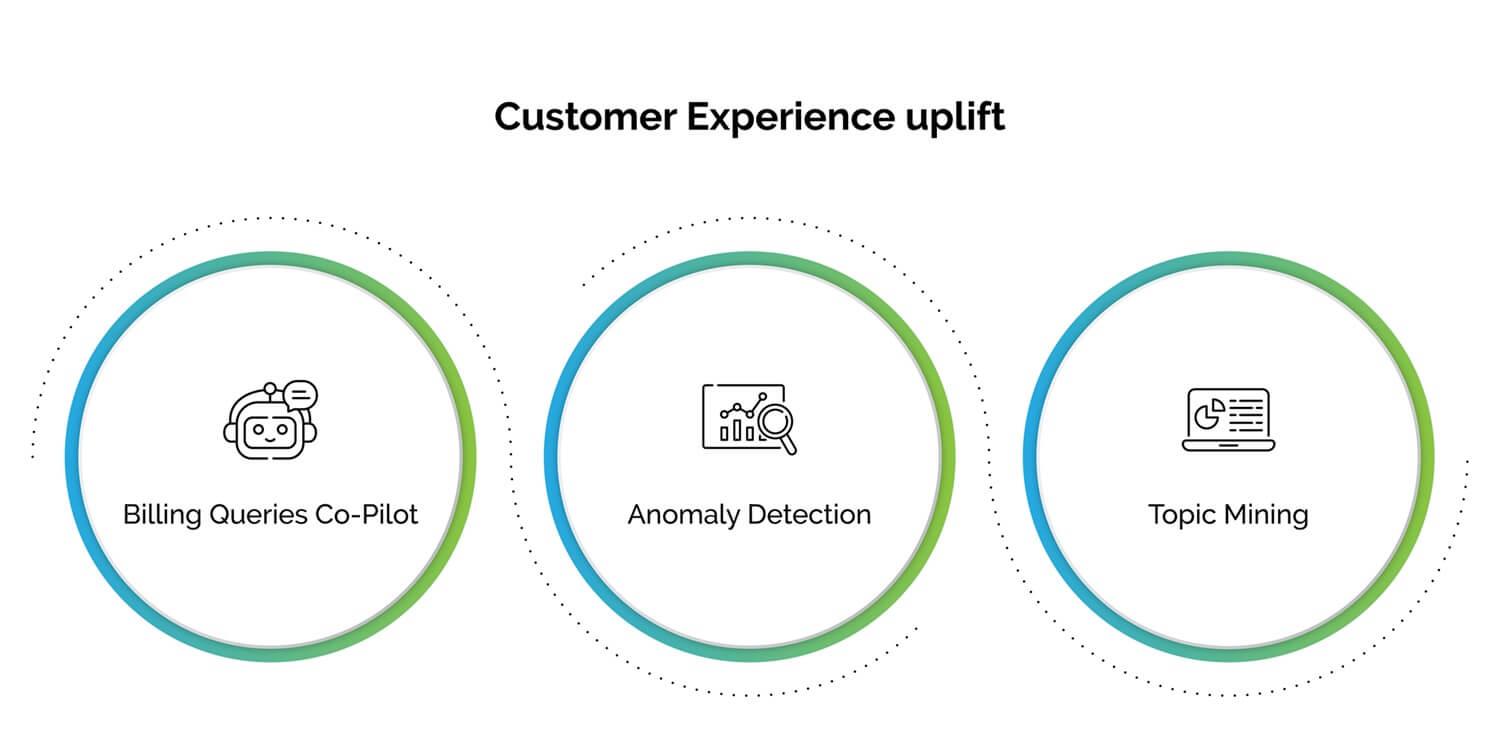
1. Billing Queries Co-Pilot: Empowering Customer Support

Handling billing queries has traditionally been a major challenge for telecom call centers, given the complexity of telecom bills and the diversity of customer needs. GenAI-powered Billing Queries Co-Pilot revolutionize this space by offering real-time assistance to Customer Care agents.

With the Co-Pilot, agents receive recommendations and solutions instantly, helping them respond to billing issues more efficiently. This tool enhances agent productivity by over 50%, as it reduces the time required to resolve customer complaints. Even junior or less experienced agents benefit from centralized domain knowledge, ensuring consistent service quality.

Benefits for Customer Experience:

  • Faster query resolution: Customers receive accurate responses without long waiting times.
  • Enhanced agent productivity: Agents handle more queries effectively, reducing backlogs.
  • Increased customer satisfaction: Quick resolutions lead to higher Net Promoter Scores (NPS).

By leveraging this tool, telcos can minimize customer frustration associated with billing errors and build loyalty through seamless support experiences.

2. Anomaly Detection: Ensuring Smooth Operations

In the telecom sector, disruptions or billing errors can severely affect customer satisfaction. GenAI-powered anomaly detection agents proactively identify and resolve potential problems across key operational areas such as:

  • Network performance and traffic patterns
  • Billing, revenue, and subscription inconsistencies
  • Payment collections and commissions

These agents monitor customer transactions and operational data to detect deviations that could indicate underlying issues. For example, unusual spikes in network traffic may signal a service disruption, while discrepancies in payments could point to fraudulent activities or system errors. Early detection enables telecom operators to resolve these issues before they impact customers.

Impact on Customer Experience:

  • Reduced downtime: Faster identification of network disruptions leads to quicker recovery.
  • Proactive problem resolution: Telcos can address issues before customers are affected, preventing churn.
  • Minimized revenue leakage: Anomaly detection across financial transactions ensures smoother billing operations.

This capability strengthens customer trust by delivering reliable services and preventing common billing or service issues that could erode loyalty.

3. Topic Mining for Customer Feedback Intelligence

Customer feedback—whether through support tickets, call transcripts, or social media posts—provides invaluable insights into service quality. However, the sheer volume of this data makes it challenging to extract actionable insights. GenAI simplifies this with topic mining, helping telcos identify critical issues and uncover improvement opportunities.

Key Applications of Topic Mining:

  • Call Center Transcripts Analysis: GenAI identifies recurring customer issues, enabling call center managers to optimize their response strategies.
  • Agent Performance Analysis: Evaluating individual agent performance becomes easier, helping managers fine-tune training programs and improve service quality.
  • Social Media Sentiment Analysis: Telcos can monitor social media channels to assess customer sentiment in real-time, ensuring proactive responses to negative feedback.
  • New Product Feature Recommendations: GenAI identifies unmet customer needs, enabling telcos to develop new services or features that align with customer expectations.

Business Impact:

This targeted approach helps telcos reduce up to 60% of repeat calls related to the same issue. By addressing customer pain points early, operators not only improve satisfaction but also optimize operational costs by decreasing the volume of support inquiries.

Strategic Outcomes: How GenAI Transforms Telecom Customer Experience

By incorporating GenAI into core customer service operations, telcos achieve transformational results. Unlike traditional AI solutions, GenAI goes beyond rule-based automation, enabling intelligent and context-aware responses, proactive problem-solving, and real-time personalization. Here’s a deeper look at the transformative outcomes GenAI delivers for telecom customer experience.

1. Enhanced Customer Satisfaction and Retention

Customer expectations in the telecom sector are evolving rapidly, with demand for instant, accurate, and personalized support. GenAI empowers telecoms to not only meet but exceed these expectations by providing fast and precise responses to customer queries across multiple channels. Tools like billing queries Co-Pilot ensure consistent service quality, regardless of agent expertise, reducing customer frustration and building long-term loyalty.

  • Proactive resolutions: Anomaly detection helps identify potential issues like billing errors or service disruptions before customers even notice them, preventing negative experiences.
  • Real-time support: AI-driven chatbots and virtual assistants provide customers with immediate answers 24/7, reducing wait times and improving first-contact resolution.
  • Reduced churn: With personalized offers and quick issue resolution, telcos can foster stronger relationships with customers, decreasing churn rates and increasing loyalty.

2. Operational Efficiency and Cost Optimization

Incorporating GenAI allows telecom operators to handle large volumes of inquiries, transactions, and interactions without increasing headcount or resources. The automation and intelligence provided by GenAI streamline operational workflows, making customer service and support centers more efficient.

  • Reduced workload for call centers: By resolving up to 60% of repeat issues through topic mining and proactive analysis, telcos can significantly reduce the volume of calls to support centers.
  • Improved agent productivity: The Billing Queries Co-Pilot and GenAI-based performance analysis provide agents with real-time insights and recommendations, enabling them to handle more interactions efficiently and focus on complex, high-value tasks.
  • Lower operational costs: AI-driven automation helps reduce reliance on large support teams, enabling operators to optimize resources and lower operational costs without compromising service quality.

3. Real-Time Personalization and NBO Solutions

Telecom operators can leverage GenAI to offer Next Best Offer (NBO) solutions, driving higher revenue and customer engagement. AI-powered systems analyze customers’ usage patterns, preferences, and behavior in real time, allowing operators to present personalized offers and recommendations.

  • Targeted upselling and cross-selling: By understanding individual customer needs, telcos can recommend the most relevant products or services, increasing conversion rates.
  • Improved CX with personalized interactions: Whether through customer care agents or automated channels, personalized responses create a sense of care and relevance, making customers feel understood and valued.
  • Adaptive offers: GenAI models can adjust offers dynamically based on new customer data, keeping recommendations timely and relevant throughout the customer journey.

4. New Revenue Streams Through Customer Insights

GenAI-driven insights allow telecoms to unlock new opportunities for product innovation and revenue generation. By analyzing call center transcripts, social media feedback, and service usage data, operators can discover unmet customer needs and areas for improvement.

  • Data-driven product development: GenAI uncovers trends and patterns from customer feedback, enabling operators to introduce new products and services that align with evolving customer demands.
  • Sentiment-driven marketing campaigns: Monitoring social media sentiment in real-time helps telecoms launch targeted campaigns, leveraging positive sentiment and mitigating negative feedback quickly.
  • Monetizing insights: Telecom operators can also offer data-backed consulting services to partners or enterprises in other industries, generating new revenue streams through advanced analytics.

5. Proactive Risk Management and Fraud Prevention

Telecom operators face continuous risks such as fraud, revenue leakage, and service disruptions that can severely impact customer experience and profitability. GenAI-powered anomaly detection tools play a vital role in mitigating these risks by identifying irregularities early and enabling proactive interventions.

  • Prevention of service disruptions: By spotting network anomalies or traffic irregularities, telcos can resolve issues quickly, minimizing downtime and maintaining high service quality.
  • Mitigating fraud risks: GenAI continuously scans for unusual patterns in payments and subscriptions, helping operators prevent fraud and protect customer accounts.
  • Revenue assurance: Early detection of revenue leakage through subscription and billing inconsistencies ensures smooth operations and protects the bottom line, enhancing customer trust.

6. Scalable Solutions for Omnichannel Customer Experience

As customers interact with telecoms through various touchpoints—mobile apps, websites, call centers, and social media—ensuring a consistent experience across channels becomes critical. GenAI enables telecom operators to orchestrate a seamless customer experience by unifying data and insights across these channels.

  • Unified knowledge base: The centralized knowledge powered by GenAI ensures agents and chatbots provide consistent answers, regardless of the communication channel.
  • Omnichannel personalization: Whether through SMS, app notifications, or chatbots, GenAI delivers coherent and personalized experiences at every touchpoint.
  • Scalable customer engagement: AI-powered virtual assistants handle thousands of interactions simultaneously, making it easy for telecoms to scale support efforts during peak periods.
Conclusion

As telecom operators face increasing competition and rising customer expectations, adopting GenAI solutions for customer experience becomes critical. From automating billing queries to proactively identifying anomalies and extracting valuable insights from customer feedback, GenAI offers a powerful toolkit for telcos to deliver superior customer experiences. Subex’s AI-powered solutions, including the Billing Queries Co-Pilot and advanced anomaly detection tools, demonstrate the tangible value that GenAI can bring to telecom operations.

By leveraging these capabilities, telecom operators can not only delight their customers but also boost operational efficiency and unlock new growth opportunities. Embracing these GenAI-driven innovations ensures that telcos remain at the forefront of delivering exceptional customer service in an increasingly competitive market.

Transform Telecom Customer Experience with GenAI-Driven Solutions

Book a Free Demo

In the hyper-connected telecom industry, customer expectations are constantly evolving. To remain competitive, telecom companies need strategies that cater to customer needs at an individualized level while driving operational efficiency. Customer segmentation is one such strategy that enables telecom providers to divide their audience into meaningful segments, allowing them to design personalized marketing campaigns, optimize pricing models, and build customer loyalty. This blog explores customer segmentation in-depth, its techniques, key benefits, challenges, and how it can be leveraged to deliver superior experiences and achieve sustainable growth.

What is Customer Segmentation in Telecom?

Customer segmentation is the process of dividing a diverse customer base into distinct groups that share similar characteristics, such as behavioral patterns, usage habits, demographics, or value to the business. This allows telecom companies to better understand the unique needs of each segment, enabling targeted offerings and effective communication strategies.

In a saturated and highly competitive market, segmentation ensures that providers optimize their customer acquisition, engagement, and retention efforts. It serves as the foundation for personalization, helping telecoms tailor products and services to meet the specific requirements of various customer groups.

Techniques of Customer Segmentation in Telecom

There are several segmentation models telecom providers can adopt to meet their strategic goals. Each model offers unique insights that help enhance customer experience, drive marketing efficiency, and improve retention rates.

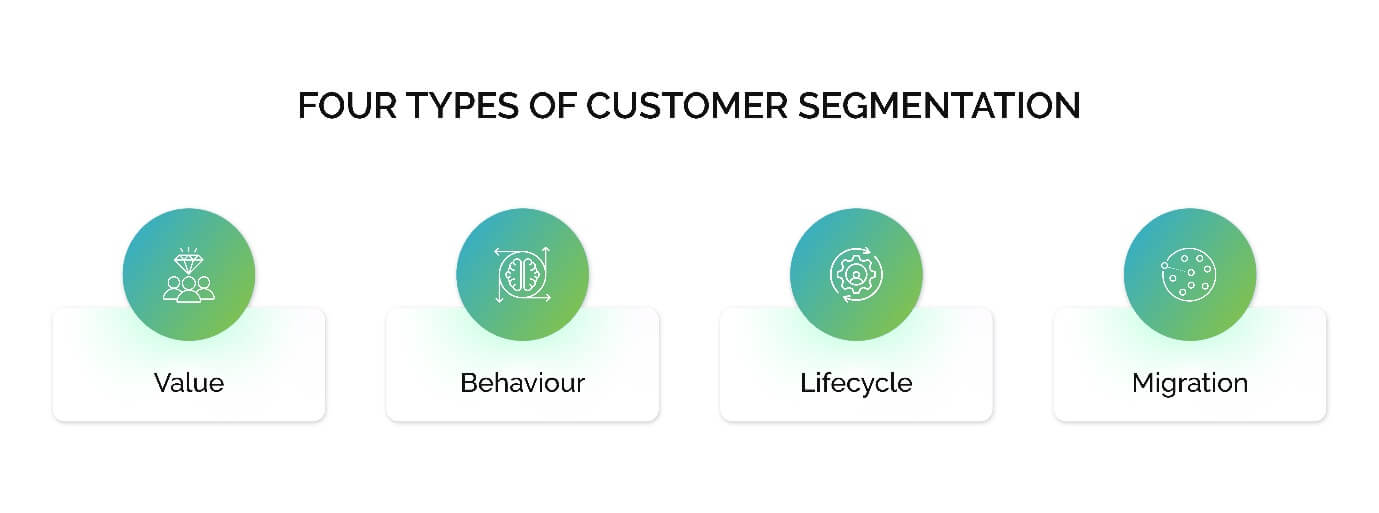
  1. Customer Value Segmentation

This technique divides customers based on their lifetime value (LTV). High-value customers—those who subscribe to premium services or maintain long-term contracts—receive personalized offers, exclusive customer support, and loyalty rewards. The 80/20 rule is relevant here, with 20% of customers often generating 80% of the company’s revenue. By focusing retention strategies on high-value segments, telecom companies can reduce churn and enhance profitability.

The steps involved in value-based segmentation include:

  • Calculating the past and predicted value of each customer.
  • Grouping customers into ten deciles (ten equally sized groups) to assess differences across segments.
  • Analyzing customer profiles to understand trends and optimize marketing strategies accordingly.
  1. Customer Behavior Segmentation

Telecom providers collect behavioral data to analyze customer interactions with their services, such as payment history, service upgrades, or support requests. Behavioral segmentation helps companies predict future actions and tailor campaigns to match each customer’s behavior. For example, a customer who frequently recharges their prepaid plan can be encouraged to switch to a postpaid plan through targeted marketing campaigns.

  1. Customer Lifecycle Segmentation

Lifecycle segmentation focuses on customers’ life stages, including onboarding, activation, engagement, and retention. Customers at different lifecycle stages require different types of communication and offers. For instance, a new customer may receive a welcome package with easy setup instructions, while long-term customers might benefit from loyalty rewards or renewal incentives.

This segmentation can also include personal life stages, such as moving to a new city or starting a family, which influence customers’ service preferences and needs.

Segmented campaigns achieve a 14% higher open rate compared to non-segmented ones.
  1. Customer Migration Segmentation

Migration segmentation analyzes shifts in customer behavior and loyalty over time. With high churn rates being a significant challenge in the telecom sector, companies use migration patterns to predict which customers are likely to switch to competitors. Identifying early signs of churn enables providers to intervene with special offers, discounts, or enhanced services to retain customers.

The annual churn rate in the telecom sector varies significantly, ranging from 14% to 67%.
AI-Powered Customer Segmentation in Telecom: A Game-Changer

The advent of artificial intelligence (AI) has redefined customer segmentation in the telecom industry, transitioning from basic demographic-based groupings to advanced, data-driven insights. Traditional segmentation focused on static attributes such as age, location, and income, limiting the depth of customer understanding. In contrast, AI-powered segmentation enables telecom providers to analyze behavioral patterns, predict customer needs, and identify shifting preferences with unprecedented precision.

By aggregating and processing vast amounts of data—from usage habits to purchasing behaviors—AI creates dynamic customer profiles that evolve in real time. This allows telecom companies to implement hyper-targeted campaigns, develop personalized service plans, and proactively address churn risks. Additionally, AI enhances lifecycle segmentation by tailoring engagement strategies to each customer’s stage, ensuring every interaction is timely and relevant. In an industry marked by fierce competition and evolving consumer expectations, AI-driven segmentation is not just a technological advancement; it’s a strategic necessity to foster loyalty, increase retention, and unlock new revenue streams.

The Benefits of Customer Segmentation in Telecom

1. Enhanced Marketing Efficiency

Segmented marketing allows telecom providers to focus their efforts on specific customer groups, ensuring that marketing messages resonate with the right audience. For example, targeting heavy data users with promotions for unlimited plans results in higher engagement. This precision improves the return on investment (ROI) and minimizes wasted marketing efforts.

According to Segment Report, 49% of consumers have made impulse purchases due to personalized offers. This highlights the power of segmentation in driving conversions through targeted messaging.

2. New Market Opportunities

Customer segmentation helps telecoms identify untapped or underserved market segments. This can lead to the discovery of new revenue streams and product innovations. For instance, segmentation might reveal a growing segment of young professionals interested in data-centric plans, prompting the launch of packages specifically designed for their needs.

Segmentation research can also highlight areas where competitors are not currently focused, enabling telecoms to develop products that stand out in the market.

3. Improved Customer Experience and Satisfaction

With deeper insights into customer preferences, telecom companies can offer personalized services, such as tailored plans or proactive customer support. Personalized experiences increase customer satisfaction and foster brand loyalty.

For example, sending personalized welcome messages during onboarding makes customers feel valued, while providing proactive support based on usage patterns prevents potential issues, enhancing the overall experience.

4. Customized Pricing Strategies

Segmentation enables telecom providers to offer customized pricing models, ensuring that each customer receives the best value. Heavy data users may receive discounts on unlimited plans, while customers with limited needs can opt for budget-friendly options. This personalized approach builds customer trust and encourages long-term relationships.

5. Churn Reduction and Retention

Identifying at-risk customers through migration segmentation helps companies implement targeted retention strategies. For example, customers nearing the end of their contract may receive renewal incentives, while those showing signs of churn could be offered exclusive discounts. These efforts significantly reduce churn and improve customer lifetime value.

6. Competitive Advantage

In a highly competitive market, combining segmentation techniques—such as behavioral and geographical segmentation—gives telecom providers a deeper understanding of customer trends across regions. This insight allows companies to refine their strategies, differentiate themselves from competitors, and secure sustainable revenue streams.

Challenges in Implementing Customer Segmentation

1. Data Privacy and Security

While segmentation requires the collection of customer data, it raises privacy concerns. Telecom companies must adopt transparent data practices, comply with regulations such as GDPR, and invest in robust security systems to protect customer information.

2. Technological Infrastructure

Effective segmentation relies on advanced analytics platforms capable of processing large datasets in real-time. Telecoms need to invest in AI-driven tools and data analytics platforms to manage and interpret customer data efficiently.

3. Evolving Customer Preferences

Customer preferences change over time, requiring telecoms to continuously monitor and update their segmentation models. Agile strategies and real-time data analysis are essential to stay aligned with evolving customer needs and market trends.

4. Cross-Functional Collaboration

Implementing segmentation strategies requires seamless collaboration across marketing, customer service, and data analytics teams. Cross-functional coordination ensures that segmentation insights are integrated into every aspect of the business, from product development to customer support.

Segmentation and Personalization: A Winning Combination in Telecom

Segmentation and personalization go hand-in-hand in delivering superior customer experiences. Personalization leverages segmentation insights to tailor interactions, services, and offers for individual customers. Here are a few examples of personalization in telecom:

  • Tailored Service Plans: Recommending plans based on customers’ usage patterns ensures they receive the most relevant offers.
  • Family and Group Plans: Personalization helps providers design packages that cater to group needs, offering cost savings and convenience.
  • Proactive Customer Support: Predicting potential issues through behavioral insights allows providers to offer solutions before problems arise.

The combination of segmentation and personalization builds stronger customer relationships, reduces churn, and enhances brand loyalty.

Conclusion: The Future of Customer Segmentation in Telecom

Customer segmentation is no longer just a marketing tool; it is a strategic necessity for telecom companies aiming to thrive in today’s competitive market. With AI-powered analytics and the rollout of 5G networks, segmentation will become even more precise, enabling telecom providers to deliver hyper-personalized experiences.

Telecom companies that embrace segmentation and personalization will not only improve customer satisfaction and loyalty but also unlock new market opportunities and achieve sustainable growth. As customer expectations continue to evolve, segmentation will remain the cornerstone of customer-centric strategies in the telecom industry.

By adopting agile segmentation models, investing in advanced analytics platforms, and maintaining a focus on privacy and collaboration, telecom companies can position themselves for success in the ever-changing digital landscape.

Frequently Asked Questions (FAQs) about Customer Segmentation in Telecom

1. What is Customer Segmentation?

Customer segmentation is the process of dividing a company’s customer base into distinct groups based on shared characteristics, behaviors, or preferences. These segments may include factors such as demographics (age, gender, income), geographic location, purchasing behavior, product usage patterns, or customer value. The goal of segmentation is to gain deeper insights into customer needs and deliver targeted services, products, and communications tailored to each group.

In the telecom industry, segmentation plays a crucial role in optimizing marketing strategies, personalizing customer interactions, reducing churn, and improving customer satisfaction. For example, telecom providers can create separate segments for high-data users, prepaid customers, or families, ensuring that each group receives offers and services that align with their specific needs. Advanced segmentation using AI-powered analytics also allows telecoms to predict customer behavior, identify high-value customers, and develop proactive retention strategies.

2. What are the common types of customer segmentation in telecom?

The most common types of customer segmentation in telecom include:

  • Usage-based segmentation: Grouping customers based on data consumption, call duration, or messaging habits.
  • Customer value segmentation: Identifying high-value customers based on their current and potential lifetime value.
  • Behavioral segmentation: Analyzing customer actions, such as service usage patterns or payment behaviors.
  • Customer lifecycle segmentation: Tailoring engagement strategies based on the customer’s journey with the provider.
  • Migration segmentation: Tracking shifts in customer behavior to predict churn or loyalty.

3. How does AI enhance customer segmentation in telecom?

AI enables advanced segmentation by analyzing vast amounts of data in real-time. It can:

  • Identify behavior trends that are not visible through traditional segmentation methods.
  • Predict customer needs and future value with precision.
  • Detect churn risks early and suggest retention strategies.
  • Tailor engagement strategies to each stage of the customer lifecycle.

4. How can segmentation reduce customer churn in telecom?

Segmentation helps identify customers who are at risk of leaving by analyzing their behavior patterns and migration trends. Telecom providers can then offer personalized discounts, loyalty rewards, or tailored plans to encourage customers to stay. This proactive approach improves retention and reduces churn rates.

5. How does customer segmentation lead to better marketing campaigns?

Segmented campaigns allow telecom companies to deliver highly relevant messages to specific customer groups. For instance, targeting heavy data users with promotions for unlimited plans or offering international travelers discounted roaming packages. Such targeted messaging leads to higher engagement, improved conversion rates, and increased customer satisfaction.

6. Can customer segmentation help discover new revenue streams?

Yes, segmentation helps identify new or underserved customer groups. Telecom providers can design targeted services or products for these segments, opening new revenue opportunities. For example, discovering a segment of young professionals with high data consumption could prompt the launch of specialized data-centric packages.

7. What are some best practices for implementing customer segmentation in telecom?

  • Investing in AI and advanced analytics platforms to gain deeper insights.
  • Ensuring data privacy and compliance with local regulations.
  • Collaborating across departments to align segmentation strategies.
  • Monitoring and updating segmentation models regularly to reflect evolving customer behaviors.
  • Using segmentation insights to enhance personalization and create meaningful customer interactions.

Transform Your Telecom Strategy with AI-Powered Segmentation

See our Demo in Action!

Introduction

Telecommunications fraud is one of the most costly and complex challenges facing the industry today. With the global telecom sector processing trillions of transactions annually, the risks of fraud are growing both in terms of frequency and sophistication. Fraudsters have developed increasingly complex methods, from SIM swap fraud to international revenue share fraud (IRSF), call spoofing, and account takeovers. Traditional fraud detection systems—often rules-based and static—are struggling to keep pace. In contrast, anomaly detection powered by Artificial Intelligence (AI) has emerged as a game-changer.

AI‘s ability to process large volumes of data, identify complex patterns, and adapt to new threats is revolutionizing fraud prevention in telecom. Anomaly detection, in particular, focuses on identifying unusual or unexpected behaviors, which are often early indicators of fraud. By flagging these anomalies, AI enables telecom operators to prevent fraud before it escalates, safeguarding both their networks and their customers.

In this blog, we will explore the role of AI-powered anomaly detection in preventing telecom fraud, the specific types of fraud it addresses, and the advanced AI techniques that enable it. We will also provide a guide to implementing AI-driven anomaly detection systems and conclude with a set of FAQs to address common questions around this crucial technology.

Understanding Telecom Fraud

Before delving into anomaly detection, it’s essential to understand the primary types of telecom fraud that AI aims to combat. Some of the most prevalent forms of fraud in the telecom industry include:

1. International Revenue Share Fraud (IRSF): Fraudsters exploit telecom operators by routing high volumes of calls to premium-rate numbers they control. This results in significant revenue losses for both the telecom operator and their customers.

2. SIM Swap Fraud: This occurs when fraudsters hijack a customer’s phone number by fraudulently transferring it to a new SIM card. They can then gain access to sensitive accounts and authentication mechanisms, like two-factor authentication (2FA) systems.

3. Subscription Fraud: Fraudsters use fake or stolen identities to sign up for telecom services without intending to pay, leaving telecom operators with unpaid bills.

4. Call Spoofing and Phishing: In this type of fraud, callers impersonate legitimate organizations by manipulating caller ID information, tricking victims into revealing personal or financial information.

5. PBX Hacking: Fraudsters gain unauthorized access to a company’s Private Branch Exchange (PBX) system to make free international calls, often resulting in massive financial losses.

What is Anomaly Detection?

Anomaly detection involves identifying data points or patterns that deviate significantly from normal behavior. In telecom fraud detection, anomalies might be unusual patterns in call duration, location, frequency, or billing patterns that signal potential fraud.

Anomaly detection systems can be classified into the following types:

1.  Supervised Anomaly Detection: This approach relies on labeled datasets where known fraudulent behaviors are used to train the system. The model then applies this knowledge to identify new cases of fraud.

2. Unsupervised Anomaly Detection: In scenarios where labeled datasets are unavailable, unsupervised methods work by learning what “normal” behavior looks like and flagging any deviations from this norm. This is particularly useful in telecom, where fraud patterns are often unknown or constantly evolving.

3. Semi-supervised Anomaly Detection: This hybrid approach uses a combination of labeled and unlabeled data to identify anomalies. It’s an effective way to address scenarios where fraudulent data is rare.

Anomaly Detection Market Overview

The global anomaly detection market was valued at USD 5.3 billion in 2022. It is expected to grow significantly, with projections showing an increase from USD 6.1 billion in 2023 to USD 15.0 billion by 2030. This represents a robust compound annual growth rate (CAGR) of 16.10% over the forecast period (2023-2030). The rising incidence of internal risks, including cyber fraud, particularly in the Banking, Financial Services, and Insurance (BFSI) sector, is driving demand for anomaly detection systems. These solutions are becoming critical in identifying irregular activities and protecting against financial and security breaches, thereby fueling market expansion.

anomaly detection market share

Trends in Anomaly detection

Growing interest in anomaly detection is significantly contributing to market expansion. The increasing adoption of anomaly detection tools within the Banking, Financial Services, and Insurance (BFSI) sector is a key driver of this growth. These tools are preferred over prescriptive and identity analytics for detecting and preventing fraud. Anomaly detection systems rely on machine learning models that continuously monitor incoming data, establishing a baseline of normal behavior for financial activities such as loan applications, transactions, and account details.

Anomaly detection software is gaining popularity within the BFSI industry due to its ability to alert human monitors to deviations from standard patterns. These systems are widely used to facilitate communication across various financial institutions and improve operational efficiency. By automating fraud detection, solutions like CSI’s fraud anomaly detection software help banks monitor suspicious activities in real-time through automatic alerts, reducing the reliance on manual processes and enhancing compliance oversight. This growing demand for IT solutions is expected to drive further growth in the anomaly detection market, increasing its overall revenue during the forecast period.

Regional Insights on Anomaly Detection

The anomaly detection market is analyzed across key regions, including North America, Europe, Asia-Pacific, and the Rest of the World. North America is projected to dominate the market during the forecast period, holding the largest market share. This is largely due to the region’s technological trends, such as the growing adoption of Bring Your Own Device (BYOD) policies, the increased use of connected smart devices, and the rise of the Industrial Internet of Things (IIoT). Historically, North America has been highly susceptible to security threats, invasions, and breaches, which has driven the demand for robust security solutions and contributed to the growth of security vendors in the region.

The study also covers key countries within each region, including the U.S., Canada, Germany, France, the UK, Italy, Spain, China, Japan, India, Australia, South Korea, and Brazil. Each of these countries plays a significant role in shaping the anomaly detection market, influenced by their respective technological advancements and security challenges. (Source)

anomaly detection market shareHow AI Enhances Anomaly Detection

AI dramatically improves anomaly detection by applying machine learning algorithms that are capable of processing vast amounts of data, identifying patterns, and adapting to new forms of fraud. Here’s how AI enhances anomaly detection for telecom fraud prevention:

1. Real-time Fraud Detection and Prevention

AI-powered systems can analyze millions of data points in real time, providing instant alerts when suspicious activity is detected. For example, machine learning models can track the behavior of individual subscribers, looking for anomalies such as an unusual number of high-cost international calls from a new location.

In real-time monitoring, AI helps detect fraud early in the transaction lifecycle, minimizing losses and stopping fraudsters before they can cause significant damage.

2. Machine Learning Models for Pattern Recognition

AI uses machine learning (ML) to recognize complex patterns and identify anomalies that might indicate fraud. Some of the most commonly used ML techniques for anomaly detection in telecom include:

  • Neural Networks and Deep Learning: Neural networks can analyze massive, high-dimensional datasets, learning to recognize subtle anomalies that indicate fraud. Deep learning models, in particular, excel in identifying patterns in call records, billing information, and network activity.
  • Clustering Algorithms: Techniques like k-means clustering and DBSCAN group similar data points together and flag outliers as potential anomalies. For instance, a clustering algorithm might group together customers with similar calling habits, flagging any outliers who deviate from the norm as suspicious.
  • Autoencoders: A type of neural network, autoencoders are designed to detect anomalies by reconstructing input data. If a data point deviates too much from the expected output, the system recognizes it as an anomaly.

3. Continuous Learning and Adaptation

One of AI’s most significant advantages in fraud detection is its ability to learn continuously. Traditional fraud detection systems rely on static rules, but fraud tactics evolve rapidly. AI-powered systems, on the other hand, learn from new data and adjust their models to detect emerging fraud schemes.

For instance, reinforcement learning can help AI systems adapt to new fraud patterns without human intervention. This continuous learning process ensures that the system remains effective even as fraudsters develop new tactics.

4. Reducing False Positives

High rates of false positives—legitimate transactions flagged as fraudulent—can be costly for telecom operators, leading to frustrated customers and wasted resources. AI significantly reduces false positives by refining its models based on historical data. This improves the accuracy of fraud detection and allows telecom companies to focus their resources on investigating true threats.

5. Predictive Analytics for Proactive Fraud Prevention

Predictive analytics enables telecom operators to anticipate fraud before it happens. By analyzing historical data, AI can identify patterns that typically precede fraud, allowing operators to take preventive action. For example, if a particular usage pattern is often associated with IRSF, the system can flag similar behaviors before large-scale fraud occurs.

Key AI Techniques for Telecom Fraud Detection

AI employs several advanced techniques to detect and prevent telecom fraud. The most common techniques used include:

1. Neural Networks and Deep Learning Models: Neural networks are effective in handling large, complex datasets common in telecom. These models are trained to detect anomalies in user behaviors, call patterns, and billing data that indicate fraud.

2. Clustering and Isolation Forests: Clustering algorithms like k-means help in grouping similar data points, enabling the detection of outliers. Isolation forests, on the other hand, work by isolating anomalous points in the data, making them an excellent choice for unsupervised anomaly detection.

3. Support Vector Machines (SVMs): One-class SVMs are a popular choice for unsupervised anomaly detection. They create boundaries around normal data points, and anything outside these boundaries is flagged as an anomaly. This makes SVMs particularly useful for detecting telecom fraud in environments with sparse labeled data.

4. Autoencoders for Anomaly Detection: Autoencoders are a form of deep learning used to detect anomalies by reconstructing input data. When the reconstructed output differs significantly from the input, the system detects it as an anomaly.

5. Dimensionality Reduction Techniques: Principal Component Analysis (PCA) and t-SNE are used to reduce the complexity of large telecom datasets. By compressing the data into fewer dimensions while retaining critical information, these techniques allow for more efficient anomaly detection.

Types of Telecom Fraud Detected by AI-Powered Anomaly Detection

AI-powered anomaly detection systems are effective in identifying various forms of telecom fraud, including:

1. Subscription Fraud: In subscription fraud, criminals use stolen or fake identities to acquire services without intending to pay. AI can detect anomalies during the sign-up process, such as mismatched geographical locations, unusual IP addresses, or excessive account creation attempts from a single device.

2. SIM Swap Fraud: SIM swap fraud occurs when fraudsters take control of a victim’s phone number by transferring it to a new SIM card. AI detects anomalies in the swapping process, such as a sudden change in device behavior or an unexpected increase in account activity.

3. International Revenue Share Fraud (IRSF): In IRSF, fraudsters make large volumes of international calls to premium-rate numbers, often generating significant revenue for themselves at the expense of the telecom provider. AI detects these anomalies by identifying spikes in international calling patterns that deviate from normal user behavior.

4. Call Spoofing: AI detects irregularities in call metadata, such as inconsistent caller ID information or unusual call routing, which are common indicators of call spoofing fraud.

5. PBX Hacking: AI-powered systems can monitor for unusual activity on corporate PBX systems, such as unauthorized calls or unusual call volumes, to prevent hackers from exploiting these system.

Implementing AI-Powered Anomaly Detection in Telecom

Successfully integrating AI-powered anomaly detection in telecom operations requires a comprehensive and strategic approach. The following steps provide a guide to implementation, ensuring that the system is robust, adaptive, and capable of handling large-scale fraud detection.

1. Data Collection and Preprocessing

The first step in implementing AI-driven anomaly detection is collecting high-quality data. Telecom companies handle a massive amount of data, including call records, customer profiles, payment information, and network traffic logs. For AI systems to work effectively, this data must be cleaned, structured, and standardized to ensure accuracy.

Preprocessing techniques like data normalization, handling missing values, and feature extraction are essential to preparing data for machine learning models. Anomalies are often subtle, so even small errors in data can lead to inaccurate predictions. Additionally, telecom companies should consider using real-time data pipelines to provide the AI models with up-to-date information​.

2. Selecting the Right Models

Telecom fraud varies widely in its nature and complexity, so no single machine learning model is suitable for all types of fraud. Therefore, telecom operators should employ a combination of models to address different fraud patterns.

For instance:

  • Supervised Learning Models (like decision trees and support vector machines) are ideal for identifying known fraud types by using historical labeled data.
  • Unsupervised Learning Models (such as k-means clustering and isolation forests) are more suited for detecting new or evolving fraud patterns by identifying deviations from normal behavior​.
  • Deep Learning Models like autoencoders and neural networks excel in finding anomalies in large, complex datasets that may be difficult to detect using traditional methods​.

An essential part of this process is model validation and tuning to ensure the chosen models provide a high level of accuracy with minimal false positives and false negatives.

3. Real-time Monitoring and Fraud Detection

Telecom fraud can escalate rapidly, and by the time it is detected, significant financial damage may have already occurred. Therefore, real-time monitoring systems are essential in any AI-driven fraud detection platform. These systems continuously analyze user behavior and transaction data as it comes in, detecting anomalies as they happen.

By leveraging AI algorithms such as neural networks or random forests, these systems can immediately flag suspicious activities like SIM swaps or unauthorized international calls. Moreover, coupling AI with automated decision-making systems can allow for rapid responses, such as freezing accounts, blocking suspicious transactions, or alerting fraud analysts​.

4. Continuous Learning and Feedback Loops

One of the critical advantages of AI is its ability to learn and improve over time. As fraudsters develop new techniques, static detection rules can quickly become obsolete. AI-driven systems, however, can leverage continuous learning to adapt to these new fraud patterns without human intervention.

Feedback loops are vital in this process. Every time the system identifies fraudulent activity, the results should be fed back into the model, allowing it to adjust its predictions for future detections. This process ensures that the system stays current with emerging fraud trends and improves its detection accuracy over time​.

5. Integration with Existing Systems

For AI-powered anomaly detection to be effective, it must be integrated into a telecom provider’s broader fraud management ecosystem. This means combining the AI system with:

  • Customer Relationship Management (CRM) systems, to track customer accounts and behaviors,
  • Billing systems, to monitor transaction patterns,
  • Call detail record (CDR) systems, for real-time call data analysis.

These integrations allow for seamless data flow and ensure that fraud detection measures are informed by all available customer and network data. Additionally, cross-system communication enables operators to take immediate action when fraud is detected, such as suspending services or notifying customers.

Benefits of AI-Powered Anomaly Detection in Telecom Fraud Prevention

The implementation of AI-powered anomaly detection provides significant benefits to telecom operators, enhancing their ability to detect and prevent fraud. These benefits include:

1. Increased Detection Accuracy

AI’s ability to process and analyze massive datasets allows it to identify fraud patterns that may be too subtle for traditional systems. Machine learning models are particularly adept at identifying complex relationships between variables, which makes it possible to catch sophisticated fraud schemes that would otherwise go unnoticed.

2. Reduced False Positives

Traditional fraud detection systems often suffer from a high rate of false positives, leading to unnecessary disruptions for legitimate customers. AI reduces false positives by learning from historical data and continually refining its models. This improves the accuracy of fraud detection, allowing telecom operators to focus their resources on genuine threats​.

3. Real-time Fraud Prevention

In the telecom industry, timing is everything. Fraudulent activities can result in significant financial losses within minutes. AI’s ability to analyze data in real-time ensures that fraud is detected and prevented before major damage occurs. Whether it’s blocking unauthorized international calls or detecting SIM swap fraud as it happens, AI ensures that telecom operators are always one step ahead of fraudsters​.

4. Scalability

The telecom industry generates enormous amounts of data every day. AI-driven anomaly detection systems are designed to scale, allowing them to handle vast quantities of data without sacrificing accuracy or speed. This scalability is crucial for telecom providers operating across multiple regions and with millions of customers​.

5. Adaptability to Emerging Threats

Telecom fraud is a constantly evolving threat, with new fraud techniques appearing regularly. AI’s ability to continuously learn and adapt to new patterns of fraud makes it far more effective than traditional rule-based systems. This adaptability ensures that telecom operators can keep pace with the ever-changing fraud landscape​.

Conclusion

The battle against telecom fraud is a constant challenge for operators worldwide. However, with AI-powered anomaly detection, telecom companies now have a powerful tool for identifying and stopping fraudulent activities before they cause significant financial damage. AI’s ability to analyze massive datasets, learn from new fraud patterns, and detect anomalies in real-time makes it an essential component of modern fraud prevention strategies.

As telecom networks continue to expand and customer data grows, AI-driven anomaly detection systems will become even more critical. By investing in these technologies, telecom operators can safeguard their customers, protect their networks, and stay one step ahead of the ever-evolving fraud landscape.

Common FAQs on AI and Anomaly Detection in Telecom Fraud Prevention

1. What is anomaly detection, and how does it help prevent telecom fraud?

Anomaly detection is a method of identifying unusual patterns or behaviors that deviate from what is considered normal. In telecom fraud prevention, anomaly detection helps identify suspicious activities like unexpected spikes in call volumes, unusual data usage, or unauthorized account changes. By flagging these anomalies, telecom operators can prevent fraudulent activities before they escalate​.

2. Why is AI important for anomaly detection in telecom fraud?

AI enhances anomaly detection by using machine learning models that can process vast amounts of data, identify complex fraud patterns, and adapt to new fraud techniques. Traditional fraud detection systems often rely on static rules, which can become outdated. AI’s ability to learn and evolve makes it much more effective at detecting and preventing emerging fraud schemes​.

3. How does real-time monitoring benefit telecom fraud prevention?

Real-time monitoring enables telecom operators to detect fraudulent activities as they happen. This is particularly important in preventing high-cost frauds like international revenue share fraud (IRSF) or SIM swap fraud. By analyzing transaction data and customer behavior in real-time, AI-powered systems can flag and stop fraud before significant financial damage occurs​.

4. Can AI reduce false positives in fraud detection?

Yes, AI can significantly reduce false positives in fraud detection. Traditional systems often flag legitimate transactions as fraudulent, leading to customer dissatisfaction and wasted resources. AI models, by learning from historical data and adjusting their predictions, can improve the accuracy of fraud detection and reduce false alarms​.

5. How do telecom operators implement AI-powered anomaly detection systems?

Implementing AI-powered anomaly detection involves several steps:

  • Collecting and preprocessing large datasets,
  • Selecting appropriate machine learning models,
  • Ensuring real-time monitoring capabilities,
  • Continuously training the AI models with new data,
  • Integrating the AI system with existing telecom infrastructure, such as billing and CRM systems.

By following these steps, telecom operators can create a robust fraud prevention system capable of handling large-scale threats​.

Detect anomalies before they become threats—empower your telecom with AI.

Book a Free Demo

Our Offices
Subex Limited
Pritech Park,
SEZ Block -09, 4th Floor B Wing Survey No. 51 to 64/4 Outer Ring Road, Bellandur Village Varthur, Hobli, Bengaluru, Karnataka 560103, India
Tel : +91 80 37451377
Subex, Inc
1499 W 120th Ave,
Suite 210 Westminster,
CO 80234, USA

Subex (UK) Limited
Unit 1J, Sambhav House, First Floor
275-287 Station Road, Harrow HA1 1NA

Email Id: info@subex.com
Contact Number: +447736518379

Subex (UK) Limited – Ipswich
Rooms N2-06 Columba House
Innovation Martlesham
Adastral Park, Ipswich,
IP5 3RE, United Kingdom.

Subex Limited Dubai Office
Office number 722,
Building number 6WA,
Dubai Airport Free Zone
Authority (DAFZA),
P.O. Box: Box 54834, Dubai
United Arab Emirates
Tel : +971 4 214 6700
Fax : +971 4 214 6714

Subex (Asia Pacific) Pte Limited
175A Bencoolen Street
#08-03 Burlington Square
Singapore 189650
Tel : +65 6338 1218
Fax: +65 6338 1216

© Copyright SUBEX 2026. All Rights Reserved.