

Signaling Risk Intelligence
Detect and mitigate various forms of fraud risks to protect revenue and enhance subscriber trust.
The Signaling Risk Intelligence Solution is designed to monitor and analyze network traffic for voice and SMS communications, specifically focusing on the SIP (Session Initiation Protocol) and SS7 (Signalling System No. 7) protocols. It combines advanced protocol analysis, machine learning, and real-time monitoring to deliver robust fraud detection.

Why detect Fraud using Signaling Methods?
Accelerates Fraud Identification
Detects fraudulent activities in significantly less time.
Enables Cross-Network Monitoring
Provides centralized oversight of signaling traffic across all vendors and domains.
Increases Detection Accuracy
Utilizes unique signaling data absent in CDRs for more precise alarms.
Blocks Fraudulent Numbers
Proactively prevents specific numbers or ranges from placing future calls.
Real Impact. Real Efficiency. Real Results.
Detect faster, tear down faster, and cut analyst decision time.

Real Time Detection
Detects voice and SMS fraud in real-time, allowing for immediate identification of fraudulent activities.
Adaptability to New Frauds
Detects and counteracts new types or methods of fraud by leveraging the monitored signaling packets.
Improved Customer Experience
Safeguards customers and provides reliable service, helping to build and maintain a positive brand reputation.
Collaboration & Visualization
Provides visual tools for teams to build customized dashboards and reports to consume insights of the signaling packets.
Quicker Time to Action
Enables faster decision-making and response time with an extensive library of detection elements and real-time attack mitigation capabilities.
Signaling Risk Intelligence - Architecture
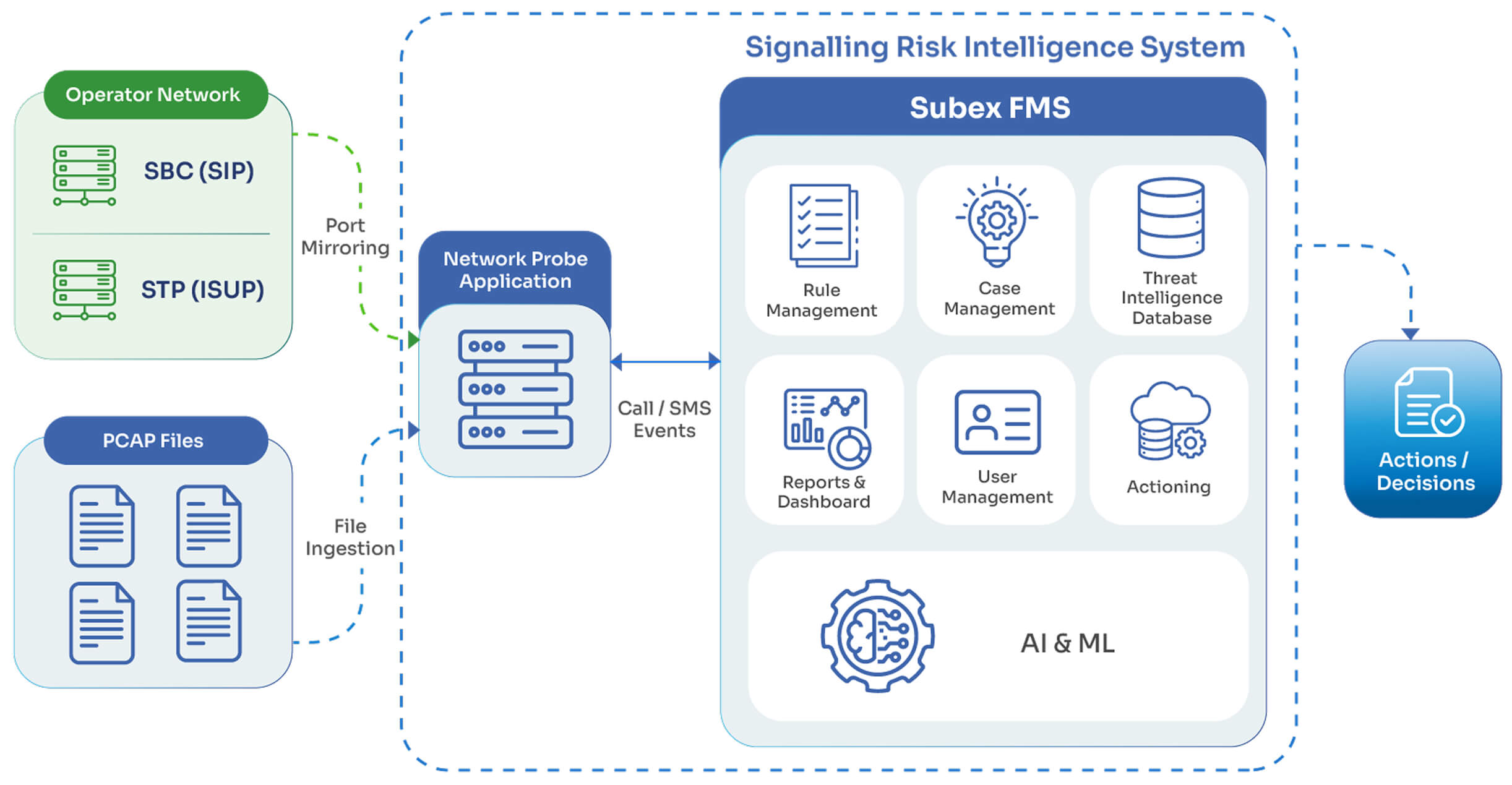
Where Signaling Intelligence Meets Mitigation
SIP and SS7 intelligence for precise detection and automated mitigation.
Network Protocol Agnostic
The probe application has capabilities to capture and analyze MAP, ISUP & SIP packets.
Multiple Data Ingestion Support
Reads network packets from port mirroring or pre-generated packet capture files shared by the operator.
Risk Intelligence Database
Uses unique signatures and a risk intelligence database to tag event attributes like A-Number and B-Number, identifying high-risk destinations and unallocated ranges.
Seamless API Integration
Integrates with network elements to automatically address high-confidence threats, detecting, reporting, and preventing future threats.
Advanced Analytics & ML Enablement
Provides rich signaling intelligence that can be leveraged to build machine learning–based fraud detection models.
- Case Study
How GO Malta Pioneered Detection and Prevention of CLI Spoofing with Subex’s Signalling Security Solution
GO, one of the leading operators in Malta, spearheaded the...
- Flyer
Signaling Risk Intelligence
The growing complexities in the telecom ecosystem and dependence on...
- Point of View
Curbing Data Charging Bypass Fraud with Signaling Intelligence
Revenue from mobile data services is poised for incessant growth...
Resource Center
- Case Study
Unitel Spearheads the Detection and Prevention of Voice Frauds with Subex’s Signaling Security Solution
Unitel, one of the leading operators in the APAC region...
- Webinar
A Case study on Leveraging Signaling Intelligence for Combating Fraud
Key Challenges and the need for telcos to be...
- Flyer
Signaling Risk Intelligence
The growing complexities in the telecom ecosystem and dependence on...
Frequently Asked Questions
Everything you need to know about how our fraud management solutions work.
How is Subex’s Fraud Management different from traditional fraud detection systems?
Traditional systems react after losses occur. Subex uses real-time scoring, behavioural intelligence, and AI-driven anticipation to surface threats the moment they emerge-across identities, subscriptions, roaming, digital payments, and partner channels. The goal is prevention, not post-incident discovery.
What types of fraud does Subex help telecom operators prevent?
Subex covers the full spectrum-from IRSF, SIM Box, subscription fraud, identity fraud, roaming fraud, digital payment abuse, partner fraud, and API misuse-using adaptive models, rules, and link analysis to detect known, unknown, and evolving patterns instantly.
Will implementing Subex’s Fraud Management solution impact customer experience?
No. Subex is designed to ensure fraud-free journeys without friction. Genuine customers move ahead seamlessly while suspicious activity is flagged or stopped in real time through autonomous, human-supervised decisioning.
Does Subex’s solution integrate with existing telecom systems and data sources?
Yes. Subex works as a modular, interoperable platform that easily connects with billing systems, network feeds, payment gateways, partner systems, and identity sources-enabling unified fraud intelligence without disrupting existing workflows.
How quickly can Subex’s Fraud Management system adapt to new or emerging fraud patterns?
Subex operates as a continuous learning engine. Its AI models evolve with live traffic, behaviour shifts, and new threat signatures-allowing operators to anticipate risks early and deploy new controls without waiting for rule updates or manual interventions.